✍️ Written by: LSRI Editorial Team
🩺 Medically Reviewed by: Dr Prashant Sankaye, Consultant Musculoskeletal specialist and Radiologist, MBBS, MS, FCPS, MRCS, CCBST, FRCR, PGCE(Med), FHEA, PGDip Sports and Exercise Medicine
📅 Last Updated: May 4, 2026
⏱️ Read Time: 5 Minutes
Frozen shoulder treatment london— medically known as adhesive capsulitis — is one of the most common and most misunderstood shoulder conditions seen in clinical practice. If your shoulder has become progressively painful and stiff over weeks or months, and you are finding it increasingly difficult to lift your arm, reach behind your back, or sleep on your side, this guide will explain exactly what is happening and what your treatment options are in London.
What Is Frozen Shoulder?
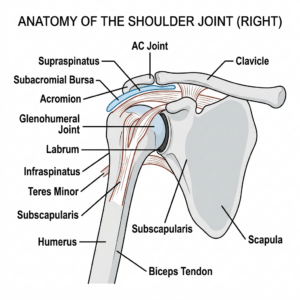
Frozen shoulder is a condition in which the capsule surrounding the glenohumeral (shoulder) joint becomes inflamed, thickened, and contracted.
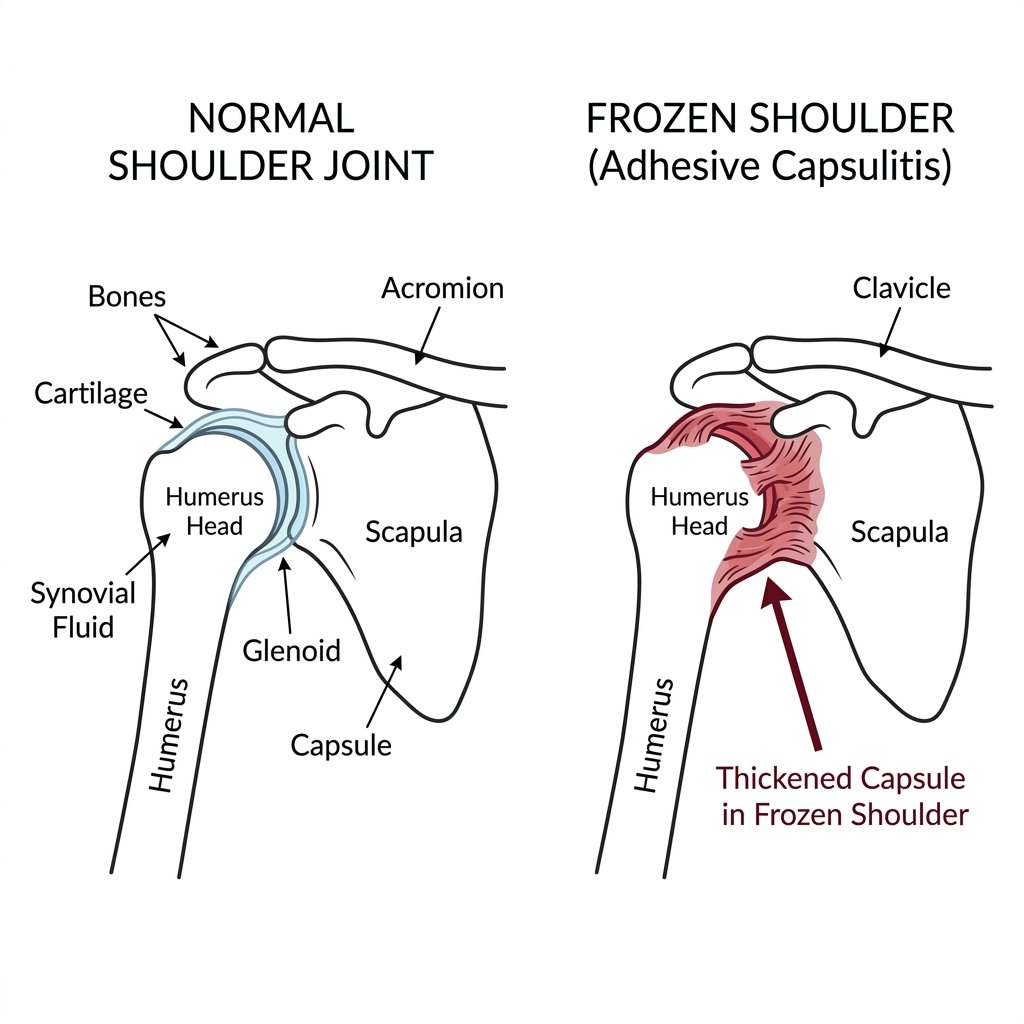
As the capsule tightens, it restricts movement in all directions, causing both significant pain and profound stiffness. It affects approximately 2–5% of the general population and is most common in people aged 40–60, with women affected slightly more often than men.
The Three Stages of Frozen Shoulder
Frozen shoulder progresses through three distinct phases:
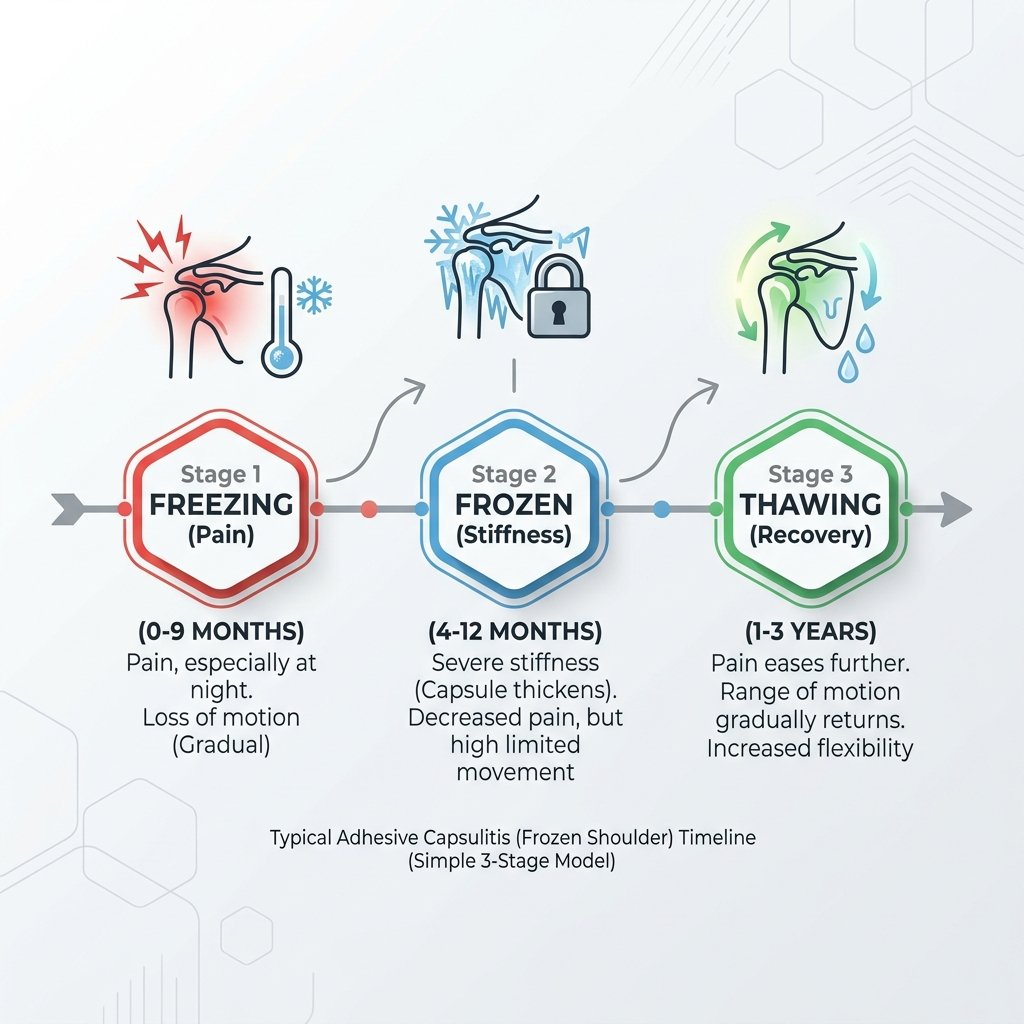
- Stage 1 — Freezing (Pain dominant, 2–9 months): Progressive onset of pain, often worse at night. Movement begins to reduce. This is the inflammatory phase where early intervention has the greatest impact.
- Stage 2 — Frozen (Stiffness dominant, 4–12 months): Pain may reduce slightly but stiffness is at its worst. Daily activities — dressing, driving, reaching overhead — become severely limited.
- Stage 3 — Thawing (Recovery, 5–24 months): Gradual return of movement. However, without treatment, full recovery can take 2–3 years and some patients never fully regain their range of motion.
Why You Should Not Simply Wait It Out
The traditional advice that frozen shoulder will “get better on its own” is partially true but clinically misleading. While some patients do recover spontaneously, many do not fully recover without intervention — and those who receive early, targeted treatment recover significantly faster and more completely.
Early diagnosis and intervention in the freezing stage can:
- Significantly reduce pain within days to weeks
- Prevent the capsule from contracting further
- Shorten the total recovery timeline from years to months
- Avoid the need for surgical intervention
How We Diagnose Frozen Shoulder at LSRI
At London Sports and Rheumatology Imaging, Dr Prashant Sankaye takes a structured diagnosis-first approach:
- Clinical Assessment: A detailed history and physical examination assessing your range of motion in all planes — forward flexion, abduction, external and internal rotation. A specific pattern of restriction (loss of external rotation in particular) is highly characteristic of frozen shoulder.
- Shoulder Ultrasound Scan: A real-time dynamic ultrasound allows assessment of the rotator cuff tendons, biceps tendon, and subacromial bursa. This is essential to rule out other conditions such as a rotator cuff tear before proceeding to injection.
- Shoulder MRI (when indicated): Where ultrasound findings are inconclusive, or where a more complex diagnosis needs to be excluded, a specialist shoulder MRI provides detailed imaging of the joint capsule, labrum, rotator cuff, and surrounding structures.
Treatment Options at London Sports and Rheumatology Imaging
We offer a complete diagnosis-to-treatment pathway — everything under one roof.
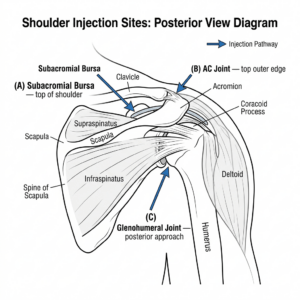
- Ultrasound-Guided Glenohumeral Steroid Injection: In the early, pain-dominant freezing stage, a corticosteroid injected directly into the glenohumeral joint under ultrasound guidance reduces the capsular inflammation rapidly. Evidence consistently shows this provides significantly faster pain relief than physiotherapy alone in Stage 1.
- Ultrasound-Guided Hydrodistension (Hydrodilatation): Hydrodistension is the gold-standard injection treatment for frozen shoulder. Under live ultrasound guidance, a combination of corticosteroid, local anaesthetic, and saline is injected into the glenohumeral joint under pressure, physically stretching the contracted capsule. Most patients notice improvement within days, with significant restoration of movement within 2–4 weeks.
- Physiotherapy: Following injection treatment, a structured physiotherapy programme is essential to maintain and build upon the restored range of motion. We work closely with specialist physiotherapists to coordinate your complete care.
- Hyaluronic Acid (Visco-supplementation): For appropriate patients, intra-articular hyaluronic acid provides joint lubrication and may reduce capsular inflammation with a more sustained effect than steroid alone.
- PRP (Platelet-Rich Plasma): For patients seeking a regenerative, steroid-free approach, PRP injection harnesses your own platelets to promote tissue healing and reduce inflammation.
Why Choose Dr Prashant Sankaye at LSRI?
- Specialist musculoskeletal radiologist with extensive shoulder imaging and injection expertise
- All injections performed under real-time ultrasound guidance — the gold standard for accuracy
- Complete pathway: diagnostic scan → specialist report → injection → physiotherapy referral
- CPD Approved Provider #790052 — independently accredited by The CPD Group
- Serving patients across London and the surrounding area — no GP referral required
Book Your Consultation
📞 020 8087 2304
🔗 Book an Appointment
Do not wait for your shoulder to “defrost” on its own. Early, expert intervention changes the outcome. For more information, visit the NHS guide on adhesive capsulitis.
Essential Advice: Frozen Shoulder Treatment London
If you are looking for frozen shoulder treatment london, early intervention is critical. Effective frozen shoulder treatment london can reduce your pain within days. We specialise in advanced frozen shoulder treatment london using ultrasound guidance. Many patients travel for our frozen shoulder treatment london. Delaying frozen shoulder treatment london can lead to years of stiffness. Book your frozen shoulder treatment london consultation today. Finding the right frozen shoulder treatment london is the first step to recovery.
Dr Prashant Sankaye is a specialist musculoskeletal radiologist and CPD Approved Trainer at London Sports and Rheumatology Imaging (LSRI Ltd), CPD Provider #790052. 
About the Author: Dr Prashant Sankaye, Consultant Musculoskeletal specialist and Radiologist, MBBS, MS, FCPS, MRCS, CCBST, FRCR, PGCE(Med), FHEA, PGDip Sports and Exercise Medicine
Dr Prashant Sankaye is a highly respected Consultant MSK Radiologist and the Clinical Director of London Sports & Rheumatology Imaging (LSRI). With over a decade of sub-specialty experience, he is a recognized expert in advanced diagnostic imaging (Ultrasound & 3T MRI) and precision ultrasound-guided therapeutic injections. His authoritative approach ensures patients avoid surgery where possible and receive the highest standard of orthopaedic, rheumatological, and sports medicine care.