Written by: LSRI Editorial Team
Medically Reviewed by: Dr Prashant Sankaye, Consultant MSK Radiologist — MBBS, MS, FCPS, MRCS, CCBST, FRCR, PGCE(Med), FHEA, PGDip Sports and Exercise Medicine
Last Updated: October 8, 2026
Read Time: 4 Minutes
PRP injections for the shoulder offer a powerful, evidence-based alternative to steroids. If you have been told you need a shoulder injection but are concerned about the effects of repeated steroid injections, or if you have already had steroid injections that have stopped working, regenerative injection therapies — particularly PRP (platelet-rich plasma) and hyaluronic acid — offer a powerful, evidence-based alternative. This guide explains exactly what these treatments involve, what the evidence says, and who they are most suitable for.
📋 In This Article
The Limitations of Repeated Steroid Injections
Corticosteroid injections are effective for many shoulder conditions, particularly in the short term. However:
- Their effect typically lasts 6–12 weeks before wearing off
- Repeated steroid injections can weaken tendons and accelerate cartilage breakdown over time
- Steroid is not suitable for all patients (diabetics, immunocompromised patients, or those with concerns about hormonal effects)
- For tendon damage (rotator cuff tears), steroid reduces pain but does not repair the underlying tissue
This is why, at London Sports and Rheumatology Imaging, we offer a full range of regenerative options for patients whose conditions require more than pain management.
PRP (Platelet-Rich Plasma) Injection for the Shoulder
What Is PRP?
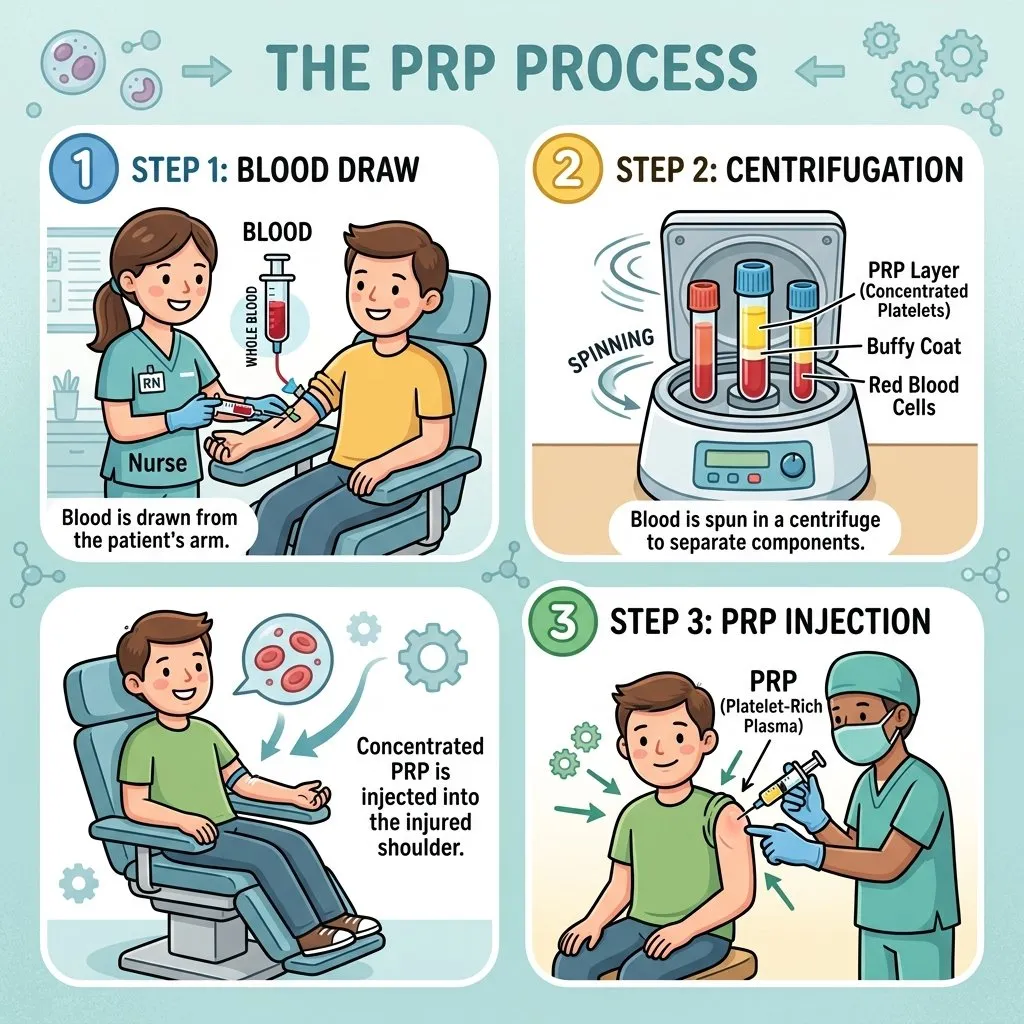
PRP is produced from your own blood. A small blood sample (typically 20–60ml) is drawn from your arm and placed in a centrifuge, which separates the blood components. The platelet-rich layer is then extracted and concentrated — producing a solution containing 3–5 times the normal platelet count of whole blood.
Platelets contain growth factors — naturally occurring proteins that stimulate tissue healing, collagen production, and reduction of inflammation. When injected under ultrasound guidance directly into a damaged tendon or joint, PRP harnesses these biological signals to promote genuine tissue repair.
What Does the Evidence Show?
- A 2025 systematic review of 30 randomised controlled trials involving approximately 2,500 patients confirmed that PRP significantly reduces pain and improves function in rotator cuff tendinopathy compared to placebo and cortisone
- A 2025 prospective study of 90 patients with partial-to-full thickness rotator cuff tears found 69% achieved complete tendon healing on ultrasound at 12 weeks after a single PRP injection
- PRP shows significantly better long-term outcomes than steroid at 24 weeks — function scores continue to improve at 6 months post-injection
What Is PRP Best For?
- Rotator cuff tendinopathy — the strongest evidence base
- Partial thickness rotator cuff tears — particularly where surgery is not yet desired
- Shoulder osteoarthritis — as an alternative to steroid or hyaluronic acid
- Patients who want a steroid-free, regenerative approach
- Athletes seeking tissue repair rather than symptom suppression
Hyaluronic Acid (Viscosupplement) Injection
Hyaluronic acid (HA) is a naturally occurring component of joint fluid, providing lubrication and cushioning within the shoulder joint. In arthritic joints, the natural hyaluronic acid becomes degraded and less effective — HA injection replenishes this.
Benefits of Hyaluronic Acid
- Sustained pain relief lasting 6–12 months from a single injection
- Reduces friction within the joint — particularly effective in early-to-moderate glenohumeral osteoarthritis
- Completely steroid-free
- Can be combined with PRP for enhanced effect in appropriate cases
- Suitable for patients with diabetes, where steroid would cause blood sugar concerns
PRP vs Steroid vs Hyaluronic Acid: Which Is Right for You?
PRP focuses on stimulating healing and provides long-term relief (12-24+ months). Hyaluronic Acid lubricates the joint for medium-term relief (6-12 months). Steroids provide rapid inflammation reduction for short-term relief (6-12 weeks).
What to Expect at Your LSRI Appointment
For PRP:
- Blood is drawn from your arm at the clinic (15 minutes)
- The sample is centrifuged and prepared (15–20 minutes)
- Dr Sankaye performs a real-time ultrasound of your shoulder
- PRP is injected under live ultrasound guidance into the precise target structure
- Total appointment time: approximately 60 minutes
For Hyaluronic Acid:
- Simpler and faster — no blood draw needed
- Ultrasound-guided injection into the glenohumeral joint — approximately 20 minutes total
Learn more about ultrasound-guided injections, get a shoulder MRI, manage a frozen shoulder, or see our shoulder injections page.
Dr Prashant Sankaye is a specialist musculoskeletal radiologist and CPD Approved Trainer at London Sports and Rheumatology Imaging (LSRI Ltd), CPD Provider #790052.