Written by: LSRI Editorial Team
Medically Reviewed by: Dr Prashant Sankaye, Consultant MSK Radiologist — MBBS, MS, FCPS, MRCS, CCBST, FRCR, PGCE(Med), FHEA, PGDip Sports and Exercise Medicine
Last Updated: October 8, 2026
Read Time: 4 Minutes
Shoulder ultrasound is one of the most powerful and versatile diagnostic tools available for shoulder pain. Unlike an X-ray, it shows soft tissue structures in real-time. Unlike MRI, it allows dynamic assessment — watching tendons and the bursa move as you rotate and elevate your arm. And crucially, when a problem is identified, an ultrasound-guided injection can often be performed in the same appointment. This is the LSRI model: diagnose and treat, without unnecessary delay.
📋 In This Article
What Does a Shoulder Ultrasound Show?
A specialist musculoskeletal shoulder ultrasound scan at LSRI assesses:
Rotator Cuff Tendons
- Supraspinatus, infraspinatus, subscapularis, teres minor
- Partial and full-thickness tears — including their exact size and location
- Tendinopathy (degeneration without a full tear)
- Calcific deposits within tendons
Subacromial Bursa
- Bursitis — fluid, thickening, and inflammation
- Impingement — assessed dynamically as you move your arm
Biceps Tendon
- Long head of biceps tenosynovitis (inflammation of the tendon sheath)
- Partial or complete tears of the biceps tendon
AC (Acromioclavicular) Joint
- Joint effusion, osteoarthritis, and ligament integrity
Dynamic Assessment — The Unique Advantage
Unlike MRI, ultrasound can assess the shoulder whilst it moves. This allows Dr Sankaye to visualise impingement occurring in real-time, watch the biceps tendon sublux out of its groove, or confirm a rotator cuff tear opens under load — information that static imaging cannot provide.
Ultrasound vs MRI: When Is Each Needed?
Both are valuable — and for complex shoulder conditions, LSRI often uses both:
- Ultrasound is best for: Rotator cuff tears, tendinopathy, and bursitis; dynamic assessment of impingement; real-time guidance for injections; quick, comfortable, and immediately available.
- MRI is best for: Labral tears (SLAP, Bankart); deep cartilage and bone assessment; full extent of rotator cuff muscle atrophy; pre-surgical planning; cases where ultrasound findings are inconclusive.
Scan + Injection in One Appointment
One of the most valued aspects of the LSRI model is that when an ultrasound confirms a treatable condition, Dr Sankaye can proceed to an ultrasound-guided injection immediately in the same appointment. This means:
- No second appointment
- No additional delay to treatment
- The injection is guided by live, real-time ultrasound — the highest standard of accuracy
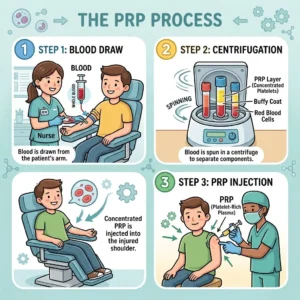
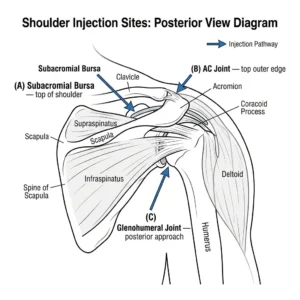
Same-appointment treatment is available for subacromial bursa injection (subacromial bursitis, impingement, rotator cuff tendinopathy), glenohumeral joint injection (frozen shoulder, osteoarthritis), hydrodistension (frozen shoulder capsule stretching), AC joint injection, PRP (platelet-rich plasma) injection, and hyaluronic acid injection.
What Happens During Your Shoulder Ultrasound at LSRI?
- Clinical history — Dr Sankaye takes a full history of your symptoms
- Physical examination — range of motion, strength, and provocative tests
- Ultrasound scan — you sit comfortably; the probe is placed on various parts of the shoulder; the scan takes approximately 15–20 minutes
- Real-time explanation — Dr Sankaye shows you what is seen on the screen and explains the findings immediately
- Treatment discussion — if an injection is indicated, this can proceed in the same appointment with your consent
- Detailed written report — provided to you and your GP or referrer
Who Should Have a Shoulder Ultrasound?
You should consider a shoulder ultrasound scan if you have pain or weakness when lifting your arm, pain at the top or outer side of your shoulder, night pain affecting sleep, pain after a fall or injury to your shoulder, a “catching” sensation or clicking in the shoulder, previously diagnosed rotator cuff problems that are worsening, or shoulder pain that has not improved with physiotherapy.
No GP referral required. Appointments available quickly. One appointment. One expert. Diagnosis and treatment without delay — London Sports and Rheumatology Imaging.
Consider a shoulder injection, PRP injection, or shoulder MRI based on findings. Read about rotator cuff tears and frozen shoulder.
Dr Prashant Sankaye is a specialist musculoskeletal radiologist and CPD Approved Trainer at London Sports and Rheumatology Imaging (LSRI Ltd), CPD Provider #790052.