Written by: LSRI Editorial Team
Medically reviewed by Dr Prashant Sankaye, Consultant MSK Radiologist ·
Last Updated: October 23, 2026
Read Time: 20 Minutes
Written by the LSRI clinical team and medically reviewed by Dr Prashant Sankaye, Consultant MSK Radiologist, on 22 October 2026.
If you are paying for yourself, you do not need a GP referral for a private MRI scan in the UK. The law that requires a referral for scans covers X-rays, CT and other scans that use radiation, but not MRI or ultrasound.1 That does not mean any scan should be booked without a clinical check. UK radiology bodies advise that, as with X-rays, an MRI should be requested by a registered healthcare professional who has looked at your symptoms, to make sure it is the right test, set up to answer the right question, and safe for you.2,3 That person does not have to be your GP.
This guide explains when you need a referral and when you don’t, how health insurance changes things, what happens to your NHS care after a private scan, and when you should not wait for a private scan at all. It is written by the LSRI clinical team, led by a consultant musculoskeletal (MSK) radiologist: the specialist doctor who reads bone, joint and muscle scans.
Key points
- MRI and ultrasound: no GP referral is legally required. The scan referral law in England, Wales and Scotland, IR(ME)R 2017, applies only to ionising radiation.1
- X-ray and CT: by law, these need a referral from a registered healthcare professional and must be justified by a practitioner before the scan.1
- A clinical check still matters. The Royal College of Radiologists calls it best practice to handle MRI referrals the same way as X-ray referrals,2 and the UK’s MRI safety guidance calls the person requesting the scan “the first line of defence” for safety.4
- Clinic or reseller? Some websites are resellers: they only take bookings and pass you to another company for the scan. Ask who checks that MRI is the right test, and who reports it. A service that can only take self-referrals cannot arrange an X-ray or CT.1
- Health insurance: most insurers want a GP referral, or use their own direct-access route, and want you to contact them before any tests.5,6,7
- NHS care afterwards: paying for a private scan does not take away your right to NHS care, but it does not move you up an NHS waiting list either.8,9
- Urgent symptoms: some symptoms need the NHS today, not a private booking. See the red box below.
Do you need a GP referral for a private MRI?
No. If you are paying for the scan yourself, you can book a private MRI without seeing your GP first. Many people do this because they want a diagnosis sooner, or because a GP appointment is hard to get. In a survey of 2,593 adults in England, published by Healthwatch England in March 2026, 16% had used private services such as non-urgent treatment and diagnostic tests in the past year, up from 9% in 2023. Long waits were the most common reason.10
What you should expect, though, is a clinical check before your scan is booked. A good private service will ask about your symptoms, decide which body part and which type of scan will answer your question, and screen you for MRI safety. At LSRI, our clinical team, led by Dr Prashant Sankaye, Consultant MSK Radiologist, reviews your symptoms and checks your request before your scan is booked. If MRI isn’t the right test, or another scan would answer your question better, we’ll tell you.
Why MRI and ultrasound don’t need a referral, but X-rays and CT do
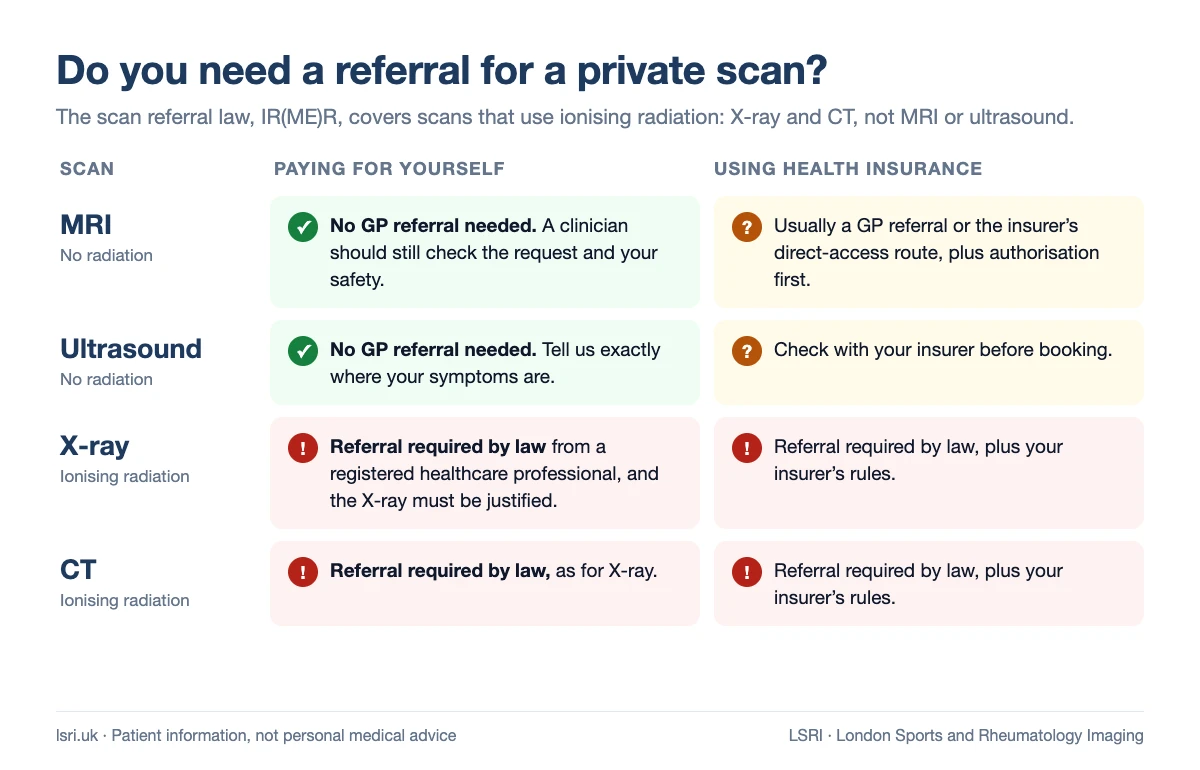
X-rays and CT scans use ionising radiation. In England, Wales and Scotland, any medical exposure to ionising radiation is governed by the Ionising Radiation (Medical Exposure) Regulations 2017, known as IR(ME)R.1 Under IR(ME)R:
- the “referrer” must be “a registered health care professional” entitled to refer by the service doing the scan, such as a doctor, or a physiotherapist or nurse with the right training;1
- the referrer must give enough clinical information for the scan to be judged worthwhile;1
- no exposure can go ahead unless a practitioner has “justified” it as “showing a sufficient net benefit”.1
MRI uses a strong magnetic field and radio waves, and ultrasound uses sound waves. Neither uses ionising radiation, so IR(ME)R does not apply to them.1 That is why you can book a private MRI or ultrasound scan yourself, but an X-ray needs a request from a registered healthcare professional.
Why a specialist should still check your request
The fact that the law allows self-referral for MRI does not mean that any scan of any body part is a good idea. The UK’s professional imaging bodies are clear about this:
- The Royal College of Radiologists says MRI and ultrasound are “not strictly included” in the referral law, but that it is “best practice that referrals for these investigations are conducted in the same way as ionising radiation examinations”.2
- The Clinical Imaging Board, set up by the Royal College of Radiologists, the Society and College of Radiographers and the Institute of Physics and Engineering in Medicine, said in 2021 that it “does not support the self-referral by the patient for MRI or any diagnostic imaging study” without a request from a registered healthcare professional.3
- The MHRA’s MRI safety guidance, updated in 2026, describes the person requesting an MRI as “the first line of defence” in keeping patients safe, because they must tell the scanning centre about any implants or medical devices before your appointment.4
The person who checks your request does not have to be your GP. It can be a specialist doctor, an appropriately trained physiotherapist, or the radiologist who will read your scan. What matters is that somebody with the right expertise has looked at your symptoms before you are scanned.
Scans often show things that are not causing your pain
MRI is very sensitive, and it shows age-related changes in many people who have no pain at all. In a review of 33 studies of people with no back pain, disc degeneration was seen on the CT or MRI scans of 37% of 20-year-olds and 96% of 80-year-olds.11 In adults aged 40 and over with no knee pain or injury, 43% had cartilage damage and 19% had a meniscal tear on MRI.12 Changes in the rotator cuff of the shoulder become steadily more common with age.13
None of this means MRI is not useful. It means that a scan answers a question best when somebody has asked it a clear question, and when the person reading it knows your story. Without that, a finding that has nothing to do with your symptoms can be blamed for them. For most new back pain without warning signs, for example, scanning straight away does not improve pain or function compared with usual care.14 Who reads the scan matters too: when one person in the USA had a lower back MRI at ten different centres within three weeks, the reports disagreed widely.15 We explain this more in who reports your MRI matters.
What happens when you book a private MRI without a GP referral
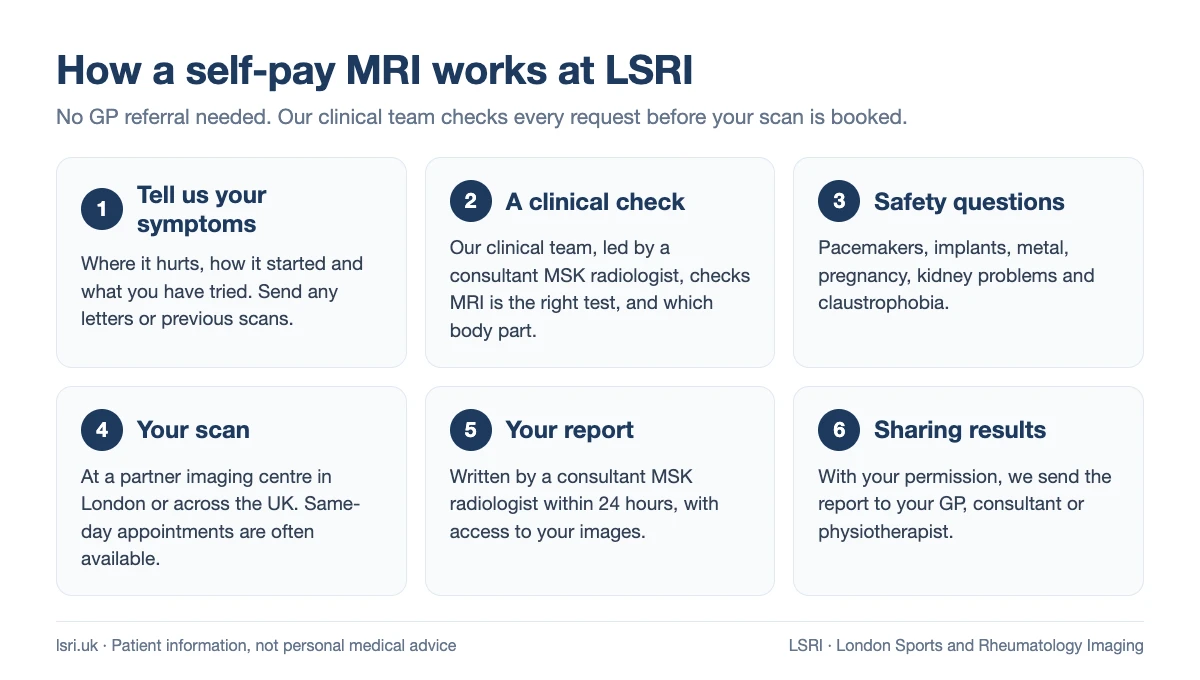
- Tell us your symptoms. When you call or book online, we ask where the problem is, how and when it started, and what you have already tried. If you have a GP or consultant letter, or a previous scan, send it too.
- A clinical check. Our clinical team, led by Dr Sankaye, checks that MRI is the right test and which body part needs scanning. Sometimes an ultrasound or an X-ray answers the question better, or first. See MRI or ultrasound for joint pain?
- Safety questions. Before any MRI you will be asked about pacemakers, implants, metal in your body, pregnancy, kidney problems and whether you are anxious in enclosed spaces.16 The scanning centre also screens everyone before they enter the scanner area.4
- Your scan. MRI scans are done at partner imaging centres in London and across the UK, and same-day appointments are often available, depending on location.
- Your report. A consultant MSK radiologist reports your scan within 24 hours, and you have access to your images.
- Sharing your results. With your permission, we send your report to your GP, consultant or physiotherapist, so that everyone is working from the same diagnosis.
Booking a private MRI online: what to check before you pay
Search for a private MRI and you will find many websites. Some are clinics run by doctors who check your request, arrange the right scan and report it. Others are resellers, also called booking services: they take your booking and payment, the scan is done by a separate imaging company, and a radiologist arranged by the reseller reports it. A reseller can be quick and convenient, but the people you deal with may not be doctors, and the website does not always make clear who is responsible for your care. It is worth knowing before you pay.
The right test matters more than a quick MRI
MRI is not always the best scan. Sometimes an ultrasound or an X-ray answers the question better, or should come first (see MRI or ultrasound for joint pain?). The law also limits what a reseller can offer. X-ray and CT scans use ionising radiation, so they need a referral from a registered healthcare professional, such as a doctor, and each scan must be justified before it goes ahead.1 A service that can only take self-referrals cannot arrange these tests for you, so MRI may be the only scan on offer, even when another test would answer your question better.
Five questions to ask any MRI provider
- Who checks that MRI is the right test for me? UK radiology bodies say an MRI, like an X-ray, should be requested by a registered healthcare professional.2,3
- Is that person a doctor or another registered healthcare professional? If not, they cannot refer you for an X-ray or CT if that turns out to be the better test.1
- Who decides how the scan is done? An MRI is made up of several types of image, and the right set depends on the body part and the question being asked. A radiologist who knows your symptoms can tailor the scan to them.
- Who reports the scan, and do they specialise in muscles, bones and joints? Reports can differ between imaging centres and radiologists, even for the same patient,15 so it helps if a consultant musculoskeletal (MSK) radiologist reads it.
- Who explains the results, and what happens if something unexpected is found? Ask whether you can talk the report through with a doctor, and who will arrange the next steps.
At LSRI, our own specialist team does each of these steps. A consultant MSK radiologist checks why the scan is needed before it is booked, recommends the right test (ultrasound, X-ray or MRI) and, when your question needs it, tailors the scan protocol. Your scan is reported by a consultant MSK radiologist within 24 hours. If you choose a scan with a consultation (from £425), we go through the results and next steps with you; the scan-only option (from £375) includes the report but no consultation or advice on treatment.
Do you need a GP referral if you are using health insurance?
Usually, yes. Health insurers have their own rules, and they are stricter than the law. The details differ between insurers and between policies, but the public guidance from the larger UK insurers follows a similar pattern:
- AXA Health says you need a GP referral letter before using your membership to see a specialist, from your own GP or its online GP service. Its muscles, bones and joints service, if your plan includes it, is an exception.5,17
- Bupa offers Direct Access for muscle, bone and joint problems on most of its policies, so you may not need to see a GP first. Bupa checks that any tests or treatment are covered.6
- Aviva says “you need a referral from a GP to make a claim”, and asks you to contact it before having any tests.7,18
Whoever your insurer is, call them before you book a scan, ask whether you need a referral, and get an authorisation number. Paying for a scan yourself and claiming afterwards may not be covered. Dr Sankaye is recognised by the major insurers and is Bupa fee-assured; call us on 0203 633 5040 and we will help you check your cover.
Will the NHS accept a private MRI?
NHS doctors can usually take a private report and images into account, but they make their own decisions about your care. A clear report from a specialist is useful to any doctor looking after you, and it helps to know how private and NHS care fit together in England:
- You keep your NHS entitlement. Government guidance says that if you pay privately for part of your care, your “entitlement to NHS services remains and may not be withdrawn”.8
- You should be at no advantage or disadvantage. The same guidance says patients should not be put at “any advantage or disadvantage” in their NHS care because they paid privately.8 NHS treatment is prioritised by clinical need.9
- Tests should not be repeated without a reason. The 2009 guidance says patients “should not be unnecessarily subjected to two sets of tests”.8 An NHS team may still repeat a scan if it needs a different view or cannot access your images.
- Your GP can take a private report into account, but is not obliged to arrange further tests that a private provider asks for. The British Medical Association advises GPs to arrange tests only when they need them for their own care of you.9
- Private specialists can refer you into NHS services if you would be eligible for an NHS referral, without going back to your GP.9
To make the handover easy, ask for a copy of your report and a link to your images, and send a copy to your GP.
Don’t wait for a private scan if you have any of these
Call 999 or go to A&E if you have back pain with:19
- loss of feeling around your genitals or bottom;
- new difficulty peeing, or wetting or soiling yourself;
- changes in how your genitals feel during sex, or new problems getting an erection or reaching orgasm;
- pain, tingling, weakness or numbness in both legs;
- chest pain;
- pain that started after a serious accident, such as a car accident.
Get urgent help from your GP or NHS 111 if you have back or joint pain and feel hot, cold, shivery or generally unwell; if back pain is severe and came on suddenly or is getting worse quickly; or if you have a hot, swollen joint with a high temperature.19,20
See your GP promptly if you have bone or back pain that is worse at night, a new lump or swelling, or weight loss you can’t explain.19,21
Other ways to get seen without a GP appointment
A private scan is not the only route. In most of England, adults can refer themselves to NHS community musculoskeletal (MSK) services without seeing a GP; these services can arrange an MRI if you need one.22 Many GP practices also have first contact physiotherapists, whom you can see without seeing a GP first.23 These routes are not for urgent problems, and the service will tell you how long the wait is once your referral has been reviewed.22
A private scan makes most sense when you want a clear diagnosis quickly: for example, if a problem is stopping you working or training, if you are deciding about an injection or surgery, or if your symptoms have not improved with treatment.
How LSRI can help
LSRI is a doctor-led musculoskeletal imaging clinic, not an emergency service. If anything in the red box applies to you, get urgent NHS care first.
- No GP referral needed for MRI or ultrasound if you are paying for yourself. Our clinical team checks every request, so your scan is set up to answer the question that matters to you.
- MRI scans at our partner imaging centres, in two options: scan only, from £375 per body part (the scan, a report from a consultant MSK radiologist within 24 hours and access to your images, without a consultation or advice on treatment), or scan with a consultation, from £425, which adds a consultation to go through your results and next steps.
- Ultrasound scans at our Harley Street and Harrow clinics, from £200.
- Not sure which scan you need? Tell us your symptoms when you book, and our clinical team will check you are booked for the right scan. Patients aged over 70 can also have a free 5-minute video consultation.
- A second opinion on a scan you have already had: see our second opinion page.
Our clinics are on Harley Street (W1G 9QJ) and in Harrow (HA2 7SJ); call 0203 633 5040.
Reading this from outside England?
The scan referral law (IR(ME)R 2017) applies in England, Wales and Scotland; Northern Ireland has its own regulations. The NHS routes and guidance described above apply to England. Emergency numbers differ: 999 or 112 in the UK, 112 across the EU, 911 in the US and Canada, and 000 in Australia.
Frequently asked questions
Can I refer myself for an MRI scan in the UK?
Yes, at many private clinics, if you are paying yourself. Good practice is for a doctor or other registered clinician to check that the scan is appropriate and safe before it is booked.3,4
Do I need a GP referral for a private ultrasound scan?
No, for the same reason as MRI: ultrasound uses sound waves, not ionising radiation.1 It is still worth telling the sonographer or radiologist exactly where your symptoms are and how they started.
Do I need a referral for a private X-ray?
Yes. X-rays use ionising radiation, so the law requires a request from a registered healthcare professional, and the exposure must be justified before it goes ahead.1 This can be your GP, a specialist, or a suitably trained physiotherapist. If you come to LSRI without a referral, our doctors can assess you and request an X-ray if it is the right test. X-rays are done at our partner imaging centre in Fitzrovia, central London.
Can a physiotherapist refer me for an MRI?
Yes. Physiotherapists are registered healthcare professionals, and imaging services can authorise suitably trained physiotherapists to request scans; UK MRI safety guidance says MR safety training should be part of that authorisation.2,4 If you are claiming on insurance, check that your insurer accepts a physiotherapist’s request.
Will my GP see my private MRI results?
Only if you or the clinic send them. Ask for a copy of the report and share it with your GP. Your GP can take it into account, but is not obliged to arrange further tests that a private provider asks for.9
Does a private MRI let me skip the NHS waiting list?
No. A private scan can give you an answer sooner, but it does not move you up an NHS waiting list. Guidance says paying privately should give you no advantage or disadvantage in your NHS care, and NHS treatment is prioritised by clinical need.8,9
What if I don’t know which part of my body to scan?
Tell us your symptoms when you book, and our clinical team will check which body part to scan. Pain is not always felt where the problem is: hip problems can be felt in the knee, and neck problems in the arm. Each body part is a separate MRI, so it is worth getting this right before you book.
References
- The Ionising Radiation (Medical Exposure) Regulations 2017 (SI 2017/1322), regulations 2, 3, 10 and 11, as amended. legislation.gov.uk (accessed 22 October 2026)
- The Royal College of Radiologists. Non-regulated professions requesting ionising radiation examinations. 18 June 2025. rcr.ac.uk (accessed 22 October 2026)
- Clinical Imaging Board (Society and College of Radiographers, Royal College of Radiologists, Institute of Physics and Engineering in Medicine). Position statement on self-referral for MRI examinations. 11 August 2021. sor.org (accessed 22 October 2026)
- Medicines and Healthcare products Regulatory Agency. Safety guidelines for magnetic resonance imaging equipment in clinical use, 5th edition. July 2026 (updated September 2026). gov.uk (accessed 22 October 2026)
- AXA Health. Making claims clear: member help. axahealth.co.uk (accessed 22 October 2026)
- Bupa UK. Getting treatment without seeing a GP (Direct Access). bupa.co.uk (accessed 22 October 2026)
- Aviva. Do I need a referral from a GP to claim? aviva.co.uk (accessed 22 October 2026)
- Department of Health. Guidance on NHS patients who wish to pay for additional private care. 23 March 2009. gov.uk (accessed 22 October 2026)
- British Medical Association. General practice responsibility in responding to private healthcare. Updated 31 August 2023. bma.org.uk (accessed 22 October 2026)
- Healthwatch England. Two-tier healthcare increases as confidence in timely access remains low. 16 March 2026. healthwatch.co.uk (accessed 22 October 2026)
- Brinjikji W, Luetmer PH, Comstock B, Bresnahan BW, Chen LE, Deyo RA, et al. Systematic literature review of imaging features of spinal degeneration in asymptomatic populations. AJNR Am J Neuroradiol 2015;36(4):811-6. doi:10.3174/ajnr.A4173
- Culvenor AG, Øiestad BE, Hart HF, Stefanik JJ, Guermazi A, Crossley KM. Prevalence of knee osteoarthritis features on magnetic resonance imaging in asymptomatic uninjured adults: a systematic review and meta-analysis. Br J Sports Med 2019;53(20):1268-78. doi:10.1136/bjsports-2018-099257
- Teunis T, Lubberts B, Reilly BT, Ring D. A systematic review and pooled analysis of the prevalence of rotator cuff disease with increasing age. J Shoulder Elbow Surg 2014;23(12):1913-21. doi:10.1016/j.jse.2014.08.001
- Chou R, Fu R, Carrino JA, Deyo RA. Imaging strategies for low-back pain: systematic review and meta-analysis. Lancet 2009;373(9662):463-72. doi:10.1016/S0140-6736(09)60172-0
- Herzog R, Elgort DR, Flanders AE, Moley PJ. Variability in diagnostic error rates of 10 MRI centers performing lumbar spine MRI examinations on the same patient within a 3-week period. Spine J 2017;17(4):554-61. doi:10.1016/j.spinee.2016.11.009
- NHS. MRI scan. nhs.uk (page last reviewed 11 September 2025; accessed 22 October 2026)
- AXA Health. Muscles, bones and joints service. axahealth.co.uk (accessed 22 October 2026)
- Aviva. Make a health insurance claim. Published 26 March 2026. aviva.co.uk (accessed 22 October 2026)
- NHS. Back pain. nhs.uk (page last reviewed 5 March 2026; accessed 22 October 2026)
- NHS. Septic arthritis. nhs.uk (page last reviewed 3 September 2026; accessed 22 October 2026)
- NHS. Bone cancer: symptoms. nhs.uk (page last reviewed 20 May 2025; accessed 22 October 2026)
- NHS. Get NHS help for back or joint problems. nhs.uk (page last reviewed 18 November 2025; accessed 22 October 2026)
- NHS England. First contact physiotherapists. england.nhs.uk (accessed 22 October 2026)
Book an appointment
Call 0203 633 5040 or book online. Clinics at Harley Street (W1G 9QJ) and Harrow (HA2 7SJ). If you have emergency symptoms, go to A&E or call 999 instead.
About this article
Purpose: written by the LSRI clinical team to explain, for people in the UK, when a referral is needed for MRI, ultrasound, X-ray and CT scans, how health insurance and the NHS fit in, and when not to wait for a private scan, based on the legislation, guidance and research listed above. It is general information, not a diagnosis or legal advice. Insurance rules vary by policy, so check yours with your insurer. If you are worried about your own symptoms, speak to your GP or, in an emergency, go to A&E.