Written by: LSRI Editorial Team
Medically reviewed by Dr Prashant Sankaye, Consultant MSK Radiologist ·
Last Updated: October 14, 2026
Read Time: 15 Minutes
Written by the LSRI clinical team and medically reviewed by Dr Prashant Sankaye, Consultant MSK Radiologist, on 9 October 2026.
Most aching joints are not rheumatoid arthritis. But swollen knuckles, wrists or toe joints that stay stiff for half an hour or more each morning are worth acting on. They can be early signs of inflammatory arthritis, where the immune system attacks the lining of the joints. One of the main forms is rheumatoid arthritis (RA), which affects about 1 in 200 people worldwide, although estimates vary widely between studies1.
If you notice early rheumatoid arthritis symptoms like these, timing matters. The first 3 months after symptoms start are thought to be a “window of opportunity” for treatment2. Longer waits for a first rheumatology assessment are linked to more joint damage and a lower chance of remission without ongoing drugs, although this evidence is observational3. Yet many people with RA wait far longer to see a specialist2,4. For the wider picture, see why early imaging matters.
Key points
- Swollen small joints of the hands or feet and morning stiffness of 30 minutes or more are recognised referral clues. Pain when the knuckles are squeezed is a feature of joint pain at high risk of becoming RA5,6.
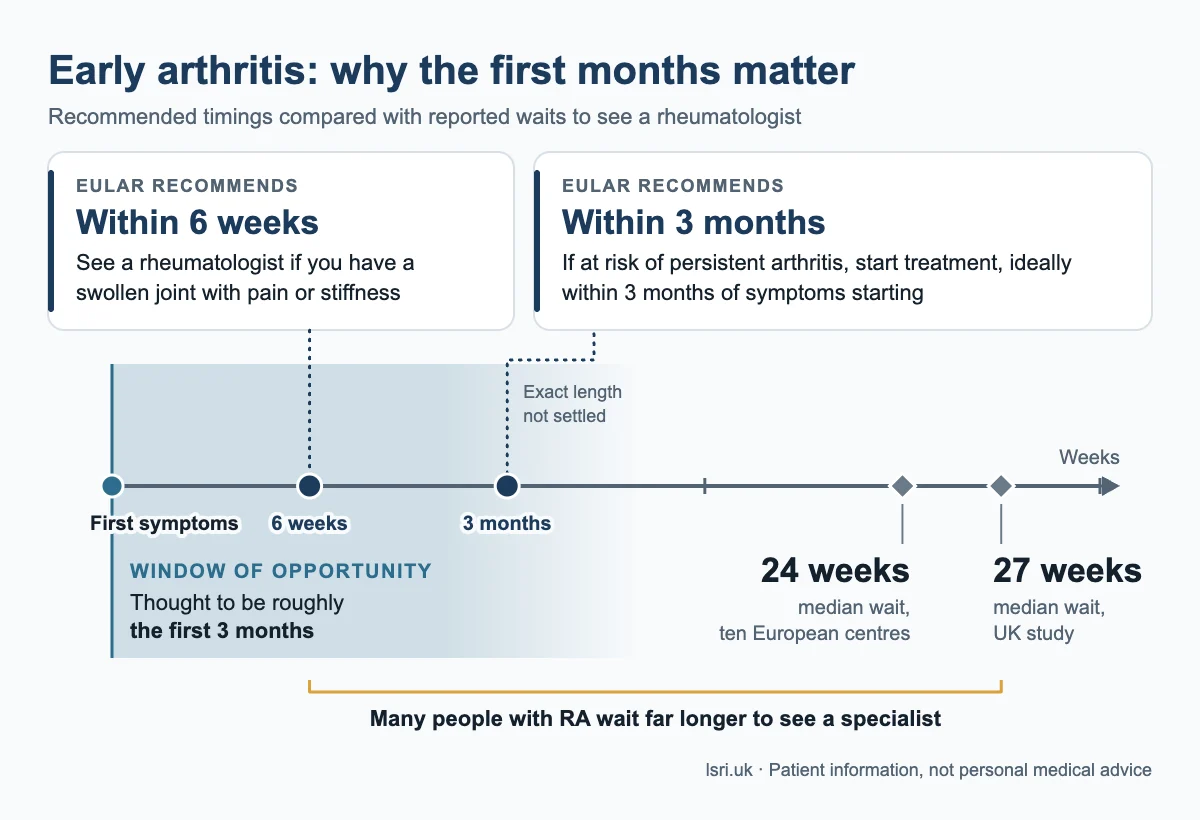
- European (EULAR) recommendations say anyone with a swollen joint plus pain or stiffness should see a rheumatologist within 6 weeks of symptoms starting7.
- In practice, median waits from first symptoms to a rheumatologist were 24 weeks across ten European centres and 27 weeks in a UK study2,4.
- In a Dutch study of 598 people with RA, those first assessed 12 weeks or more after symptoms began had faster joint damage and less drug-free remission3.
- Normal blood tests or a normal X-ray do not rule out early RA8,9.
- Ultrasound and MRI can find inflammation that examination misses, but they support, rather than replace, a rheumatologist’s assessment7,9,10.
How is inflammatory arthritis different from “wear and tear”?
Inflammatory arthritis is driven by the immune system, which inflames the thin lining inside the joint. Osteoarthritis, the “wear and tear” type, is the most common kind of arthritis11.
When the joint lining is inflamed (synovitis), the joint swells and can feel warm and tender12. Unchecked, the inflammation can cause lasting joint damage3. On scans, joint damage can appear as erosions: small areas where bone at the joint edge has been worn away.
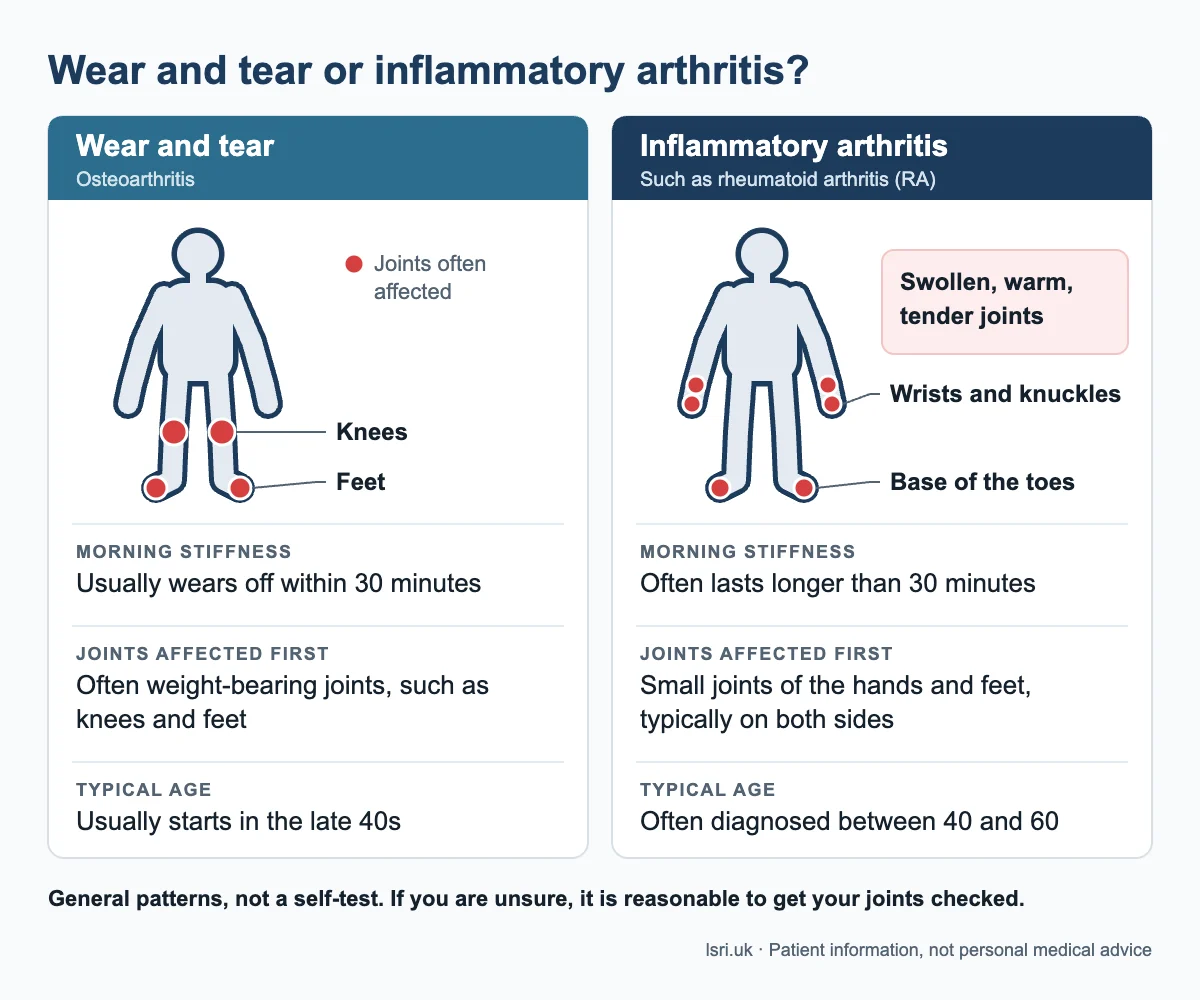
| Feature | Osteoarthritis (“wear and tear”) | Inflammatory arthritis, such as RA |
|---|---|---|
| Joints affected first | Often weight-bearing joints, such as knees and feet11 | Small joints of the hands and feet12 |
| Morning stiffness | Usually wears off within 30 minutes12 | Often lasts longer than 30 minutes12 |
| Pattern | Varies | Typically both sides at once, though not always12 |
| Typical age | Usually starts in the late 40s11 | Often diagnosed between 40 and 6011 |
| Whole-body symptoms | Not typical | Can include tiredness, poor appetite and weight loss12 |
Our article on osteoarthritis vs rheumatoid arthritis explains these differences in more detail.
What are the early warning signs?
Doctors look for swelling, not just pain, especially in the small joints of the hands and feet. Long morning stiffness and tender knuckles are other clues5,6.
- Swollen joints. Soft, puffy swelling around the knuckles, fingers, wrists or toe joints. Three or more swollen joints is one referral clue that rheumatologists set out for family doctors5.
- Knuckles and toe joints. Involvement of the knuckles (MCP joints) or the joints at the base of the toes (MTP joints) is another clue5. Pain when a doctor gently squeezes across the knuckles (the squeeze test), or difficulty making a fist, are further warning features6.
- Long morning stiffness. Stiffness of 30 minutes or more is a referral clue5. In the EULAR description of joint pain at high risk of becoming RA, the threshold is 60 minutes or more6.
- Both sides. RA typically affects matching joints on both sides of the body12.
- Family history. A parent, brother, sister or child with RA6.
These clues guide doctors. They are not a self-test. The EULAR joint-pain definition was developed mainly for research and combines several features, not one clue alone6.
Why is early inflammatory arthritis easy to miss?
The first signs are subtle, may come and go12, and standard tests can be normal.
Some people wait before seeking help. In a UK study of 822 people with RA, those whose symptoms came and went or crept up slowly waited longer before seeking help. So did people who first tried over-the-counter medicines or ice and heat packs4.
Blood tests can be normal. No single test can confirm RA8. Rheumatoid factor, an antibody (a protein made by the immune system), is raised in more than half of people with RA when the disease starts. So a normal result does not rule RA out, while about 1 in 20 people without RA also test positive8. People with a positive anti-CCP antibody test are very likely to develop RA, but not everyone with RA has this antibody8.
X-rays can be normal early on. X-rays show bone, not the inflamed joint lining, and may show no damage in early RA. Ultrasound and MRI may detect damage at an earlier stage9.
What can a delay cost?
A longer wait before assessment and treatment is linked to more joint damage and a lower chance of remission. The evidence centres on the first 12 weeks or so, but the exact length of the window is not settled13.
- More joint damage, less remission. A Dutch early arthritis clinic followed 598 people with RA. Those first assessed 12 weeks or more after symptoms began had joint damage on X-ray progressing about 1.3 times faster over six years. Of these, 10.5% reached lasting remission without disease-modifying drugs, against 18.5% of those assessed within 12 weeks3.
- A similar pattern elsewhere. A systematic review of 18 studies linked a longer symptom duration before treatment with more X-ray damage and a lower chance of drug-free remission. Its authors said the data “may support” a window of opportunity13.
There are honest limits. Most of this evidence comes from observational studies that compare people who happened to be seen or treated earlier or later, so other factors may play a part13. A later diagnosis is not a lost cause: EULAR’s treatment target for every person with RA is sustained remission or low disease activity14.
How is early inflammatory arthritis diagnosed?
A rheumatologist (a doctor specialising in arthritis and related immune conditions) makes the diagnosis. It rests on your history and a careful examination, supported by blood tests and sometimes imaging7,9.
EULAR describes clinical examination as the method of choice for detecting arthritis, which may be confirmed by ultrasound7. Blood tests usually include rheumatoid factor, anti-CCP antibodies and inflammation markers such as ESR and CRP8. EULAR advises that people at risk of persistent arthritis start treatment (disease-modifying drugs) as early as possible, ideally within 3 months of symptoms starting7.
What ultrasound and MRI can show
Ultrasound uses sound waves to make real-time pictures, and its Doppler setting can show blood flow, which is increased in inflamed tissue. MRI uses strong magnetic fields and radio waves to make detailed images8.
- Ultrasound and MRI are better than clinical examination at detecting joint inflammation9.
- When the diagnosis is in doubt, X-ray, ultrasound or MRI can improve certainty beyond clinical criteria alone9.
- In 136 people with positive anti-CCP antibodies but no joint swelling on examination, 42% developed inflammatory arthritis during follow-up (median 18 months). Risk was highest in those with Doppler signal on ultrasound15.
Read more about rheumatoid arthritis imaging at our clinic.
What imaging cannot do
A scan cannot diagnose RA on its own. EULAR advises that a definite diagnosis is made only after careful history-taking and examination7.
Small changes are also common in people without arthritis. In an MRI study of the hand, wrist and foot joints of 193 symptom-free adults, only 28% had no sign of inflammation and only 22% had no erosion. Most findings were mild and more common with age10. In the anti-CCP study, two-thirds of people who did not develop arthritis during the study also had an ultrasound abnormality at the start15.
Do you need a scan straight away?
A scan is usually not the first step. The NHS advises seeing a GP when unexplained joint pain, swelling or stiffness does not go away in a few days11. Aches without swelling that settle quickly, for example after unusual activity, are often not inflammatory arthritis. But if you are unsure, or if they keep coming back or do not settle, it is reasonable to see your GP or have them checked with a scan. In our view, imaging such as ultrasound can help tell the difference. Imaging is most useful when there is diagnostic doubt after examination7,9. If you already see a rheumatologist, they will decide which scans you need.
What else can cause swollen joints?
Not every swollen joint is RA. Other causes can look similar early on and need different treatment.
- Psoriatic arthritis: joint symptoms with psoriasis, a red, scaly skin rash11.
- Gout: often the big toe joint, which becomes painful, swollen and hot11.
- Viral arthritis: after some infections, such as the virus behind slapped cheek syndrome, adults can have joint pain and stiffness for many weeks16.
- Joint infection (septic arthritis): this can cause one suddenly painful, swollen joint. Severe pain and swelling in just one joint that started suddenly, red or hot skin around it, or sore joints with a fever need urgent assessment11. See our guide to a hot, swollen joint.
Get urgent advice for sudden severe pain and swelling in one joint, or red or hot skin over a joint. The same applies to sore joints with a high or low temperature, or feeling hot, cold or shivery. In the UK, ask for an urgent GP appointment or get help from NHS 11111. If you feel very unwell, go to A&E or call 999. LSRI is not an emergency service.
What should you do if you think you have early inflammatory arthritis?
Here is what we suggest:
- Book a GP appointment if unexplained joint swelling, pain or stiffness lasts more than a few days11.
- Describe the pattern clearly. Say which joints swell, how many minutes morning stiffness lasts, whether both sides are affected, and any family history of RA or psoriasis5,6.
- Keep a symptom diary. Symptoms can come and go12, so note swollen joints and stiffness each day. Photos of swelling on bad days help.
- Ask about a rheumatology referral. EULAR recommends that anyone with a swollen joint plus pain or stiffness is seen within 6 weeks of symptoms starting7.
- Do not be falsely reassured by one normal test. A normal rheumatoid factor or X-ray does not rule out early RA8,9.
- Use imaging as part of the assessment. Ultrasound or MRI helps when the picture is unclear9. Share the report with your GP or rheumatologist.
- Find reliable support. In the UK, the National Rheumatoid Arthritis Society (NRAS) runs a helpline and information service17.
- Get urgent help for a single hot, swollen joint, or sore joints with a fever. Ask for an urgent GP appointment or contact NHS 11111. Go to A&E if you feel very unwell.
What does treatment look like once RA is diagnosed?
Treatment centres on disease-modifying anti-rheumatic drugs (DMARDs): medicines that calm the immune system and slow joint damage. EULAR advises starting them as soon as RA is diagnosed, usually including methotrexate14.
The approach is “treat to target”: aiming for remission, or at least low disease activity, with regular reviews and a change of treatment if the target is not reached14. Already diagnosed? See our guide to rheumatoid arthritis flare-ups.
How LSRI can help
LSRI is a doctor-led musculoskeletal imaging clinic. Our approach is simple: diagnose first, diagnose accurately, then treat.
- Ultrasound (including Doppler) and MRI of the hands, wrists and feet, reported by a Consultant Musculoskeletal (MSK) Radiologist. Reports are usually ready within 24 hours.
- MRI from £375 per body part, including the scan, a specialist report and access to your images (from £425 with a consultation).
- Second opinions on scans and reports you already have.
- Clinics at Harley Street (W1G 9QJ) and Harrow (HA2 7SJ). Call 0203 633 5040.
A scan can show inflammation or damage in a joint, but it is not a diagnosis of rheumatoid arthritis. That needs a rheumatologist’s assessment, usually with blood tests. LSRI does not do blood tests. Please take your report to your GP or rheumatologist.
Reading this from outside the UK?
The medical information here applies wherever you live. The EULAR recommendations quoted are European, so local guidelines and waiting times may differ. “GP” means your family or primary care doctor, and NHS 111 is a UK service. In an emergency, call 999 or 112 in the UK, 112 in the EU, 911 in the US and Canada, or 000 in Australia.
Frequently asked questions
What are the first signs of rheumatoid arthritis?
Early signs are pain, swelling and stiffness in the small joints of the hands and feet, often on both sides12. Morning stiffness of 30 minutes or more and involvement of the knuckles or toe joints are recognised clues for referral5.
How long does morning stiffness last in rheumatoid arthritis?
In RA, morning stiffness often lasts longer than 30 minutes, while in osteoarthritis it usually wears off within 30 minutes12.
Can you have rheumatoid arthritis with normal blood tests?
Yes. No blood test can prove or rule out RA, and not everyone with RA has a raised rheumatoid factor or anti-CCP antibodies8. Diagnosis rests on a specialist’s assessment of the whole picture7.
Will an X-ray show early rheumatoid arthritis?
Not always. X-rays may be normal in early RA, while ultrasound and MRI detect inflammation better and may show damage earlier9.
How quickly should I see a rheumatologist?
EULAR recommends being seen within 6 weeks of symptoms starting if you have a swollen joint with pain or stiffness7. In practice, median waits of 24 to 27 weeks have been reported in Europe and the UK2,4.
References
- Almutairi K, Nossent H, Preen D, Keen H, Inderjeeth C. The global prevalence of rheumatoid arthritis: a meta-analysis based on a systematic review. Rheumatol Int 2021;41(5):863-877. doi:10.1007/s00296-020-04731-0
- Raza K, Stack R, Kumar K, Filer A, Detert J, Bastian H, et al. Delays in assessment of patients with rheumatoid arthritis: variations across Europe. Ann Rheum Dis 2011;70(10):1822-1825. doi:10.1136/ard.2011.151902
- van der Linden MPM, le Cessie S, Raza K, van der Woude D, Knevel R, Huizinga TWJ, et al. Long-term impact of delay in assessment of patients with early arthritis. Arthritis Rheum 2010;62(12):3537-3546. doi:10.1002/art.27692
- Stack RJ, Nightingale P, Jinks C, Shaw K, Herron-Marx S, Horne R, et al. Delays between the onset of symptoms and first rheumatology consultation in patients with rheumatoid arthritis in the UK: an observational study. BMJ Open 2019;9(3):e024361. doi:10.1136/bmjopen-2018-024361
- Emery P, Breedveld F, Dougados M, Kalden J, Schiff M, Smolen J. Early referral recommendation for newly diagnosed rheumatoid arthritis: evidence based development of a clinical guide. Ann Rheum Dis 2002;61(4):290-297. doi:10.1136/ard.61.4.290
- van Steenbergen HW, Aletaha D, Beaart-van de Voorde LJJ, Brouwer E, Codreanu C, Combe B, et al. EULAR definition of arthralgia suspicious for progression to rheumatoid arthritis. Ann Rheum Dis 2017;76(3):491-496. doi:10.1136/annrheumdis-2016-209846
- Combe B, Landewé R, Daïen CI, Hua C, Aletaha D, Álvaro-Gracia JM, et al. 2016 update of the EULAR recommendations for the management of early arthritis. Ann Rheum Dis 2017;76(6):948-959. doi:10.1136/annrheumdis-2016-210602
- NHS. Rheumatoid arthritis: diagnosis. Page last reviewed 8 March 2023. nhs.uk
- Colebatch AN, Edwards CJ, Østergaard M, van der Heijde D, Balint PV, D’Agostino MA, et al. EULAR recommendations for the use of imaging of the joints in the clinical management of rheumatoid arthritis. Ann Rheum Dis 2013;72(6):804-814. doi:10.1136/annrheumdis-2012-203158
- Mangnus L, van Steenbergen HW, Reijnierse M, van der Helm-van Mil AHM. Magnetic resonance imaging-detected features of inflammation and erosions in symptom-free persons from the general population. Arthritis Rheumatol 2016;68(11):2593-2602. doi:10.1002/art.39749
- NHS. Arthritis. Page last reviewed 19 January 2026. nhs.uk
- NHS. Rheumatoid arthritis: symptoms. Page last reviewed 8 March 2023. nhs.uk
- van Nies JAB, Krabben A, Schoones JW, Huizinga TWJ, Kloppenburg M, van der Helm-van Mil AHM. What is the evidence for the presence of a therapeutic window of opportunity in rheumatoid arthritis? A systematic literature review. Ann Rheum Dis 2014;73(5):861-870. doi:10.1136/annrheumdis-2012-203130
- Smolen JS, Edwards CJ, Konzett V, Laskou F, Aletaha D, Caporali R, et al. EULAR recommendations for the management of rheumatoid arthritis with synthetic and biologic disease-modifying antirheumatic drugs: 2025 update. Ann Rheum Dis 2026;85(6):991-1009. doi:10.1016/j.ard.2026.01.023
- Nam JL, Hensor EMA, Hunt L, Conaghan PG, Wakefield RJ, Emery P. Ultrasound findings predict progression to inflammatory arthritis in anti-CCP antibody-positive patients without clinical synovitis. Ann Rheum Dis 2016;75(12):2060-2067. doi:10.1136/annrheumdis-2015-208235
- NHS. Slapped cheek syndrome. Page last reviewed 18 April 2024. nhs.uk
- National Rheumatoid Arthritis Society (NRAS). Helpline, information and support. nras.org.uk
Book an appointment
Call 0203 633 5040 or book online. Clinics at Harley Street (W1G 9QJ) and Harrow (HA2 7SJ). If you have emergency symptoms, go to A&E or call 999 instead.
About this article
Purpose: written by the LSRI clinical team to help the public recognise the early signs of inflammatory arthritis, such as rheumatoid arthritis, and why assessment and treatment in the first few months matter, based on the research and guidance listed above. It is general information, not a diagnosis. If you are worried about your own symptoms, speak to your GP or, in an emergency, go to A&E. This article does not describe any individual patient and is not a criticism of any clinician.