Written by: LSRI Editorial Team
Medically reviewed by Dr Prashant Sankaye, Consultant MSK Radiologist ·
Last Updated: October 10, 2026
Read Time: 18 Minutes
Written by the LSRI clinical team and medically reviewed by Dr Prashant Sankaye, Consultant MSK Radiologist, on 9 October 2026.
A joint that suddenly becomes hot, swollen, very painful and hard to move needs to be seen by a doctor the same day. One possible cause is septic arthritis: an infection inside the joint, usually with bacteria. It is a medical emergency1: without proper treatment it can destroy a joint within days2, and it carries a risk of death, especially in older people3.
Many hot, swollen joints turn out to be something else, such as gout4. But infection cannot be ruled out by how the joint looks, a normal temperature or a scan2,4,5,6. This article explains septic arthritis symptoms, how the infection is diagnosed and what to do. It is part of our series on why early and accurate diagnosis matters.
Key points
- A recently hot, swollen, tender joint with restricted movement should be treated as septic arthritis until proven otherwise, and if suspicion is high, even without a fever4.
- Fever is often missing: in pooled studies, only about 57% of adults with septic arthritis had one5.
- The key test is drawing fluid from the joint with a needle and testing it. Blood tests and X-rays cannot reliably rule infection out2,4.
- Gout crystals do not exclude infection: in one hospital study, about 5% of joints with crystals were also infected7.
- In England, 7% of people admitted mainly with septic arthritis of a native knee who needed a washout operation died within 90 days3.
- Infection after a joint injection is rare, roughly 4 to 9 per 10,000 joint needle procedures. Worsening pain, heat or swelling afterwards needs urgent checking8,9,10.
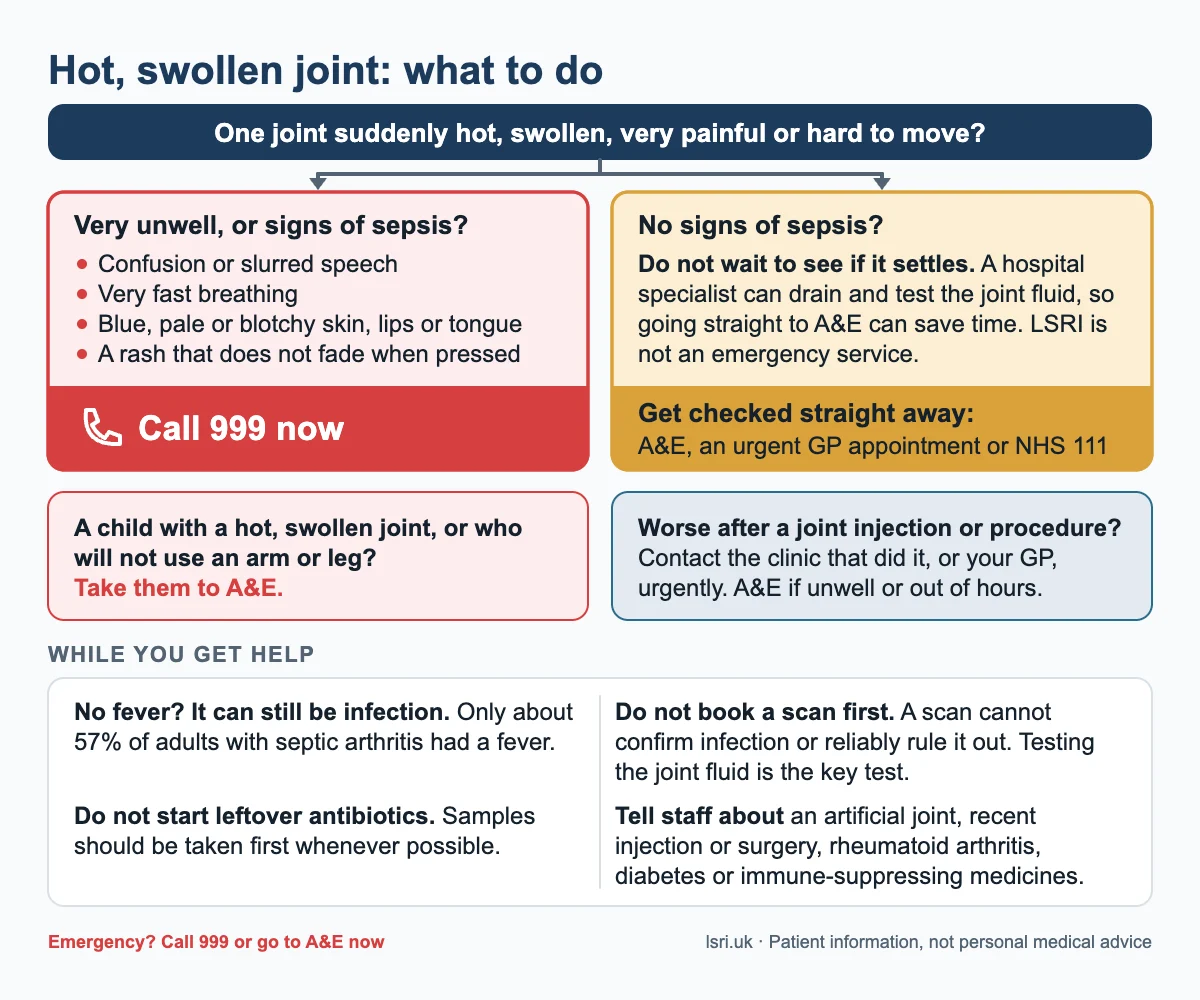
Get checked straight away if you have any of these: go to A&E, get an urgent GP appointment or call NHS 111. Call 999 if you are very unwell.
- A joint that has become hot, swollen and very painful over hours or a few days4,11
- A joint you cannot move, or cannot put weight on, because of the pain11
- A painful, swollen joint with a high temperature, shivering or feeling generally unwell11
- An artificial joint, such as a hip or knee replacement, that becomes painful, hot or swollen4,11
- Increasing pain, heat, redness or swelling in a joint in the days or weeks after an injection or operation on it (or contact the clinic that did it)10,12
- A child with a hot, swollen joint, or who will not use an arm or leg, or holds a joint very still: take them to A&E13
Call 999 straight away if an adult or child aged 5 or over has signs of sepsis: confusion or slurred speech, very fast breathing, blue, pale or blotchy skin, lips or tongue, or a rash that does not fade when pressed14. LSRI is not an emergency service.
What is septic arthritis?
Septic arthritis is an infection inside a joint. It is uncommon, but it can damage a joint within days if it is not treated properly2.
Germs reach the joint through the blood from an infection elsewhere, through an injury, or after surgery or an injection2,11. A nationwide study in Iceland (1990 to 2002) found about 7 cases per 100,000 people a year, rising from 4 to 11 per 100,000 over that time8. The risk is higher in people with weak immune systems or artificial joints2.
Who is at higher risk?
Septic arthritis is more likely when a joint is already damaged, the immune system is weakened, or the joint has recently had a needle or surgery5,11. Risk factors include:
- Older age, especially over 802,5
- Existing joint disease, such as rheumatoid arthritis (where the immune system attacks the joint lining) or osteoarthritis5,6
- An artificial joint5,11
- Diabetes5,11
- A weakened immune system, including from medicines that suppress it6,11
- A skin infection, especially with an artificial joint; this pairing was one of the strongest warning signs in a major review2,5
- Injecting drugs6,11
- Recent joint surgery (within about three months) or a joint injection2,6,8
- Gonorrhoea, a sexually transmitted infection11
Risk factors are not the whole story. In one series, about 22% of people with culture-proven septic arthritis had no known risk factor2.
What are the symptoms of septic arthritis?
The usual pattern is sudden, severe pain in one joint, with swelling, warmth and difficulty moving it or putting weight on it. Symptoms usually develop quickly, over a few days11.
The skin over it may be red, although redness can be harder to see on black or brown skin11. In pooled studies, pain (85%) and swelling (78%) were common, but sweats (27%) and shaking chills (19%) were not5.
Why a normal temperature does not rule it out
Only about 57% of adults with proven septic arthritis had a fever when assessed5. More than 4 in 10 did not. UK guidance says that if suspicion is high, the joint should be treated as infected even without a fever4. Signs can also be subtler in people with weakened immune systems6.
Children and artificial joints
Children get septic arthritis too, and a hot, swollen joint in a child needs the same emergency assessment13. A young child may not use an arm or leg, or may hold the joint in the position that is most comfortable. Tenderness usually increases when the joint is moved13. An infected joint replacement needs urgent assessment by an orthopaedic (bone and joint surgery) team. Sometimes the replacement has to be removed, with a new one fitted once the infection has been treated4,11.
Infection can also affect the spine: see our guide to back pain with fever.
Why is septic arthritis missed or delayed?
Early septic arthritis can look like more common conditions. Quick checks such as temperature, blood tests or an X-ray can be normal or unhelpful early on2,4.
- It mimics other conditions. These include gout and pseudogout (attacks caused by crystals), rheumatoid and reactive arthritis, a fracture, bleeding into the joint and skin infection2,6.
- Gout and infection can coexist. In one study of 600 joint fluid samples containing crystals, about 5% (31 samples) came from joints that were also infected7.
- Most hot big toes are gout. The big-toe joint is the commonest hot joint in general practice and is almost always gout4. That base rate does not apply to a hot knee, hip or shoulder.
- Rheumatoid arthritis can blur the picture. It raises the risk of infection, and the disease itself causes hot, swollen joints2,6. See our guide to rheumatoid arthritis flare-ups.
- Blood tests are not decisive. A raised white cell count in the blood is found in only 42% to 90% of people with septic arthritis2.
- Early X-rays show little. They may show only swelling or fluid; bone changes appear later2,4.
- Even the fluid test can miss it. A negative Gram stain (a quick microscope test for bacteria) or culture does not exclude infection4.
What can delay cost?
Septic arthritis can permanently damage a joint and can be fatal, especially in older people1,3. Prompt diagnosis and treatment reduce the risk of both2,5.
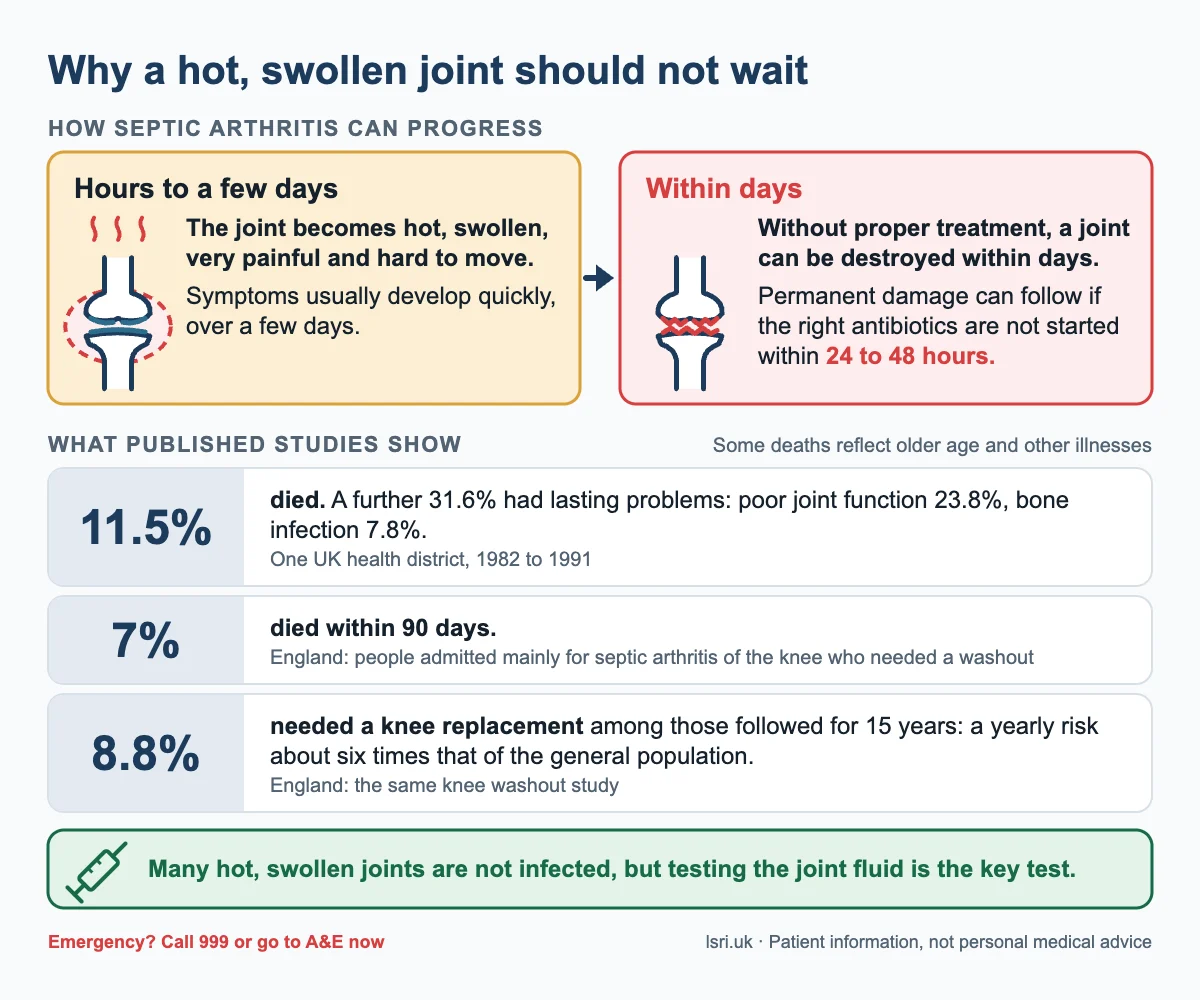
- Joint damage within days. Reviews warn that a joint can be destroyed within days. Permanent damage can follow if the right antibiotics are not started within 24 to 48 hours2,6.
- Lasting problems. In one UK health district (1982 to 1991), 11.5% of people died, and a further 31.6% had lasting problems (poor joint function in 23.8% and bone infection in 7.8%)15. A 2021 review puts poor functional outcomes, such as amputation, joint fusion, joint replacement or severe loss of function, at about 24% to 33%6.
- Risk to life. Twenty years of data from England covered more than 12,000 people who needed a knee washout for septic arthritis. Of those admitted mainly for the infection, 7% died within 90 days, and about 23% of those over 793.
- Long-term joint wear. Among those followed for 15 years, 8.8% needed a knee replacement, a yearly risk about six times that of the general population3.
These numbers need context. Some deaths reflect older age and other illnesses3,6. In one Swiss hospital series of 204 infections (1997 to 2015), 41 people died during follow-up, but only one death was related to sepsis16. That study also found that washing out the joint within 6 hours of arrival gave similar long-term results to washing it out later, in people without clinical sepsis16. Everyone in that study did have drainage and antibiotics, so it does not show that treatment can wait. The urgency is about prompt assessment, sampling and treatment, not necessarily night-time surgery.
How is septic arthritis diagnosed?
It is diagnosed by drawing fluid out of the joint with a needle and testing it. Blood tests and imaging help, but cannot confirm or rule out infection on their own4,6.
Joint aspiration: the key test
Joint aspiration (arthrocentesis) uses a needle to draw fluid from the joint. The fluid is checked under the microscope (Gram stain), grown in the laboratory (culture), examined for crystals, and its white cells are counted4,6. Guidelines ask for this, and for blood cultures, before antibiotics start whenever possible4,17.
A very high white cell count in the fluid makes infection much more likely. A count above 100,000 cells per microlitre was about 28 times as likely in people with septic arthritis as in those without it5. A lower count does not exclude it6.
Blood tests
Blood cultures (tests for bacteria in the blood) should be taken. They are positive in more than a third of people2,4. The white cell count and inflammation markers (CRP and ESR) help track treatment, but are not reliable enough on their own to rule septic arthritis in or out2,4.
What imaging can and cannot show
For suspected septic arthritis without implanted hardware, when the first X-ray is normal or shows only fluid or swelling, the American College of Radiology rates ultrasound, image-guided aspiration, MRI and CT with contrast as usually appropriate next steps18. These ratings guide hospital teams. They do not mean a scan should come before the joint is sampled.
| Test | What it can show | What it cannot do |
|---|---|---|
| X-ray | A baseline picture; may show swelling, fluid, a fracture or calcium crystal deposits4,6 | Cannot diagnose infection; bone damage shows only later2,4 |
| Ultrasound (sound waves, no radiation) | Fluid in the joint; guides the needle into hard-to-reach joints such as the hip6,17 | Cannot show whether fluid is infected; the fluid has to be tested6 |
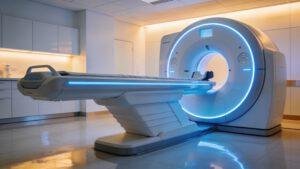
| MRI (magnets and radio waves) | Spread of infection into bone (osteomyelitis) or soft tissue; sensitive for bone infection4,6 | Of low use for the acute diagnosis; it should not delay sampling the joint2,4 |
In children, ultrasound detects joint fluid in about 90% of primary bacterial arthritis (81% across all cases). A normal scan does not completely rule infection out, so a repeat scan or MRI is advised if suspicion remains13.
When a scan is not the answer
If a joint is hot, swollen and very painful, do not arrange a scan yourself. No imaging finding is specific to septic arthritis in adults6; testing the joint fluid is the key step4,6. Booking a scan first can waste hours. A typical big-toe gout attack can usually be diagnosed without a scan4.
How is septic arthritis treated?
Treatment combines antibiotics with draining the infected fluid, usually in hospital4,11.
- Antibiotics are usually given into a vein at first, then as tablets for several weeks. The average hospital stay is about two weeks11. The antibiotic is matched to the germ found, and evidence on the best length of treatment is limited4,17.
- Drainage may be by repeated needle aspiration, keyhole (arthroscopic) washout or open surgery. An infected hip often needs surgery4.
- Recovery includes physiotherapy to restore movement, and finishing the antibiotic course so the infection does not return11.
A steroid injection should not be given into a joint where infection has not been ruled out4.
After an injection or joint procedure
Any needle or operation that enters a joint carries a small risk of infection, so it helps to know the warning signs8,9.
Published studies report a risk of under 1 in 1,000 for joint needle procedures:
| Study | What was counted | Infections |
|---|---|---|
| Iceland, 1990 to 2002 | Arthrocentesis (needle into the joint); procedure numbers were estimated | 0.037%, about 3 per 7,900 procedures, roughly 1 in 2,6008 |
| Denmark, 2006 to 2013 | Steroid injections, infections within 14 days | 11 after 14,118 injections (0.08%), about 1 in 1,3009 |
| USA (one hospital), 2010 to 2020 | Hip, knee and shoulder steroid injections, infections within 6 months | 14 after 15,021 injections (0.093%), about 1 in 1,10010 |
These studies counted different things over different time frames, so the figures cannot be compared exactly. Infection was more likely in older people, men and people with existing joint disease9.
Warning signs do not always appear in the first day or two. In the US study, infections were diagnosed a median of 3.5 weeks after the injection, ranging from 1 to 16 weeks10. Some people get a flare of pain in the first 24 hours after a steroid injection, which usually settles within a couple of days. A joint that becomes more painful and hot, especially if you feel unwell, should be checked straight away12.
Contact the clinic that did your injection or procedure, or your GP, urgently if in the days or weeks afterwards you notice any of these. Go to A&E if you feel unwell or it is out of hours.
- pain that keeps getting worse instead of settling
- the joint becoming hotter, redder or more swollen
- a high temperature, shivering or feeling generally unwell
- being unable to move the joint or put weight on it
After an injection at LSRI, we aim to explain these warning signs before you leave.
What should you do if a joint is hot and swollen?
Get checked straight away. Do not wait to see whether it settles4,11.
- Get checked straight away: A&E, an urgent GP appointment or NHS 111. In the UK, the NHS advises an urgent GP appointment or NHS 111 for these symptoms, and says they need to be checked straight away11. A suspected infected joint usually needs a hospital specialist who can drain and test the joint fluid4, so going straight to A&E can save time. Call 999 if you are very unwell.
- Do not book a scan first. A scan cannot confirm infection, and cannot reliably rule it out2,6.
- Do not start leftover antibiotics. Samples should be taken before antibiotics whenever possible4,17.
- Tell the team your risk factors. These include an artificial joint, recent injection or surgery, rheumatoid arthritis, immune-suppressing medicines and diabetes5,11.
- Take a child with a hot joint, or who will not use a limb, to A&E13.
- After treatment, finish the antibiotics and do the physiotherapy11.
- Call 999 at once for signs of sepsis, such as confusion, very fast breathing or blotchy skin14.
What LSRI can and cannot do
LSRI is a doctor-led musculoskeletal imaging clinic, not an emergency service. A hot, swollen, painful joint needs urgent medical assessment the same day, not a routine clinic appointment.
Why we send you to hospital. We can draw fluid from a joint (aspiration), but a suspected joint infection is better assessed in a hospital emergency department, where the fluid can be tested, blood tests done and treatment started the same day. We do not provide blood tests or emergency care.
What we can help with, when it is not an emergency:
- Joint pain or swelling that has lasted weeks without the warning signs above. Ultrasound scans can show joint fluid and synovitis (inflamed joint lining). MRI scans show cartilage, bone and soft tissues. A Consultant MSK Radiologist reports scans, usually within 24 hours.
- Swelling in several joints, which can be an early sign of inflammatory arthritis. See our guide to the first three months of early inflammatory arthritis.
- A second opinion on existing scans and reports: see our second opinion page.
- Ultrasound-guided injections. We perform ultrasound-guided injections.
Reading this from outside the UK?
The medical information here applies wherever you live, but emergency numbers differ. Call 112 in the EU, 911 in the US and Canada, and 000 in Australia. Wherever you are, a hot, swollen, painful joint needs same-day assessment at your nearest emergency department.
Frequently asked questions
Can you have septic arthritis without a fever?
Yes. In pooled studies, only about 57% of adults with septic arthritis had a fever5. UK guidance advises treating a hot, swollen joint as infected if suspicion is high, even without a fever4.
How quickly can septic arthritis damage a joint?
Reviews warn that a joint can be destroyed within days without proper treatment2. Permanent damage can occur if the right antibiotics are not started within 24 to 48 hours of onset6.
Can a blood test or X-ray rule out septic arthritis?
Not reliably. Blood tests can be normal or only mildly raised, and early X-rays may show nothing more than swelling2,4. Infection is confirmed by drawing fluid from the joint and testing it4,6.
Is it gout or septic arthritis?
It can be hard to tell, and the two can occur together: in one study, about 5% of joints with crystals were also infected7. Testing the joint fluid, including a culture, is how doctors tell them apart4,6.
How common is infection after a steroid injection into a joint?
It is rare: published studies report roughly 4 to 9 infections per 10,000 joint procedures, depending on how cases were counted8,9,10. If pain keeps increasing, or heat, redness, swelling or fever appear, in the days or weeks afterwards, contact the clinic that did the injection or your GP urgently, or go to A&E if you feel unwell or it is out of hours10,12.
References
- Mathews CJ, Weston VC, Jones A, Field M, Coakley G. Bacterial septic arthritis in adults. Lancet 2010;375(9717):846-855. doi:10.1016/S0140-6736(09)61595-6
- Long B, Koyfman A, Gottlieb M. Evaluation and management of septic arthritis and its mimics in the emergency department. West J Emerg Med 2019;20(2):331-341. doi:10.5811/westjem.2018.10.40974
- Abram SGF, Alvand A, Judge A, Beard DJ, Price AJ. Mortality and adverse joint outcomes following septic arthritis of the native knee: a longitudinal cohort study of patients receiving arthroscopic washout. Lancet Infect Dis 2020;20(3):341-349. doi:10.1016/S1473-3099(19)30419-0
- Coakley G, Mathews C, Field M, Jones A, Kingsley G, Walker D, et al. BSR & BHPR, BOA, RCGP and BSAC guidelines for management of the hot swollen joint in adults. Rheumatology (Oxford) 2006;45(8):1039-1041. doi:10.1093/rheumatology/kel163a
- Margaretten ME, Kohlwes J, Moore D, Bent S. Does this adult patient have septic arthritis? JAMA 2007;297(13):1478-1488. doi:10.1001/jama.297.13.1478
- Earwood JS, Walker TR, Sue GJC. Septic arthritis: diagnosis and treatment. Am Fam Physician 2021;104(6):589-597. aafp.org
- Papanicolas LE, Hakendorf P, Gordon DL. Concomitant septic arthritis in crystal monoarthritis. J Rheumatol 2012;39(1):157-160. doi:10.3899/jrheum.110368
- Geirsson AJ, Statkevicius S, Víkingsson A. Septic arthritis in Iceland 1990-2002: increasing incidence due to iatrogenic infections. Ann Rheum Dis 2008;67(5):638-643. doi:10.1136/ard.2007.077131
- Petersen SK, Hansen IMJ, Andreasen RA. Low frequency of septic arthritis after arthrocentesis and intra-articular glucocorticoid injection. Scand J Rheumatol 2019;48(5):393-397. doi:10.1080/03009742.2019.1584329
- Mueller MR, Cleland T, Hileman CO, Olsen A, Wissner R, Monden KR. Septic arthritis following intra-articular corticosteroid injections: a retrospective analysis. Arch Orthop Trauma Surg 2026;146(1):107. doi:10.1007/s00402-026-06262-y
- NHS. Septic arthritis. Last reviewed 3 September 2026. nhs.uk
- Versus Arthritis. What are steroid injections and how are they used? versusarthritis.org
- Woods CR, Bradley JS, Chatterjee A, Kronman MP, Arnold SR, Robinson J, et al. Clinical practice guideline by the Pediatric Infectious Diseases Society (PIDS) and the Infectious Diseases Society of America (IDSA): 2023 guideline on diagnosis and management of acute bacterial arthritis in pediatrics. J Pediatric Infect Dis Soc 2024;13(1):1-59. doi:10.1093/jpids/piad089
- NHS. Sepsis. Last reviewed 14 May 2026. nhs.uk
- Weston VC, Jones AC, Bradbury N, Fawthrop F, Doherty M. Clinical features and outcome of septic arthritis in a single UK Health District 1982-1991. Ann Rheum Dis 1999;58(4):214-219. doi:10.1136/ard.58.4.214
- Lauper N, Davat M, Gjika E, Müller C, Belaieff W, Pittet D, et al. Native septic arthritis is not an immediate surgical emergency. J Infect 2018;77(1):47-53. doi:10.1016/j.jinf.2018.02.015
- Couderc M, Bart G, Coiffier G, Godot S, Seror R, Ziza JM, et al. 2020 French recommendations on the management of septic arthritis in an adult native joint. Joint Bone Spine 2020;87(6):538-547. doi:10.1016/j.jbspin.2020.07.012
- Expert Panel on Musculoskeletal Imaging: Pierce JL, Perry MT, Wessell DE, Lenchik L, Ahlawat S, Baker JC, et al. ACR Appropriateness Criteria Suspected Osteomyelitis, Septic Arthritis, or Soft Tissue Infection (Excluding Spine and Diabetic Foot): 2022 update. J Am Coll Radiol 2022;19(11S):S473-S487. doi:10.1016/j.jacr.2022.09.013
Book an appointment
Call 0203 633 5040 or book online. Clinics at Harley Street (W1G 9QJ) and Harrow (HA2 7SJ). If you have emergency symptoms, go to A&E or call 999 instead.
About this article
Purpose: written by the LSRI clinical team to help the public recognise the warning signs of septic arthritis and why a hot, swollen, painful joint needs urgent assessment the same day, based on the research and guidance listed above. It is general information, not a diagnosis. If you are worried about your own symptoms, speak to your GP or, in an emergency, go to A&E. This article does not describe any individual patient and is not a criticism of any clinician.