Written by: LSRI Editorial Team
Medically reviewed by Dr Prashant Sankaye, Consultant MSK Radiologist ·
Last Updated: October 14, 2026
Read Time: 17 Minutes
Written by the LSRI clinical team and medically reviewed by Dr Prashant Sankaye, Consultant MSK Radiologist, on 9 October 2026.
Back pain is very common, and it usually improves within a few weeks1. Very rarely, it is caused by infection. Infection is estimated to account for about 1 in 10,000 (0.01%) of people with back pain in primary care2. That rarity is part of the problem: back pain is so common that spinal infection is often diagnosed late or missed3.
This article explains spinal infection symptoms and warning signs, why diagnosis is often late, what delay can cost and how the infection is diagnosed. If you have back pain with new leg weakness, numbness, or bladder or bowel changes, stop reading and call 999 or go to A&E now1.
Key points
- Spinal infection is rare: an estimated 0.01% (1 in 10,000) of people with back pain in primary care2.
- Fever is present in only up to 45% of people with bacterial infection of the spinal bones4.
- In one emergency department study of spinal epidural abscess, the “classic” trio of back pain, fever and nerve problems was present at the first visit in only 13%5.
- In that study, 75% had a delayed diagnosis, and lasting weakness was more common after delay (45% compared with 13%)5.
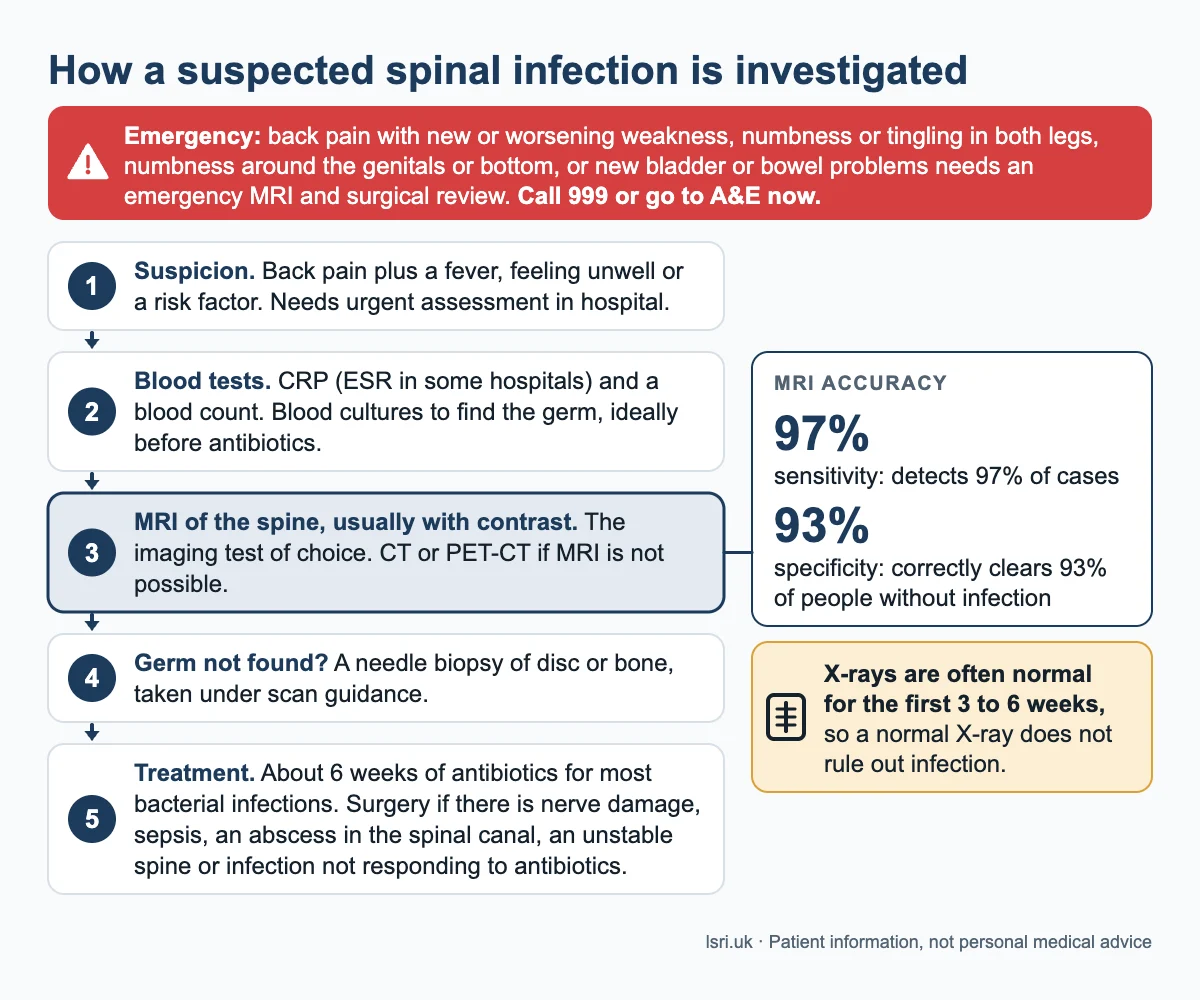
- X-rays are often normal for the first 3 to 6 weeks, because bone damage takes that long to show. MRI is the imaging test of choice4.
- Back pain with a fever or feeling unwell needs same-day medical assessment; with new leg weakness, numbness, or bladder or bowel changes, call 999 or go to A&E1.
What is a spinal infection?
A spinal infection is an infection, usually bacterial, of the spinal bones (vertebrae), the discs between them, or the space around the spinal cord. There are two main types3,6:
- Vertebral osteomyelitis (spondylodiscitis). Osteomyelitis means bone infection; discitis means disc infection. Spondylodiscitis is the broader term, covering infection of the vertebrae, the disc or both. It is the main form of bloodstream-spread bone infection in people over 50. The germ Staphylococcus aureus causes about half of cases not due to tuberculosis3.
- Spinal epidural abscess. This is a collection of pus in the epidural space, the thin layer of fat and blood vessels around the sheath that protects the spinal cord. Pus here can press on the cord or nerves6,7.
The two can occur together8. Infection inside a joint is covered in our guide to septic arthritis.
How common is it, and who is at risk?
In a study of one Danish county, bacterial (pyogenic) spondylodiscitis rose from 2.2 to 5.8 cases per 100,000 people a year between 1995 and 2008, although it is unclear how much of this reflects better testing9. At one US teaching hospital, spinal epidural abscess rose from 2.5 to 8.0 cases per 10,000 admissions between 2005 and 201510.
Reported risk factors include:
- older age: people over 65 are affected up to 3.5 times more often8
- diabetes7,8
- a weakened immune system, for example from long-term steroids or HIV2,4
- injecting drugs4,10
- kidney failure treated with haemodialysis4
- a recent spinal operation, spinal injection or other spinal procedure2,4,6
- a recent infection elsewhere, such as bacteria in the blood (bacteraemia), a heart valve infection (endocarditis) or a boil4,7
- a long-term drip or line into a vein4
- coming from, or living in, a country where TB is common2
In one emergency department study, 98% of people with a spinal epidural abscess had at least one risk factor, compared with 21% of people with ordinary spine pain5. But other studies found no obvious risk factor in a sizeable minority, so having none does not rule infection out6,10.
What are the warning signs?
The main warning sign is back pain with signs of infection, or back pain that behaves unlike ordinary back pain, especially in someone with a risk factor2,4. Watch for back pain plus:
- a fever or chills, or feeling hot, cold, shivery or generally unwell1,4
- pain that is severe, getting worse quickly, or steadily worsening1,2
- pain that does not ease with rest or is worse at night1
- unexplained weight loss or tiredness1,2
- new pain spreading along a nerve, for example down a leg7
- new weakness, numbness or tingling in the legs, numbness around the genitals or bottom, or bladder or bowel problems1
The last group is an emergency. In spinal epidural abscess, symptoms tend to progress from back pain to nerve pain, then to weakness, numbness and loss of bladder or bowel control7. The speed of this is hard to predict6. The same symptoms are also warning signs of cauda equina syndrome. Other serious causes of back pain have their own warning signs: see can back pain be a sign of cancer? and spinal metastases.
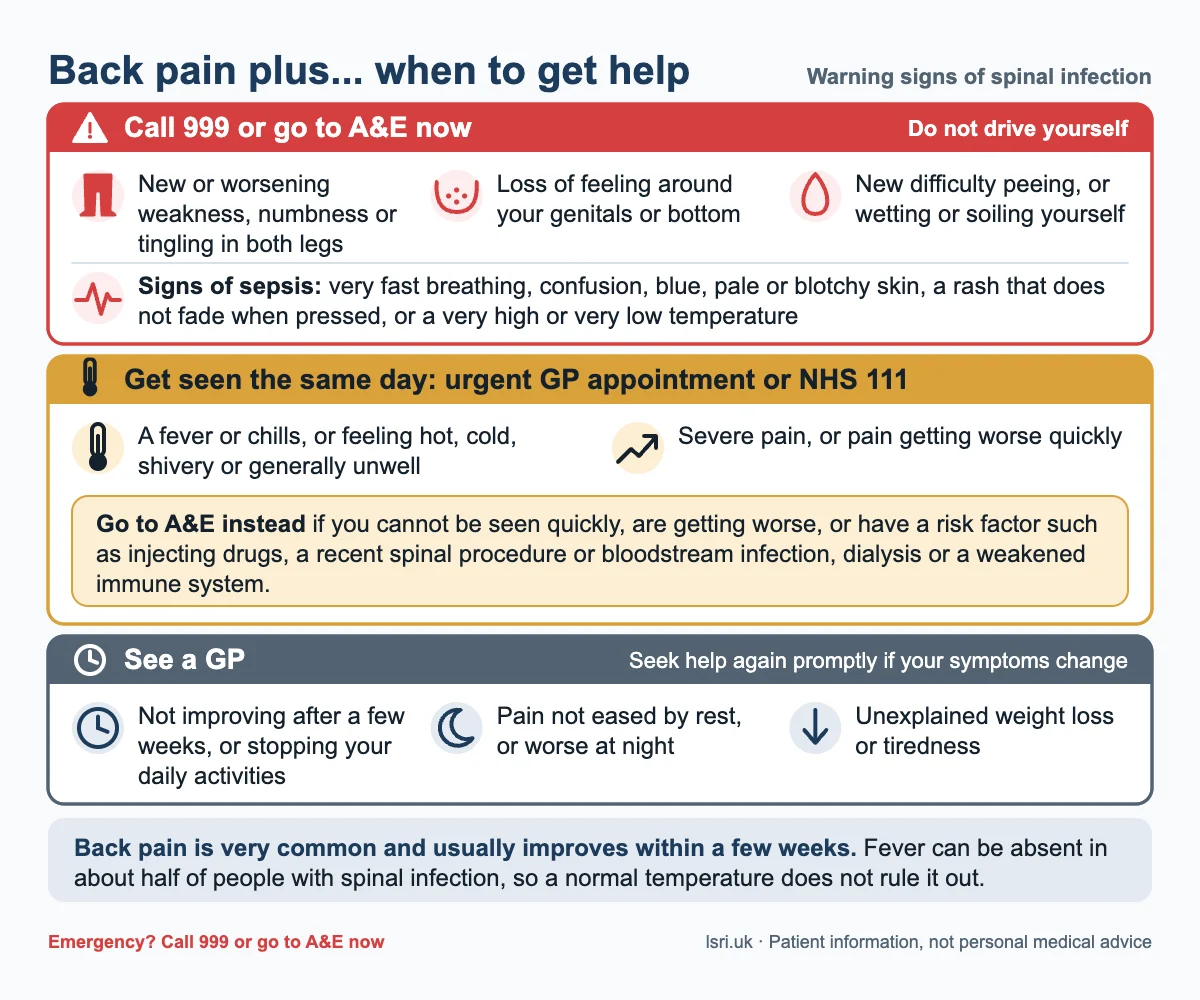
Call 999 or go to A&E now if you have back pain and:
- new or worsening weakness, numbness or tingling in both legs
- loss of feeling around your genitals or bottom (anus), or changes in how your genitals feel during sex
- new difficulty peeing, or wetting or soiling yourself
- signs of sepsis (a serious reaction to infection): very fast breathing, confusion, blue, pale or blotchy skin, a rash that does not fade when pressed, or a very high or very low temperature11
Do not drive yourself1. If you have back pain with a fever or feel hot, cold, shivery or unwell, but none of these signs, get an urgent medical assessment the same day: ask for an urgent GP appointment or contact NHS 1111.
Why is spinal infection often diagnosed late?
Spinal infection is often diagnosed late because it is rare, early symptoms look like ordinary back pain, fever is often absent and early tests can be normal3,4. These are features of the illness itself.
- The textbook picture is the exception. The classic trio of back pain, fever and nerve problems was present in only 13% of people with a spinal epidural abscess at their first visit in one study5. In a series of 162 people, it was present in about a third10.
- Fever is often absent. A clinicians’ red-flags framework warns fever can be absent in about half of people with spinal infection, so its absence should not reassure2.
- Early tests can look normal. Bone damage takes 3 to 6 weeks to show on X-ray4, so a normal X-ray does not rule out infection8. The white blood cell count is normal in up to 40% of people with vertebral osteomyelitis4.
In studies, many people had been seen more than once before the diagnosis was made:
| Study | Condition | What was found |
|---|---|---|
| Davis and colleagues, 2004: 63 emergency department patients | Spinal epidural abscess | 75% had a diagnostic delay (more than one emergency visit, or admission without the diagnosis and over 24 hours to a definitive scan)5 |
| Artenstein and colleagues, 2016: 162 hospital patients | Spinal epidural abscess | 50.6% had a healthcare visit for similar symptoms in the previous 30 days (29.6% in a comparison group without an abscess)10 |
What can a delay cost?
Delay gives the infection time to damage bone, spread and press on the spinal cord or nerves. Nerve damage that is established before treatment may not fully recover5,6.
- Permanent weakness or paralysis. In that small study of 63 people, residual weakness affected 45% of those whose spinal epidural abscess was diagnosed late, compared with 13% of those diagnosed without delay5. Recovery depends on how severe nerve problems are, and how long they have lasted, before surgery. About a third of survivors may have a poor neurological outcome, often due to diagnostic delay6. In the series of 162 people, 12% were left permanently paralysed10.
- Sepsis and risk to life. Infection can lead to sepsis, a serious reaction to infection that can be life-threatening11. Recent studies report death rates of 2% to 20% for spinal epidural abscess6, and up to 20% for spondylodiscitis that is inadequately treated8.
- More treatment and lasting pain. Nerve damage, sepsis or an unstable spine can mean surgery as well as antibiotics4,8, and back pain often persists after treatment8.
A structured approach can help. One US emergency department began checking risk factors, then ESR and CRP blood tests, before deciding on MRI. Diagnostic delays fell from 83.6% to 9.7%, and weakness at diagnosis from 81.8% to 19.4%12. This was a before-and-after comparison of 55 and 31 people, not a randomised trial, so other factors may have contributed. For the wider picture, see why early imaging matters.
How is a spinal infection diagnosed?
Spinal infection is diagnosed with blood tests, blood cultures and an MRI scan of the spine, arranged urgently in hospital, and sometimes a needle biopsy4,13.
- Inflammation blood tests. C-reactive protein (CRP) and erythrocyte sedimentation rate (ESR) rise with inflammation. In people with back pain, a raised ESR or CRP has a reported sensitivity of 94% to 100% (it picks up almost all cases), but many other conditions raise them too4. The French guideline now uses CRP rather than ESR13.
- Blood cultures. Blood is tested to grow the germ, ideally before antibiotics4,13. In studies summarised by one systematic review, the germ was identified in 25% to 59% of the blood cultures taken8.
- MRI of the spine. MRI uses a strong magnet and radio waves, not X-rays. It is the imaging test of choice, usually with gadolinium contrast, a dye injected into a vein that helps show infection and pus4,13,14. The US guideline reports a sensitivity of 97% (it detects 97% of cases) and a specificity of 93% (it correctly clears 93% of people without infection)4. A systematic review reported similar figures of 92% and 96%8.
- CT or PET-CT can be used if MRI is not possible4,13.
- Biopsy. If blood cultures do not find the germ, a needle sample of disc or bone can be taken under scan guidance4,13. In studies summarised by one systematic review, CT-guided fine-needle biopsy found the germ in only 19% to 30% of cases8.
What MRI can and cannot tell you
MRI changes can appear 3 to 5 days after infection starts2. But no test is perfect. Inflamed wear-and-tear changes beside a disc (Modic type 1 changes), tumours and fractures can look similar; contrast-enhanced MRI helps tell them apart, and PET-CT can help separate infection from Modic type 1 changes, although it cannot reliably separate infection from a tumour8. Scan findings can also look worse while someone is getting better, so the US guideline advises against routine repeat MRI when symptoms and blood tests are improving4.
When infection is suspected, MRI is one part of an urgent hospital assessment alongside blood tests and cultures4,13. One review recommends emergency MRI for people with severe back pain and progressing nerve problems, and urgent MRI (within 24 hours) for those with a recent Staphylococcus aureus bloodstream infection or spinal injection or instrumentation6. The scan is therefore best done as part of that urgent hospital assessment, so that blood tests, cultures and treatment can follow without delay.
Scans for back pain without warning signs
Most back pain without warning signs settles with time1, and guidelines do not recommend routine imaging before treatment has been tried. The American College of Radiology rates all imaging as usually not appropriate for low back pain without red flags before treatment has been tried, but rates MRI as usually appropriate when there is suspicion of cancer, infection or a weakened immune system14.
In our experience, a scan can still be useful when pain is not settling or is affecting work and daily life: a clear result, showing no sign of a serious cause, can be reassuring and help people get back to work and normal activity with confidence. Our guide to spine MRI for back pain explains what a scan can and cannot show.
What does treatment involve?
Most spinal infections are treated with several weeks of antibiotics, and some people also need surgery4,8.
- Antibiotics. The US guideline recommends about 6 weeks for most bacterial vertebral osteomyelitis, into a vein or as well-absorbed tablets4. A randomised trial of 359 patients, summarised in a systematic review, found 6 weeks of antibiotics was not inferior to 12, with about 91% cured at one year in each group8.
- Finding the germ first. When someone is stable with normal nerve function, guidelines suggest identifying the germ before starting antibiotics4,13.
- Surgery. This is advised for nerve damage, sepsis, an abscess in the spinal canal, an unstable spine or infection not responding to antibiotics4,8. In one series of spinal epidural abscess, 39.5% were treated with antibiotics alone10.
- Follow-up. Progress is checked through symptoms and CRP, and the French guideline advises follow-up for at least a year4,13.
What should you do?
Match your action to your symptoms. If you have back pain with a fever or any nerve symptoms, do not wait for a routine appointment or book a scan.
- Give ordinary back pain time, but get it checked if it is not improving. See a GP if it has not improved after a few weeks, is stopping your day-to-day activities, or is worrying you1.
- Tell your doctor about any risk factors. Mention recent infections, operations or spinal injections, diabetes, dialysis, immune-suppressing treatment and injecting drug use. This helps doctors decide who needs urgent tests10,12.
- Go back if your symptoms change. If ordinary back pain is joined by a fever, steadily worsening pain, night pain or nerve symptoms, seek help again promptly1.
- Get seen the same day if you have back pain with a fever or feel shivery or unwell. In the UK, ask for an urgent GP appointment or contact NHS 1111. Go to A&E if you cannot be seen quickly or are getting worse. Also go to A&E if you have a risk factor such as injecting drugs, a recent spinal procedure or bloodstream infection, dialysis or a weakened immune system: these groups are most at risk of spinal infection4,6.
- Call 999 or go to A&E if you have back pain and signs of sepsis. These include very fast breathing, confusion, blotchy skin or a very high or very low temperature11.
- Call 999 or go to A&E now if you have back pain with nerve symptoms. These include new or worsening leg weakness or numbness, numbness around the genitals or bottom, or new bladder or bowel problems. Do not drive yourself1,6.
Reading this from outside the UK?
The medical information here applies wherever you live, although causes vary: in some regions TB and Brucella are common causes of spinal infection4. Emergency numbers differ: call 112 in the European Union, 911 in the US and Canada, 000 in Australia, or your local emergency number. NHS 111 is UK-only; elsewhere, contact your doctor or local urgent care service the same day if you have back pain with a fever.
What LSRI can and cannot do
LSRI is a doctor-led outpatient imaging clinic. We are not an emergency service, and we cannot assess or treat a suspected spinal infection, which needs blood tests, blood cultures and hospital care. If you have back pain with a fever, feel unwell, or have any nerve symptoms, please do not book a scan with us: follow the steps above.
Where we can help:
- Back pain that is not improving and has no red flags. We offer MRI scans reported by a Consultant MSK Radiologist, from £375 per body part, including the scan, a specialist report and access to your images, or from £425 with a consultation. Reports are usually ready within 24 hours.
- A second opinion on a spine MRI you already have, for back pain that is not caused by an infection. If you are recovering from a spinal infection, your follow-up is best kept with your hospital team. See our second opinion page.
Our clinics are on Harley Street (W1G 9QJ) and in Harrow (HA2 7SJ). Call 0203 633 5040.
Frequently asked questions
Can back pain be a sign of an infection?
Yes, but rarely: infection accounts for an estimated 0.01% (1 in 10,000) of people with back pain in primary care2. It is more likely with a fever or feeling unwell, steadily worsening pain, a recent infection or spinal procedure, or risk factors such as diabetes, dialysis or injecting drugs1,4.
Can you have a spinal infection without a fever?
Yes. Fever is present in only up to 45% of people with bacterial vertebral osteomyelitis4, and about half of people with spinal infection may have no fever2. Steadily worsening back pain, especially with a risk factor, still needs medical review.
What blood test shows a spinal infection?
No single blood test confirms it. CRP and ESR are raised in most cases but also in many other conditions, and blood cultures can identify the germ4.
Would an X-ray show a spinal infection?
Often not early on. Bone damage takes 3 to 6 weeks to show on X-ray4, so a normal X-ray does not rule infection out8. MRI is the imaging test of choice4,14.
How long does it take to recover from a spinal infection?
Most bacterial spinal bone infections need about 6 weeks of antibiotics4, with follow-up for at least a year13. Nerve recovery after a spinal epidural abscess depends on how severe and long-lasting the damage was before surgery6. Some people have ongoing back pain8.
References
- NHS. Back pain. Page last reviewed 5 March 2026. nhs.uk
- Finucane LM, Downie A, Mercer C, Greenhalgh SM, Boissonnault WG, Pool-Goudzwaard AL, et al. International framework for red flags for potential serious spinal pathologies. J Orthop Sports Phys Ther 2020;50(7):350-372. doi:10.2519/jospt.2020.9971
- Gouliouris T, Aliyu SH, Brown NM. Spondylodiscitis: update on diagnosis and management. J Antimicrob Chemother 2010;65(Suppl 3):iii11-iii24. doi:10.1093/jac/dkq303
- Berbari EF, Kanj SS, Kowalski TJ, Darouiche RO, Widmer AF, Schmitt SK, et al. 2015 Infectious Diseases Society of America (IDSA) clinical practice guidelines for the diagnosis and treatment of native vertebral osteomyelitis in adults. Clin Infect Dis 2015;61(6):e26-e46. doi:10.1093/cid/civ482
- Davis DP, Wold RM, Patel RJ, Tran AJ, Tokhi RN, Chan TC, et al. The clinical presentation and impact of diagnostic delays on emergency department patients with spinal epidural abscess. J Emerg Med 2004;26(3):285-291. doi:10.1016/j.jemermed.2003.11.013
- Bond A, Manian FA. Spinal epidural abscess: a review with special emphasis on earlier diagnosis. Biomed Res Int 2016;2016:1614328. doi:10.1155/2016/1614328
- Reihsaus E, Waldbaur H, Seeling W. Spinal epidural abscess: a meta-analysis of 915 patients. Neurosurg Rev 2000;23(4):175-204. doi:10.1007/PL00011954
- Herren C, Jung N, Pishnamaz M, Breuninger M, Siewe J, Sobottke R. Spondylodiscitis: diagnosis and treatment options. A systematic review. Dtsch Arztebl Int 2017;114(51-52):875-882. doi:10.3238/arztebl.2017.0875
- Kehrer M, Pedersen C, Jensen TG, Lassen AT. Increasing incidence of pyogenic spondylodiscitis: a 14-year population-based study. J Infect 2014;68(4):313-320. doi:10.1016/j.jinf.2013.11.011
- Artenstein AW, Friderici J, Holers A, Lewis D, Fitzgerald J, Visintainer P. Spinal epidural abscess in adults: a 10-year clinical experience at a tertiary care academic medical center. Open Forum Infect Dis 2016;3(4):ofw191. doi:10.1093/ofid/ofw191
- NHS. Sepsis. Page last reviewed 14 May 2026. nhs.uk
- Davis DP, Salazar A, Chan TC, Vilke GM. Prospective evaluation of a clinical decision guideline to diagnose spinal epidural abscess in patients who present to the emergency department with spine pain. J Neurosurg Spine 2011;14(6):765-770. doi:10.3171/2011.1.SPINE1091
- Lacasse M, Derolez S, Bonnet E, Amelot A, Bouyer B, Carlier R, et al. 2022 SPILF – Clinical practice guidelines for the diagnosis and treatment of disco-vertebral infection in adults. Infect Dis Now 2023;53(3):104647. doi:10.1016/j.idnow.2023.01.007
- Hutchins TA, Peckham M, Shah LM, Parsons MS, Agarwal V, Boulter DJ, et al. ACR Appropriateness Criteria Low Back Pain: 2021 update. J Am Coll Radiol 2021;18(11S):S361-S379. doi:10.1016/j.jacr.2021.08.002
Book an appointment
Call 0203 633 5040 or book online. Clinics at Harley Street (W1G 9QJ) and Harrow (HA2 7SJ). If you have emergency symptoms, go to A&E or call 999 instead.
About this article
Purpose: written by the LSRI clinical team to help the public recognise the warning signs of spinal infection, such as back pain with a fever, and why it needs urgent medical assessment, based on the research and guidance listed above. It is general information, not a diagnosis. If you are worried about your own symptoms, speak to your GP or, in an emergency, go to A&E. This article does not describe any individual patient and is not a criticism of any clinician.