Written by: LSRI Editorial Team
Medically reviewed by Dr Prashant Sankaye, Consultant MSK Radiologist ·
Last Updated: October 14, 2026
Read Time: 13 Minutes
Written by the LSRI clinical team and medically reviewed by Dr Prashant Sankaye, Consultant MSK Radiologist, on 5 October 2026.
Back pain is one of the most common reasons people see a GP or physiotherapist, and the great majority of it is not serious. Only about 1 in 200 people with low back pain turn out to have cancer as the cause.1,2 But because back pain is so common, that small fraction still adds up to a lot of people, and for them the speed of diagnosis matters enormously. This anonymised case from our clinic, where nine months of back pain turned out to be cancer that had spread to the sacrum, shows the warning signs to look out for and when a scan should no longer wait. For general advice on spinal imaging, see when you need an MRI for back pain.
Key points
- Most back pain gets much better within weeks. Cancer is the cause in only about 0.5% of people with low back pain.
- The strongest single warning sign is a past history of cancer. Others include constant or worsening pain, pain at night, feeling generally unwell, unexplained weight loss, and pain that is not improving as expected.
- The sacrum, the bone at the base of the spine, is hard to assess on a plain X-ray, and cancer in bone may not show on X-ray until a lot of bone has been lost. MRI shows the bone marrow directly.
- Back pain with numbness around the genitals or bottom, new bladder or bowel problems, or weakness in the legs is an emergency: go to A&E or call 999.
- If your pain is not following the expected course, ask for your diagnosis to be reviewed, and for imaging if the cause is still unclear.
The case: nine months of “mechanical” back pain
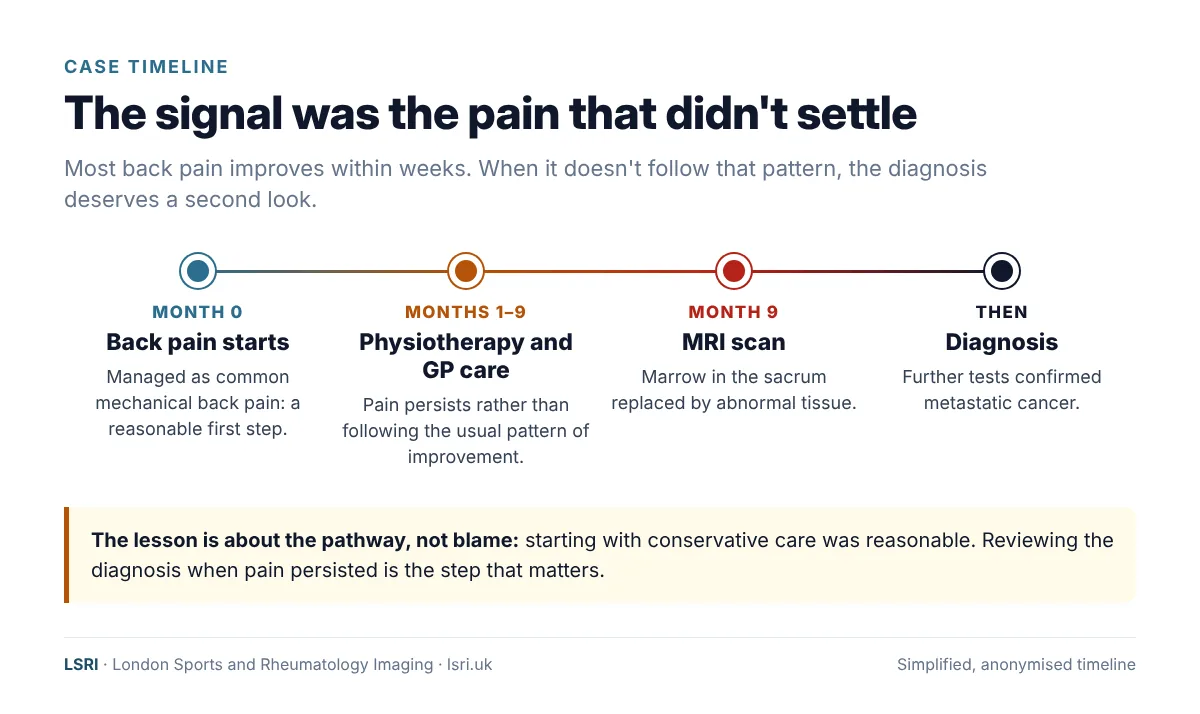
An adult patient developed low back pain. For about nine months it was managed as common mechanical back pain, with physiotherapy and care from their GP. That was a reasonable place to start: it is how most back pain is managed, and most people get better with it.
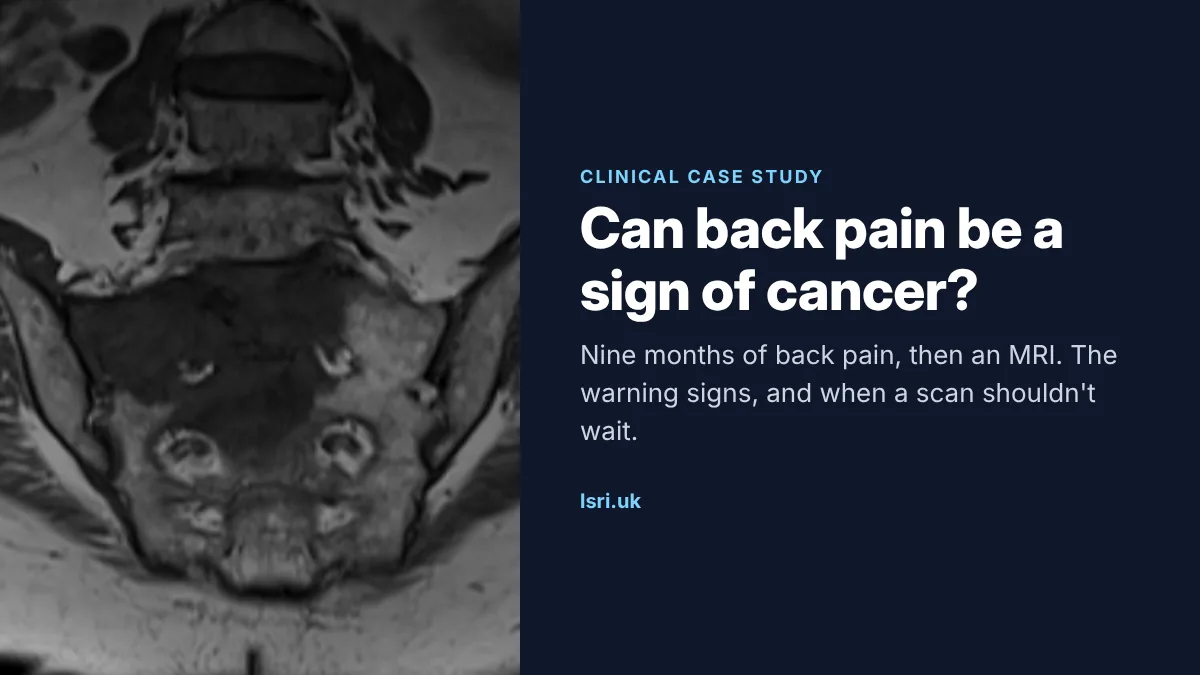
But this pain did not settle in the way ordinary back pain usually does. When the patient had an MRI scan at LSRI, it showed that much of the normal bone marrow in the upper sacrum had been replaced by abnormal tissue. Further tests confirmed metastatic cancer: cancer that had spread to the bone from elsewhere in the body.
This case is not about blame. Back pain is extremely common, cancer is a rare cause of it, and the early symptoms of spinal cancer often look exactly like ordinary back pain. A 2026 review of studies on spinal metastases found that between 40% and 70% of cases were first put down to a harmless cause.3 The lesson is about the pathway: when pain does not follow the expected course, the diagnosis needs to be looked at again.
What the MRI showed
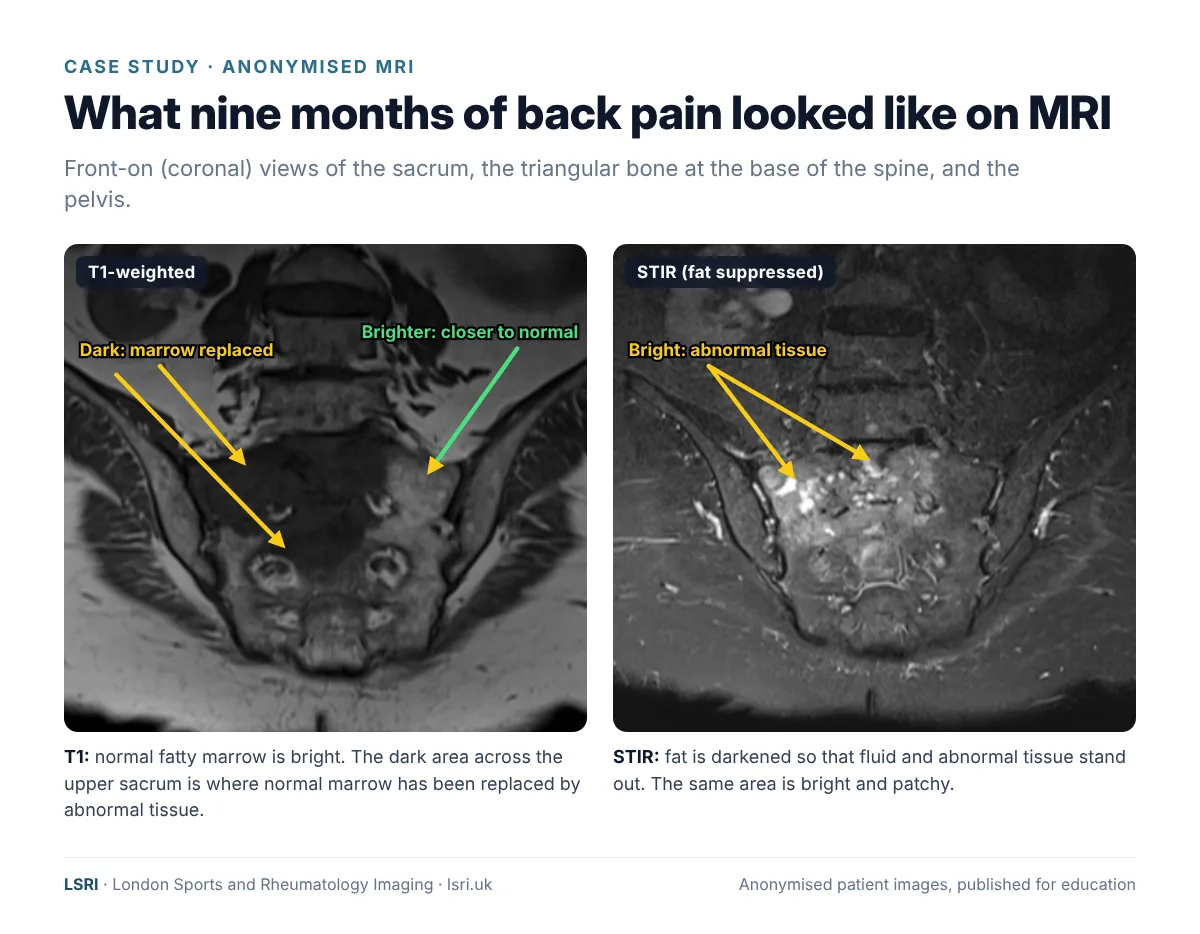
In adults, healthy bone marrow contains a lot of fat, and fat is bright on a T1-weighted MRI. When cancer cells grow in the marrow they push out that fat, so the affected bone turns dark on T1. That is what the left-hand image shows across much of the upper sacrum, while an area on the other side still looks closer to normal.
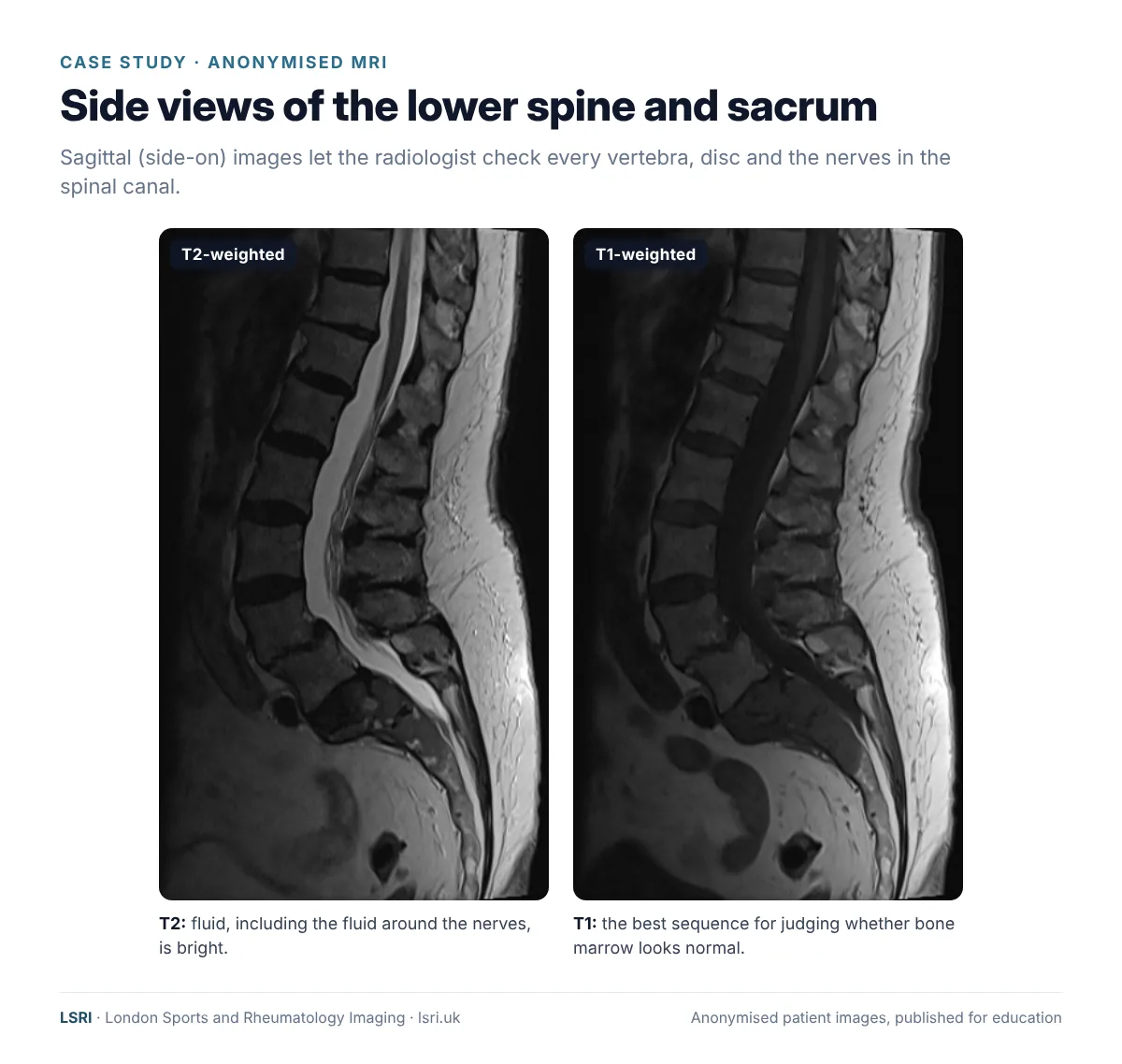
The right-hand image is a STIR sequence, which darkens fat so that water stands out. Tumour tissue and the swelling around it contain more water than healthy marrow, so the same area looks bright and patchy. Reading the two sequences together, with the side views of the spine below, is how a radiologist builds a confident picture of what is going on and how far it extends. MRI is the most accurate widely available test for cancer that has spread to bone: in a large pooled analysis it correctly identified about 91% of patients with bone metastases, and correctly ruled them out in about 95% of patients without.4
Why the sacrum is a hiding place
The sacrum is the large, triangular bone that joins the spine to the pelvis. Problems here are easy to miss for three reasons:
- The symptoms are non-specific. Pain in the low back, buttock or hip, or sciatica-like leg pain, is common to many harmless problems, from sacroiliac joint strain to a disc bulge. Tumours of the sacrum often cause clear-cut symptoms only once they are large enough to press on nerves or pelvic organs.5
- X-rays struggle. The curved shape of the sacrum and the tissues and bowel gas in front of it make it hard to see clearly on a plain X-ray.5 More generally, a destructive bone lesion usually only becomes visible on X-ray once roughly 30–50% of the bone in that area has been lost.6 A normal X-ray does not rule it out.
- Metastases are its most common cancer. Cancer that has spread from elsewhere, for example from the lung, breast, kidney or prostate, is the most common malignant tumour found in the sacrum.5
Warning signs that should prompt a review
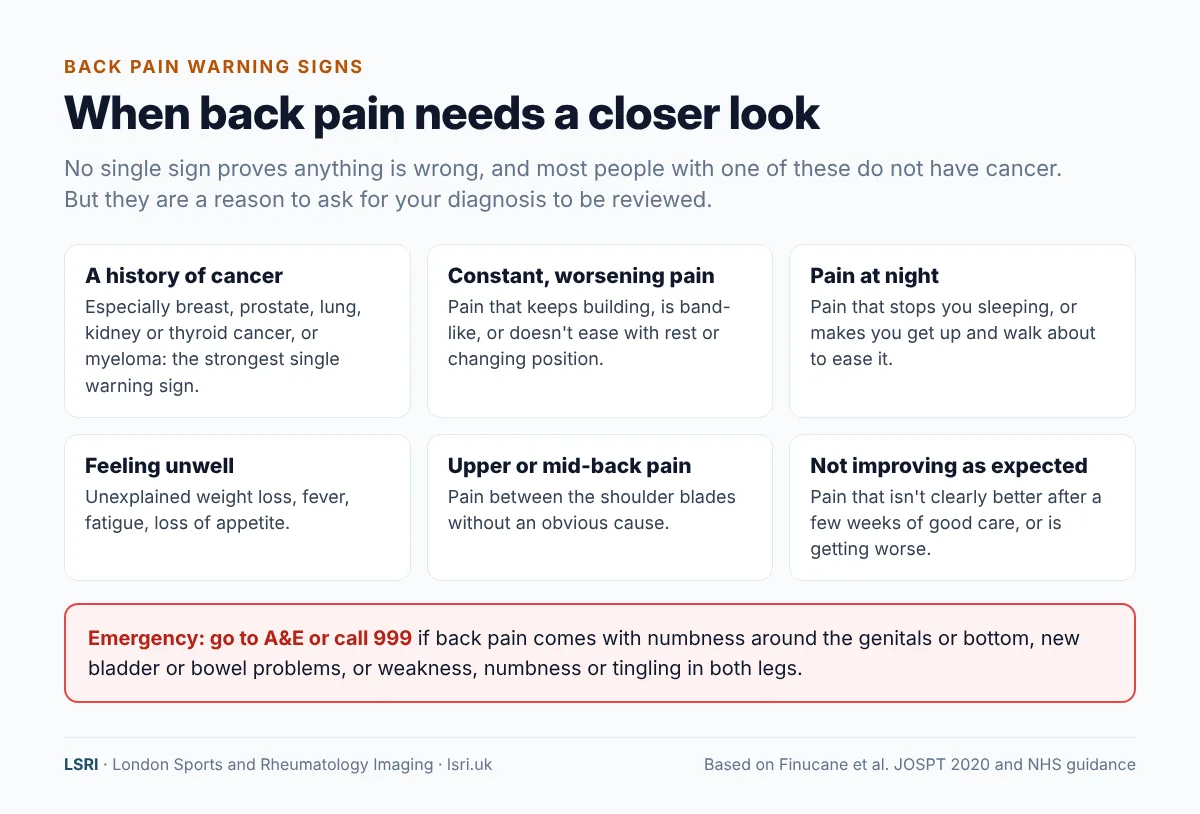
No single symptom proves that back pain is serious, and most people with one of these features do not have cancer. In one study of more than 1,100 people with new back pain in primary care, 80% had at least one so-called red flag, yet none of them turned out to have cancer.7 Red flags are a reason to think again, not a diagnosis. The features an international expert framework links most closely with spinal cancer are:8
- A history of cancer, especially types that tend to spread to bone, such as breast, prostate, lung, kidney and thyroid cancer, and myeloma. This is the single most important warning sign.2
- Pain that is constant, progressive or severe, band-like, or that does not ease with rest or changing position. Being unable to lie flat.
- Night pain that stops you sleeping, or that you have to get up and walk about to ease.
- Feeling generally unwell: tiredness, loss of appetite, nausea or unexplained weight loss.
- An unfamiliar or changing pattern of pain, particularly in the upper or mid-back.
- Nerve symptoms such as weakness, numbness or changes in walking, bladder or bowel function.
“Not getting better” is a warning sign too
Ordinary back pain usually follows a recognisable pattern. In a systematic review of people with recent-onset low back pain, pain and disability fell by more than half within the first month on average, improvement continued for about three months, and then levelled off.9 The NHS advises seeing a GP if back pain has not improved after a few weeks, is worse at night, or comes with weight loss you cannot explain.10
That pattern is useful. In an early study of nearly 2,000 people with back pain, cancer was linked with pain lasting more than a month, failure to improve with conservative treatment, age over 50 and a previous cancer.11 On their own these features are weak signs.2 Together, and especially when pain keeps going for months, they are a clear reason to revisit the diagnosis.
When back pain is an emergency
Go to A&E or call 999 if back pain comes with:
- numbness or tingling around your genitals or bottom;
- new problems peeing, controlling your bladder or bowels;
- weakness, numbness or tingling in both legs, or unsteadiness on your feet;
- chest pain, or pain after a serious accident or fall.
If you have, or have had, cancer and develop new back pain or any of these symptoms, contact your cancer team’s emergency number straight away, even at a weekend.10,12 Do not wait for a routine scan.
Penny wise, pound foolish: the real cost of waiting
For most people with back pain, a scan is not needed and would not change their treatment. Routine scanning of everyone would mostly find age-related changes that are common in people without any pain, and could cause needless worry.
The calculation changes when pain is persistent or has warning features. Then the cost of not knowing grows month by month: repeated appointments, painkillers, time off work and, in the rare serious case, a disease that keeps progressing. Cancer that has spread to the spine can weaken vertebrae until they fracture, and can press on the spinal cord or nerves. Treatment works best when it starts before that happens, which is why an early answer matters far more than the price of a scan. Our guide to spinal metastases explains the evidence on timing.
NHS diagnostic services are under well-documented pressure. In March 2026, 393,913 people in England were waiting for an NHS MRI scan, and 21.6% of them had waited six weeks or more, against a standard of less than 1%.13 The Royal College of Radiologists’ 2025 census reported a 32% shortfall of consultant radiologists.14 GPs and physiotherapists work within these limits every day. If you are worried and facing a long wait, a private scan with specialist reporting is one way to get an answer sooner, alongside, not instead of, your GP’s care.
What to do if you are worried about your back pain
- Check for emergency symptoms first (see the box above). If you have any, go to A&E.
- Tell your GP or physiotherapist if your pain is not improving, is getting worse, keeps you awake, or comes with weight loss or feeling unwell, and mention any past history of cancer, even from many years ago.
- Ask whether the diagnosis should be reviewed and whether imaging would help. A reasonable question is: “My pain isn’t following the usual pattern. Could we look for another cause?”
- If an MRI is needed, make sure the scan answers the right question. When cancer is a concern, guidance recommends imaging the whole spine, not just the painful area, because cancer often affects more than one level.8
- Keep everyone informed. If you have a private scan, share the report with your GP so that any next steps happen quickly.
How LSRI can help
- Advice before you book. Call us to discuss whether a scan is likely to help, and which one. If you have emergency symptoms, we will direct you to A&E.
- Specialist reporting. Your MRI is reported by a consultant musculoskeletal radiologist within 24 hours. If the scan shows something serious, we contact you and your GP so that urgent next steps are not delayed.
- The right protocol. We tailor the scan to your symptoms, including whole-spine imaging when it is needed.
- Clear pricing. MRI from £375 per body part, including the scan, a specialist report and access to your images.
- Time to talk. MRI with a consultation, to go through the results and next steps, is from £425.
See our private MRI scans page, or read our guide on what really decides MRI quality.
Frequently asked questions
Can back pain be the first sign of cancer?
Occasionally, yes. Back pain is usually not caused by cancer, but in some people it is the first symptom. About 1 in 4 people who develop spinal cord compression from cancer did not know they had cancer when it happened.8
What does back pain from cancer feel like?
There is no single type of pain that proves cancer. It is more often constant, gradually worsening, present at night or at rest, and accompanied by feeling unwell or weight loss. But ordinary back pain can share some of these features, which is why the overall pattern, and a history of cancer, matter most.
Would an X-ray show cancer in my back?
Not reliably in its early stages. An X-ray usually only shows bone destruction once a large part of the bone has been lost, and the sacrum is particularly hard to see on X-ray. MRI shows changes in the bone marrow much earlier.
Should everyone with back pain have an MRI?
No. Most back pain improves without a scan, and MRI often shows age-related changes that are common in people with no pain. A scan is most useful when there are warning signs, when pain is not improving as expected, or when the result would change treatment.
Do I need a GP referral for a private MRI?
No GP referral is needed in most cases if you are paying for yourself. If you are claiming through private medical insurance, your insurer may require a referral, so check with them first. We always recommend sharing your results with your GP.
Book an appointment
Call 0203 633 5040 or book online. Clinics at Harley Street (W1G 9QJ) and Harrow (HA2 7SJ). If you have emergency symptoms, go to A&E or call 999 instead.
References
- Reginato LS, Machado GC, Maher CG, et al. Prevalence of serious spinal pathologies and nonspinal conditions in low back pain: a systematic review and meta-analysis. Pain Medicine 2026;27(1):43–52. doi:10.1093/pm/pnaf078
- Downie A, Williams CM, Henschke N, et al. Red flags to screen for malignancy and fracture in patients with low back pain: systematic review. BMJ 2013;347:f7095. doi:10.1136/bmj.f7095
- Wicker K, Tran R, Ablove R. Diagnostic errors in spinal metastases: a systematic review of contributing clinical and systemic factors. European Spine Journal 2026;35(2):732–740. doi:10.1007/s00586-025-09584-4
- Yang HL, Liu T, Wang XM, et al. Diagnosis of bone metastases: a meta-analysis comparing 18FDG PET, CT, MRI and bone scintigraphy. European Radiology 2011;21(12):2604–2617. doi:10.1007/s00330-011-2221-4
- Campos Arenas MR, Sánchez Porro del Río M, Garrido Rull J. Sacral lesions: differential diagnosis for the general radiologist. European Congress of Radiology 2017, poster C-2147. epos.myesr.org
- Beaufort Q, Lefevre V, Carsuzaa T. Imaging of spinal metastases: modality performance, complications, and differential diagnosis. Neurochirurgie 2026;72(3):101804. doi:10.1016/j.neuchi.2026.101804
- Henschke N, Maher CG, Refshauge KM, et al. Prevalence of and screening for serious spinal pathology in patients presenting to primary care settings with acute low back pain. Arthritis & Rheumatism 2009;60(10):3072–3080. doi:10.1002/art.24853
- Finucane LM, Downie A, Mercer C, et al. International framework for red flags for potential serious spinal pathologies. Journal of Orthopaedic & Sports Physical Therapy 2020;50(7):350–372. doi:10.2519/jospt.2020.9971
- Pengel LHM, Herbert RD, Maher CG, et al. Acute low back pain: systematic review of its prognosis. BMJ 2003;327:323. doi:10.1136/bmj.327.7410.323
- NHS. Back pain. nhs.uk
- Deyo RA, Diehl AK. Cancer as a cause of back pain: frequency, clinical presentation, and diagnostic strategies. Journal of General Internal Medicine 1988;3(3):230–238. doi:10.1007/BF02596337
- Macmillan Cancer Support. Metastatic spinal cord compression (MSCC). macmillan.org.uk
- NHS England. Diagnostic Waiting Times and Activity, March 2026. england.nhs.uk
- The Royal College of Radiologists. Clinical radiology census 2025. rcr.ac.uk
About this case study
Patient privacy: the images are anonymised, with no names, dates or other identifying details, and non-essential details of the case have been left out. They are shared for education. Purpose: written by the LSRI clinical team to help the public recognise when back pain needs a closer look, based on the research and guidance listed above. It is general information, not a diagnosis; if you are worried about your own symptoms, speak to your GP or, in an emergency, go to A&E. The case is not a criticism of any clinician: starting with conservative care is usual and appropriate for back pain.