Written by: LSRI Editorial Team
Medically reviewed by Dr Prashant Sankaye, Consultant MSK Radiologist ·
Last Updated: October 14, 2026
Read Time: 17 Minutes
Written by the LSRI clinical team and medically reviewed by Dr Prashant Sankaye, Consultant MSK Radiologist, on 9 October 2026.
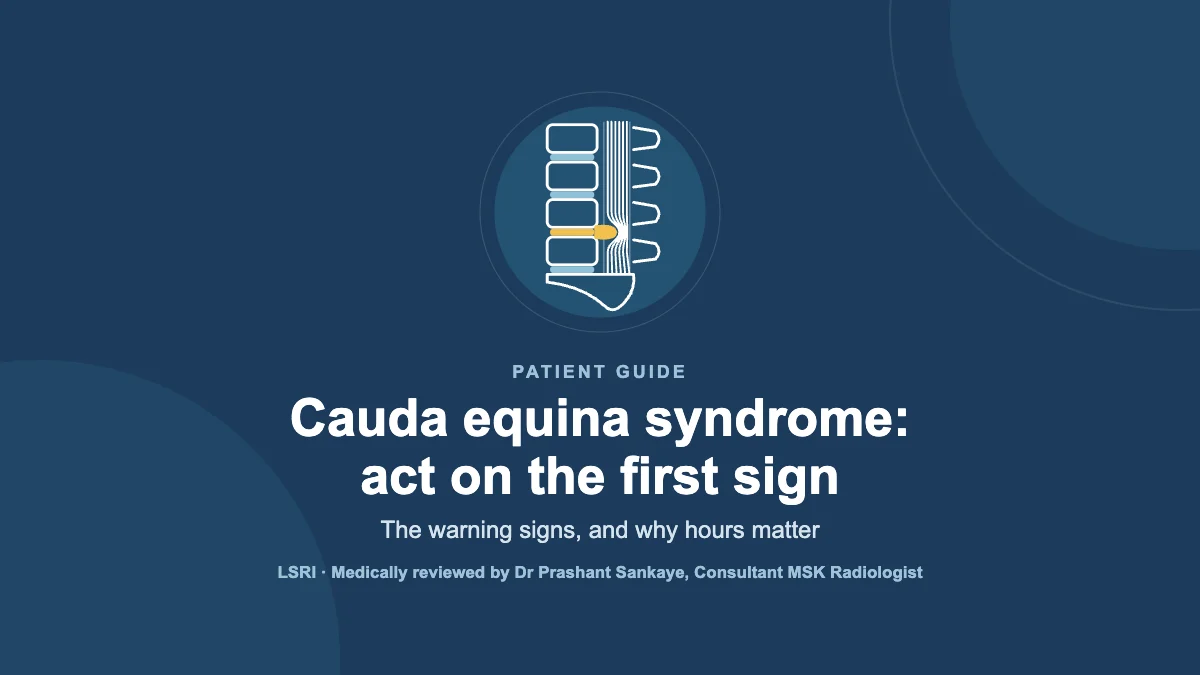
Cauda equina syndrome (CES) happens when the bundle of nerves at the bottom of the spinal canal is badly squeezed, most often by a large slipped disc. It is rare, but it is an emergency. If the pressure is not relieved in time, it may cause permanent loss of bladder and bowel function, loss of sexual function, and paralysis of the legs1.
Most back pain and sciatica is not CES. Back pain usually improves within a few weeks, and sciatica within a few weeks to a few months2,3. This guide explains the few cauda equina syndrome symptoms that change that, and why acting the same day matters. If you have back or leg pain with any of the warning signs below, stop reading and go to A&E or call 999 now3.
Key points
- CES is rare: about 2.7 new cases per 100,000 people a year in Scotland, counting people who needed emergency surgery for CES caused by disc disease4. About 3 in 1,000 people seen in hospital with low back pain had it (pooled from four studies)5.
- Back or leg pain plus new numbness around the genitals or bottom, new bladder, bowel or sexual problems, or sciatica on both sides, or severe or worsening weakness or numbness in both legs: go to A&E or call 999 now3,1.
- Do not wait for incontinence or severe pain: incontinence is a late sign, and the bladder can stop emptying without pain6,1.
- The key test is an emergency MRI arranged by the hospital, within four hours of the request in England1.
- People whose CES is caught before the bladder stops emptying tend to do better7,8. The timing evidence is mostly observational, and fixed deadlines such as “48 hours” are debated9,10,11.
- Lasting effects are common: in a UK study of 621 people, about half of those who replied a year after surgery reported bladder problems11.
What is cauda equina syndrome?
CES is pressure on the nerve roots in the lower spinal canal. It affects bladder, bowel or sexual function and the feeling around the genitals and back passage8,12.
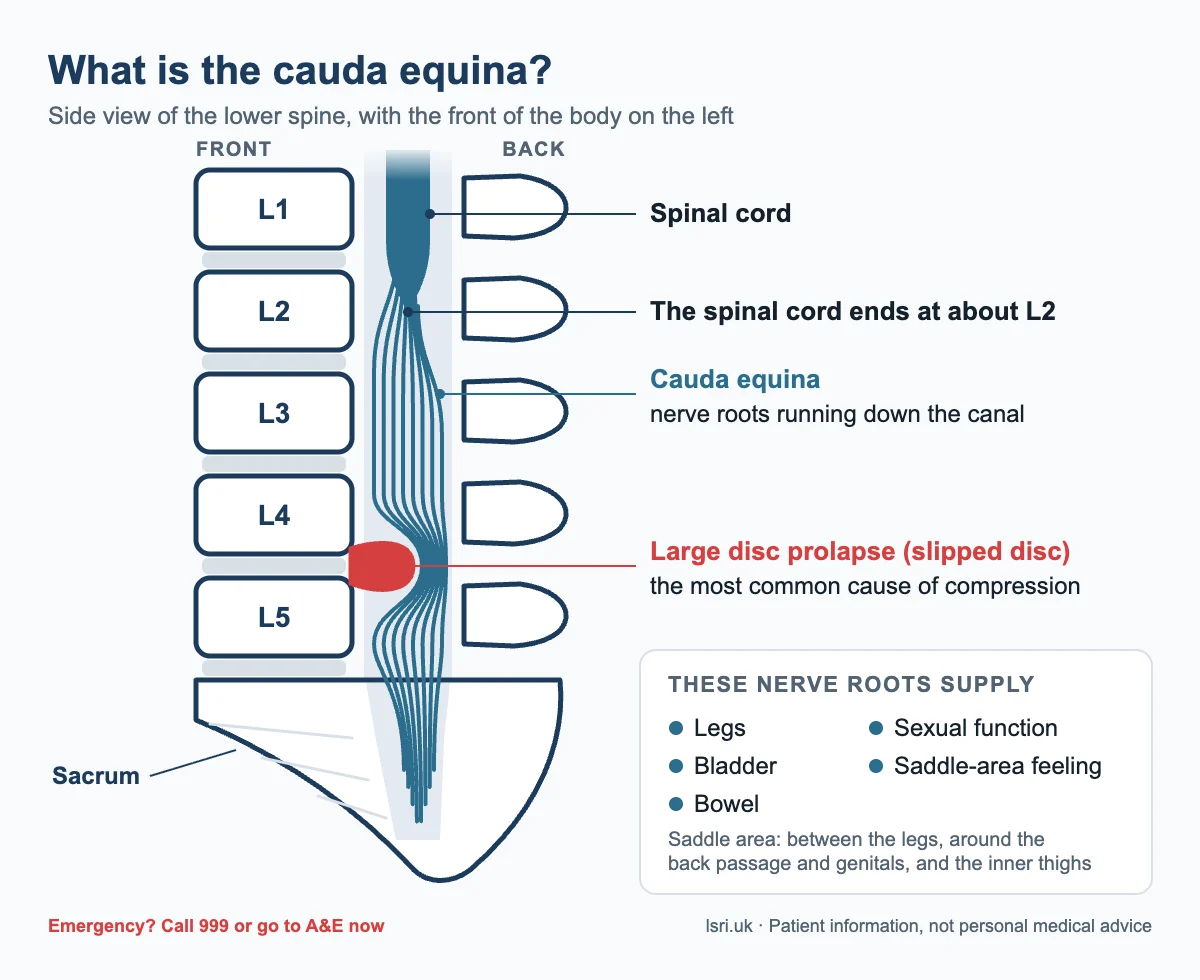
In adults the spinal cord ends at around the second lumbar vertebra (L2), in the upper part of the lower back6. Below that, separate nerve roots carry on down the spinal canal. Together they look like a horse’s tail, which is what cauda equina means in Latin. These roots supply the legs. They also control the bladder, bowel and sexual function, and the feeling in the “saddle” area: between the legs, around the back passage and genitals, and the inner thighs1,12.
The most common cause is a large disc prolapse (slipped disc) pressing back into the canal1,11. Less common causes include tumours, fractures, problems with blood vessels, infection and complications of medical procedures12. We cover two of these separately: cancer that has spread to the spine and back pain with fever and spinal infection.
How rare is CES? Most back pain is not CES
CES is uncommon, and most people with back pain or sciatica will not get it.
Researchers in Scotland identified, across all centres performing spinal surgery, everyone who needed emergency surgery for CES caused by degenerative disc disease in one year. They found 149 cases in 5.4 million people: about 2.7 new cases per 100,000 people per year, at least four times higher than earlier European estimates. CES was more common in women and in people aged 30 to 494. England’s national pathway quotes 1 to 3 per 100,0001.
A systematic review (a study that gathers and weighs all the research on a question) pooled four studies and found CES in about 0.27% of people with low back pain who were seen in hospital5. Across 18 studies of adults who presented as an emergency with suspected CES, 19% (about 1 in 5) had CES confirmed on examination and scan5. The authors judged the evidence limited because studies used different definitions5.
So a normal emergency scan is a common and welcome result, not a wasted trip.
What are the warning signs of cauda equina syndrome?
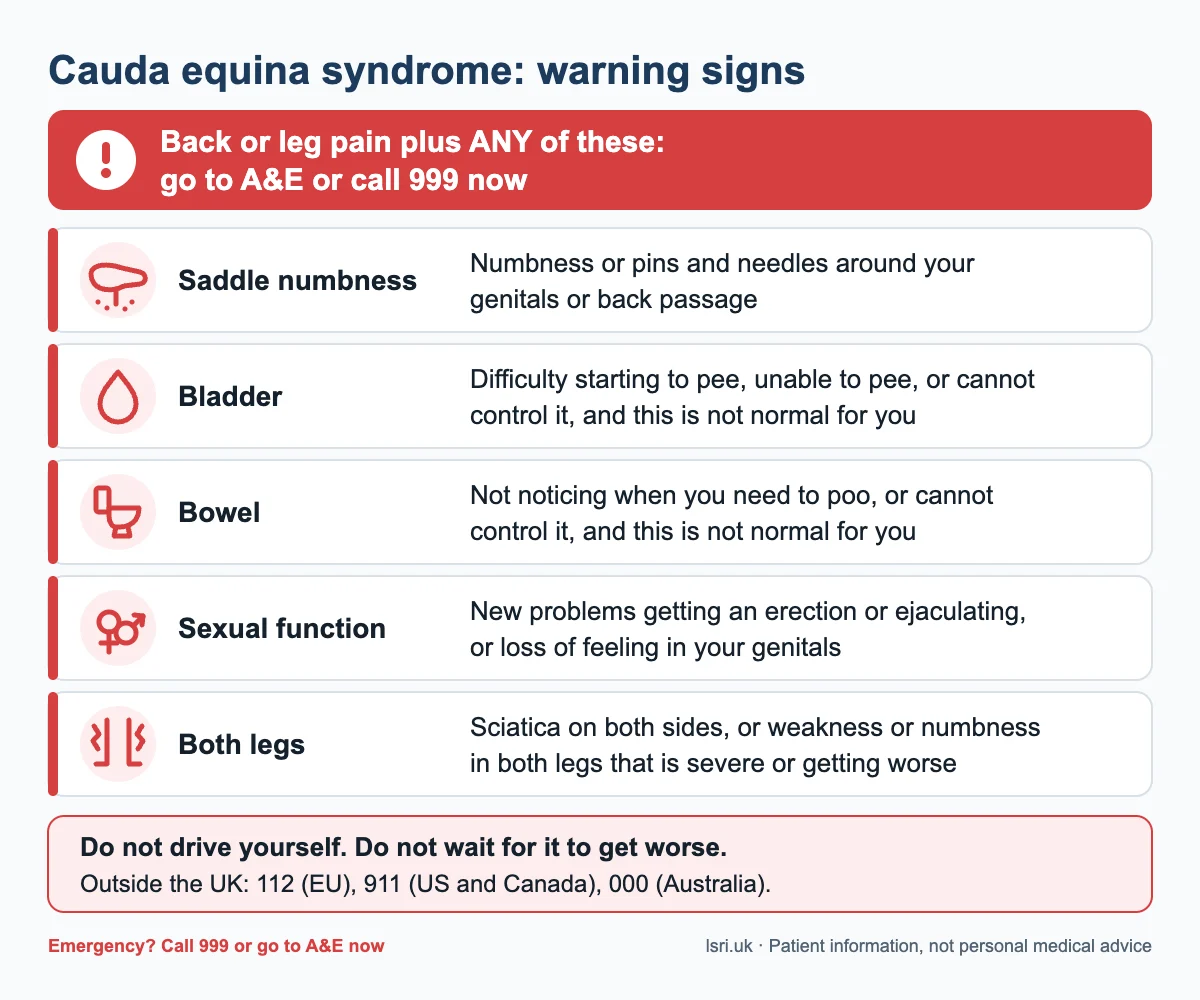
The warning signs are new changes in saddle feeling, bladder, bowel or sexual function, or severe or worsening problems in both legs, in someone with back or leg pain3,1. The key word is new: England’s national pathway focuses on symptoms that have started, or got worse, recently1. If you are unsure how long you have had a sign, treat it as new and get checked. You do not need several signs. The NHS advises going to A&E or calling 999 if you have any one of the signs it lists3.
Go to A&E or call 999 now if you have back or leg pain and:
- numbness or pins and needles around your genitals or back passage (saddle numbness)
- difficulty starting to pee, being unable to pee, or not being able to control when you pee, and this is not normal for you
- not noticing when you need to poo, or not being able to control it, and this is not normal for you
- sciatica on both sides, or weakness or numbness in both legs that is severe or getting worse
- new problems getting an erection or ejaculating, or loss of feeling in your genitals
These signs come from NHS advice and England’s national CES pathway3,1. Do not drive yourself: ask someone to take you, or call 999 for an ambulance3. LSRI is not an emergency service.
Two stages: why the early signs matter
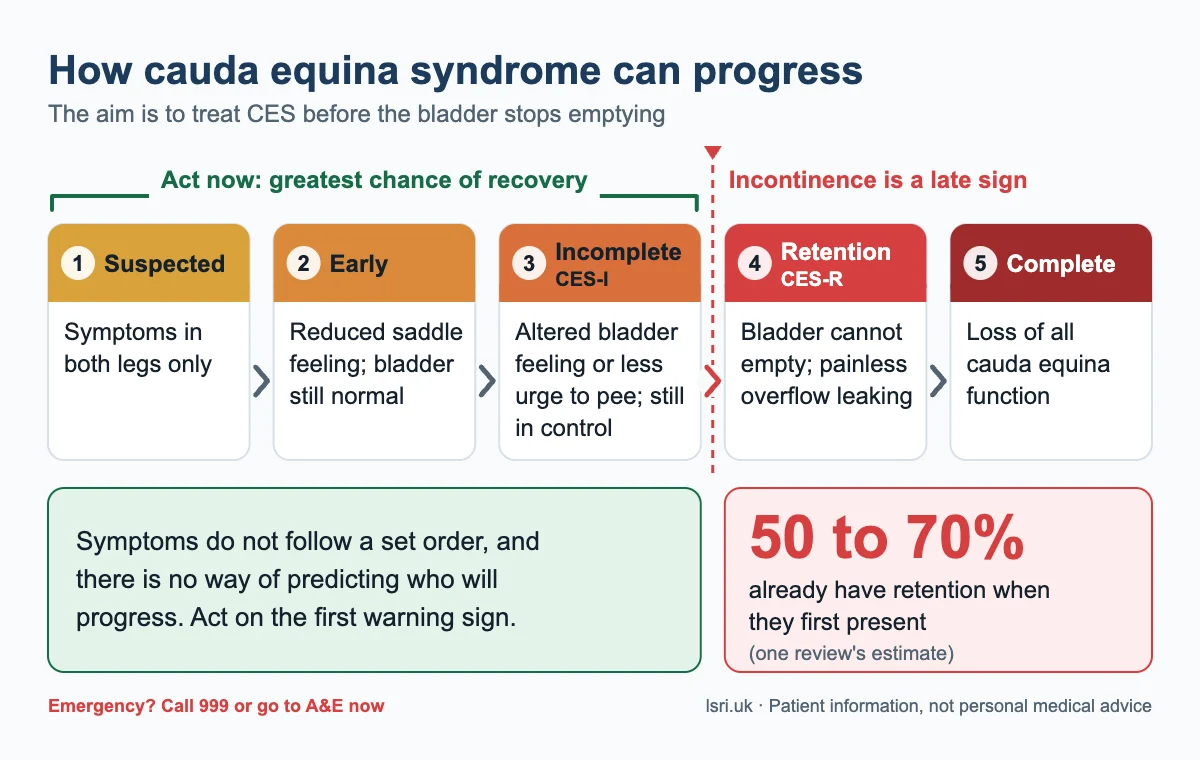
Specialists usually describe two main stages. The aim is to treat CES in the first stage, before the bladder stops emptying7.
- Incomplete CES (CES-I). The nerves are affected but still partly working. People may notice altered feeling when peeing, a weaker urge to go, a poor stream or needing to strain, but they still have control of their bladder and can pass urine, even if it is difficult6.
- CES with retention (CES-R). The bladder is no longer under the person’s control and cannot empty properly. Urine builds up and can leak out (“overflow”), and this is painless6,1.
Stage predicts recovery: people with incomplete CES have a better outlook than those with retention7,8. One review estimated that 50 to 70% already have retention when they first present, and urged every effort to stop CES-I becoming CES-R7. Incontinence is a late sign6. Waiting for it means waiting too long.
Why do hours matter? What the evidence on timing shows
Relieving pressure on the nerves early, before retention develops, is thought to give the greatest chance of recovery7,10. But much of the evidence is observational, so it shows links, not proof10,11, and the exact time limit is debated10.
| Study | Type | Main finding |
|---|---|---|
| Ahn and colleagues, 20009 | Pooled analysis of 42 studies, 322 people | Better recovery of feeling, strength, bladder and bowel with surgery within 48 hours of onset than after 48 hours. No significant extra benefit for under 24 hours versus 24 to 48 hours. |
| DeLong and colleagues, 200813 | Pooled analysis of 16 observational studies of CES-R | Later surgery linked to worse bladder results, statistically significant at the 24- and 72-hour cut-offs. The authors supported early surgery. |
| Chau and colleagues, 201410 | Systematic review, mainly qualitative | “No strong basis” for 48 hours as a blanket safe time to delay surgery. Stage at surgery (incomplete CES or retention) was probably the strongest predictor. |
| Woodfield and colleagues, 202311 | UK study of 621 people, 33 centres | Needing a catheter before surgery predicted needing one at discharge; time to surgery did not. |
| Mustafa and colleagues, 202314 | Systematic review of 110 studies | Only 14.5% used an established CES definition; no agreed start point for timing. |
In the UK study, people who needed a catheter before surgery were operated on sooner, and the authors said they could not comment on whether delay leads to worse outcomes11.
The message for patients is still clear. Speed matters because CES can progress from the incomplete stage to retention7, symptoms do not follow a set order, and there is no way of predicting who will progress15. England’s national pathway asks for MRI within four hours of the request and surgery for incomplete CES as quickly as possible. Even with retention, surgery should follow within 24 hours of the MRI1. Forty-eight hours comes from research, and one review found no strong basis for treating it as a safe time to wait10. For the wider picture, see why early imaging matters.
Why can cauda equina syndrome be missed or diagnosed late?
CES can be hard to recognise early. The first signs are often subtle and vague, and can come on slowly15,8.
- No fixed pattern. No single symptom or combination of symptoms is accurate enough to confirm or rule out CES on its own1, and symptoms do not develop in a set order15.
- Subtle or slow onset. Early symptoms are often vague, and some people develop them gradually15,8.
- Embarrassment. People may not mention bladder, bowel or sexual changes because they feel embarrassed8.
- Pain takes centre stage. A review that reported patient accounts found some people ignored saddle numbness and put more weight on their pain15. Yet retention can be painless1,6.
- Words get in the way. In a patient study described in the same review, people asked about “problems with sexual function” all thought it meant whether they were sexually active15.
- The bladder can look reassuring. In a large UK study of people who all needed surgery for CES, 59% (216 of 368) of those who had a bladder scan had under 200 ml of urine left after peeing11. Bladder scans should not be used on their own to rule CES in or out1.
- Services vary. A national review in England found many patients with suspected CES were not being referred, and wide variation in detection1.
None of this is about blame. It is why clear warning signs and a fast route to MRI matter.
How is cauda equina syndrome diagnosed?
CES is diagnosed by combining a doctor’s assessment with an emergency MRI scan of the lower spine, both arranged by the hospital1.
The doctor will ask about your symptoms, including bladder, bowel and sexual changes, and check the power and feeling in your legs and the feeling around your back passage1. MRI (magnetic resonance imaging) uses a strong magnet and radio waves to make detailed pictures of the discs and nerve roots. It is the imaging test of choice for CES8. In England, the national pathway says MRI should be done at the hospital where the patient arrives, in or out of hours, and within four hours of the request1.
A scan alone does not make the diagnosis: doctors put symptoms, examination and scan together1. Most people scanned for suspected CES do not have it5.
Why not book a scan yourself? If you have warning signs, a booked outpatient scan is the wrong route. The national pathway sends people with CES symptoms straight to the nearest hospital with emergency MRI1. Go to A&E or call 999.
When you do not need an emergency scan
Back pain or sciatica without warning signs is not an emergency and usually improves with time2,3. Scans also have limits: they often show age-related changes in people with no pain. In a review of CT and MRI studies of people without back pain, disc bulges were seen in 30% of 20-year-olds and 84% of 80-year-olds16. Our guides to spine MRI for back pain and whether back pain can be a sign of cancer explain when a planned scan helps.
What is the treatment for cauda equina syndrome?
Confirmed CES is usually treated with emergency surgery to take the pressure off the nerves, called decompression1.
When a disc is the cause, the surgeon removes the disc material pressing on the nerves, which can be harder than routine disc surgery17. Complication rates are higher than in decompression surgery for other reasons1, and one review recommends prompt surgery by a suitably experienced surgeon for incomplete CES7.
Many people improve, but lasting effects are common. One year after surgery, the UK study of 621 people found11:
| One year after surgery for CES | Proportion |
|---|---|
| Reported abnormal bladder function | 50% (122 of 245) |
| Still using a catheter | 14% (34 of 248) |
| Reported abnormal bowel function | 43% (104 of 241) |
| Sexual dysfunction on a standard questionnaire | 51% (127 of 250) |
| Leg weakness recorded by clinicians | 66% (188 of 284) |
Not everyone gave one-year information (284 people returned questionnaires), so these figures describe those who did11.
There was real improvement too. Average disability scores (Oswestry Disability Index, 0 to 100) fell from 63 on admission to 31 at one year, and function improved even in people who presented with retention11. The national pathway estimates that around 70% of people with painless retention benefit from decompression, although they have a poorer outlook than people treated earlier1.
The national pathway recommends pointing people to support groups1, so ask your hospital team about the support available to you.
What should you do?
- Act on the first warning sign, the same day. Go to A&E or call 9993. Do not wait to see if it settles, for the pain to get worse, or for incontinence, which is a late sign6.
- Do not drive yourself. Ask someone to take you, or call 999 and ask for an ambulance3.
- Do not try to book a scan first. The hospital arranges the emergency MRI and, if needed, surgery1.
- Say exactly what has changed, and when. Use plain words, such as “Since yesterday I have numbness around my bottom and genitals.” Mention numbness or bladder changes even if pain bothers you most, and say when each symptom started15.
- If your scan is clear, keep watching. Ask what to look out for, and go back straight away if new symptoms appear. The national pathway stresses safety-netting advice (what to watch for and when to return) for people with back pain and other symptoms, and says new or worsening CES symptoms need an emergency referral1.
- For back pain without warning signs, get the right level of help. See a GP if it has not improved after a few weeks3. Ask for an urgent GP appointment or contact NHS 111 if you feel hot, cold, shivery or generally unwell, or if severe pain starts suddenly or gets worse quickly2.
What LSRI can and cannot do
LSRI is not an emergency service. We cannot arrange emergency MRI or emergency surgery. If you have any warning sign of CES, go to A&E or call 999 rather than contacting us.
We can help with problems that are not urgent:
- Back pain or sciatica that is not improving. Our MRI scans are reported by a Consultant MSK Radiologist within 24 hours. MRI is from £375 per body part, including the scan, a specialist report and access to your images, or from £425 with a consultation.
- A second opinion on an MRI you already have. See our second opinion page.
If warning signs appear while you are waiting for a routine scan with us, go to A&E or call 999.
Reading this from outside the UK?
The warning signs and the need for same-day hospital care are the same everywhere; only the number changes. Call 112 in the EU, 911 in the US and Canada, 000 in Australia, or your local emergency number, or go to the nearest hospital emergency department. In the UK, 999 and 112 both work.
Frequently asked questions
What does saddle numbness feel like?
It is reduced feeling, numbness or pins and needles where a saddle would touch: between your legs and around your back passage and genitals1,3,12. If it is new and you have back or leg pain, go to A&E or call 9993.
Is sciatica in both legs an emergency?
The NHS advises going to A&E or calling 999 for sciatica on both sides, or for severe or worsening weakness or numbness in both legs3. Most people checked for suspected CES do not have it5, but symptoms in both legs can be an early stage6.
Is 48 hours the deadline for cauda equina surgery?
No single deadline has been established. A 2000 meta-analysis favoured surgery within 48 hours9, but a later review found no strong basis for treating 48 hours as a safe time to wait10. The advice is to act on the first warning sign3,7.
Will I fully recover after surgery for cauda equina syndrome?
Many people improve, but lasting effects are common: in a UK study, half of those who replied reported bladder problems one year after surgery11. People who are at the incomplete stage generally do better than those with retention7,8.
Should I book a private MRI if I am worried about cauda equina syndrome?
Not if you have warning signs: go to A&E or call 999. Hospitals in England are expected to scan within four hours of the request and to treat confirmed CES as an emergency1.
References
- Getting It Right First Time (GIRFT), NHS England. Spinal Surgery: National Suspected Cauda Equina Syndrome (CES) Pathway. February 2023, updated March 2026. gettingitrightfirsttime.co.uk
- NHS. Back pain. Page last reviewed 5 March 2026. nhs.uk
- NHS. Sciatica. Page last reviewed 3 December 2024. nhs.uk
- Woodfield J, Lammy S, Jamjoom AAB, Fadelalla MAG, Copley PC, Arora M, et al. Demographics of cauda equina syndrome: a population-based incidence study. Neuroepidemiology 2022;56(6):460-468. doi:10.1159/000527727
- Hoeritzauer I, Wood M, Copley PC, Demetriades AK, Woodfield J. What is the incidence of cauda equina syndrome? A systematic review. J Neurosurg Spine 2020;32(6):832-841. doi:10.3171/2019.12.SPINE19839
- Lavy C, Marks P, Dangas K, Todd N. Cauda equina syndrome: a practical guide to definition and classification. Int Orthop 2022;46(2):165-169. doi:10.1007/s00264-021-05273-1
- Gardner A, Gardner E, Morley T. Cauda equina syndrome: a review of the current clinical and medico-legal position. Eur Spine J 2011;20(5):690-697. doi:10.1007/s00586-010-1668-3
- Lavy C, James A, Wilson-MacDonald J, Fairbank J. Cauda equina syndrome. BMJ 2009;338:b936. doi:10.1136/bmj.b936
- Ahn UM, Ahn NU, Buchowski JM, Garrett ES, Sieber AN, Kostuik JP. Cauda equina syndrome secondary to lumbar disc herniation: a meta-analysis of surgical outcomes. Spine 2000;25(12):1515-1522. doi:10.1097/00007632-200006150-00010
- Chau AMT, Xu LL, Pelzer NR, Gragnaniello C. Timing of surgical intervention in cauda equina syndrome: a systematic critical review. World Neurosurg 2014;81(3-4):640-650. doi:10.1016/j.wneu.2013.11.007
- Woodfield J, Hoeritzauer I, Jamjoom AAB, Jung J, Lammy S, Pronin S, et al. Presentation, management, and outcomes of cauda equina syndrome up to one year after surgery, using clinician and participant reporting: a multi-centre prospective cohort study. Lancet Reg Health Eur 2023;24:100545. doi:10.1016/j.lanepe.2022.100545
- Spinal Injuries Association. Cauda equina syndrome. spinal.co.uk (accessed 8 October 2026)
- DeLong WB, Polissar N, Neradilek B. Timing of surgery in cauda equina syndrome with urinary retention: meta-analysis of observational studies. J Neurosurg Spine 2008;8(4):305-320. doi:10.3171/SPI/2008/8/4/305
- Mustafa MA, Richardson GE, Gillespie CS, Islim AI, Wilby M, Clark S, et al. Definition and surgical timing in cauda equina syndrome: an updated systematic review. PLoS One 2023;18(5):e0285006. doi:10.1371/journal.pone.0285006
- Greenhalgh S, Finucane L, Mercer C, Selfe J. Assessment and management of cauda equina syndrome. Musculoskelet Sci Pract 2018;37:69-74. doi:10.1016/j.msksp.2018.06.002
- Brinjikji W, Luetmer PH, Comstock B, Bresnahan BW, Chen LE, Deyo RA, et al. Systematic literature review of imaging features of spinal degeneration in asymptomatic populations. AJNR Am J Neuroradiol 2015;36(4):811-816. doi:10.3174/ajnr.A4173
- Gleave JRW, Macfarlane R. Cauda equina syndrome: what is the relationship between timing of surgery and outcome? Br J Neurosurg 2002;16(4):325-328. doi:10.1080/0268869021000032887
Book an appointment
Call 0203 633 5040 or book online. Clinics at Harley Street (W1G 9QJ) and Harrow (HA2 7SJ). If you have emergency symptoms, go to A&E or call 999 instead.
About this article
Purpose: written by the LSRI clinical team to help the public recognise the warning signs of cauda equina syndrome and why it needs emergency care, based on the research and guidance listed above. It is general information, not a diagnosis. If you are worried about your own symptoms, speak to your GP or, in an emergency, go to A&E. This article does not describe any individual patient and is not a criticism of any clinician.