Written by: LSRI Editorial Team
Medically reviewed by Dr Prashant Sankaye, Consultant MSK Radiologist ·
Last Updated: October 14, 2026
Read Time: 12 Minutes
Written by the LSRI clinical team and medically reviewed by Dr Prashant Sankaye, Consultant MSK Radiologist, on 5 October 2026.
Spinal metastases are cancers that have spread to the bones of the spine from somewhere else in the body. Their first symptom is usually back or neck pain, which is why they are so easily mistaken for ordinary back pain. In this anonymised case from our clinic, ongoing back pain was being treated as routine mechanical back pain; an MRI of the whole spine then showed abnormal marrow in many vertebrae. This guide explains the symptoms of spinal metastases, the emergency warning signs everyone should know, why a normal X-ray is not reassuring, and why an early MRI can protect a person’s ability to walk. If your pain started recently, read our case study on whether back pain can be a sign of cancer first.
Key points
- The spine is the most common place in the skeleton for cancer to spread to. Breast, prostate, lung, kidney and thyroid cancers, and myeloma, are the most common sources.
- The usual first symptom is pain, often constant, worsening, present at night, or felt in the mid-back. About 1 in 4 people who develop spinal cord compression from cancer did not know they had cancer.
- Plain X-rays can look normal until a large amount of bone has been lost. MRI shows the bone marrow, the spinal cord and the nerves, and the whole spine should be scanned.
- Leg weakness, numbness, unsteadiness, or new bladder or bowel problems with back pain need emergency assessment: go to A&E or call 999.
- Being able to walk at the time of treatment is one of the strongest predictors of being able to walk afterwards, so earlier diagnosis matters.
The case: ongoing back pain treated as routine
An adult patient had ongoing back pain that was being managed in the same way as ordinary mechanical back pain. As the pain continued, an MRI scan was arranged. Instead of the even, healthy marrow signal expected in the vertebrae, the scan showed patchy, abnormal marrow at many levels of the thoracic (mid-back) and lumbar (low back) spine and in the sacrum. The appearances were those of widespread metastatic disease, which needs urgent specialist assessment.
Multiple metastases develop over time. Pain that persists, particularly with any of the warning features below, is the moment to look for another explanation. As in our other case studies, this is not about blame: early spinal metastases genuinely look like common back pain, and in the studies reviewed in 2026, between 40% and 70% of cases were at first put down to a harmless cause.1
What the MRI showed
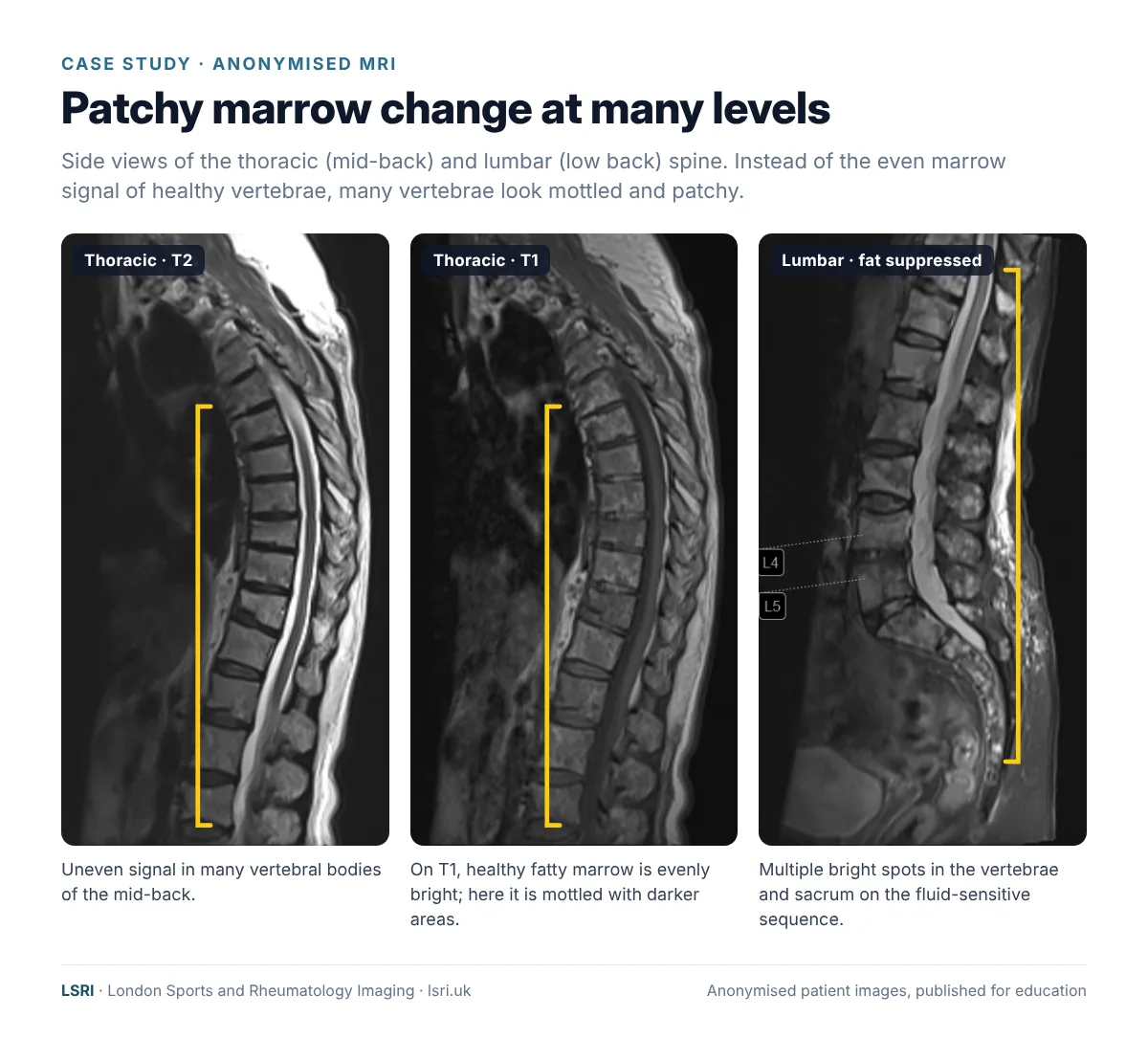
Healthy adult vertebrae have a fairly even marrow signal. On the T1-weighted images, normal fatty marrow is bright and evenly textured; here it is mottled, with darker areas where marrow has been replaced. On the fat-suppressed lumbar image, which makes water bright, there are multiple bright spots in the vertebrae and sacrum. Seen across so many levels, this pattern is very different from the localised changes of a worn disc or joint.
Notice that the scan covered the thoracic and the lumbar spine. Spinal metastases are often found at several levels, and in a UK study of patients with suspected spinal cord compression from cancer, 39% of those found to have compression had it at more than one level.2 That is why international guidance recommends MRI of the whole spine when spinal metastases are suspected, rather than only the painful area.3
What are spinal metastases?
When cancer spreads (metastasises), bone is one of the most common places it settles, and the spine is the most common site in the skeleton.4 The cancers that most often spread to bone are prostate, breast, lung, kidney and thyroid cancer; myeloma, a cancer of the bone marrow itself, also commonly affects the spine.5 About 70% of spinal metastases are in the thoracic spine, 20% in the lumbar spine and 10% in the neck.3
How often it happens depends on how you count. In autopsy studies of people with advanced cancer, spinal metastases are found in a large proportion of patients, with figures as high as 60–70% quoted.4 Far fewer cause symptoms. Around 3 to 5 in every 100 people with advanced cancer develop spinal cord compression.6
Symptoms of spinal metastases
Pain is the most common first symptom. In a Scottish study of 319 people with spinal cord compression from cancer, 94% had pain, and it was severe in most.7 Features that make cancer more likely include:3
- pain that is constant, progressive or severe, or band-like around the chest or abdomen;
- pain at night that stops you sleeping, or being unable to lie flat;
- pain in the thoracic (mid or upper) back;
- pain that is worse when coughing, sneezing or straining;6
- an unfamiliar or worsening pattern of pain;
- feeling generally unwell, tired, off your food or losing weight without trying;
- a current or past history of cancer, which is the strongest single warning sign.8
Nerve symptoms usually come later and are a sign that the cord or nerves are under pressure: weakness or heaviness in the legs, numbness or pins and needles, unsteadiness, and changes in bladder or bowel control.
Why spinal metastases are often missed
- The pain looks ordinary. Back pain is extremely common, and most of it is harmless. Individual warning signs are also common in people without cancer, so none is decisive on its own.8
- Not everyone knows they have cancer. In about a quarter of people with spinal cord compression from cancer, there is no known cancer diagnosis at the time.3
- X-rays can look normal. A destructive lesion usually only becomes visible on a plain X-ray once roughly 30–50% of the bone in that area has been lost.9 MRI shows marrow replacement much earlier.
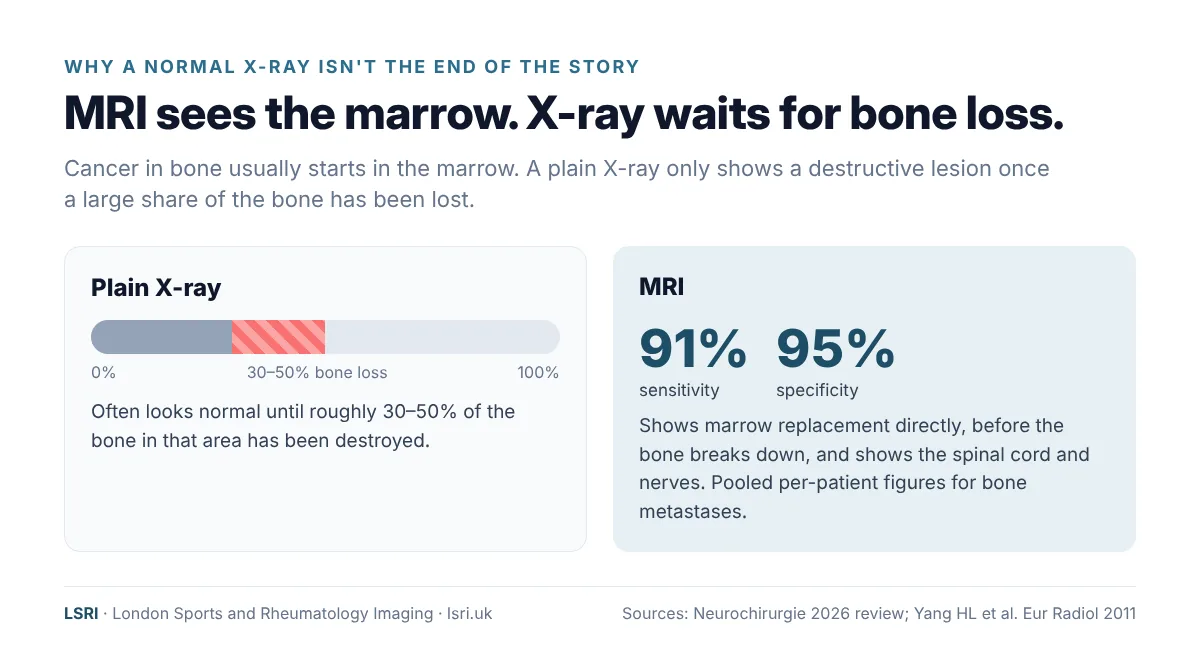
MRI is the most accurate widely available test for spinal metastases. In a pooled analysis of studies on bone metastases, MRI correctly identified about 91% of affected patients and correctly ruled out disease in about 95% of those without it.10
Metastatic spinal cord compression: the emergency everyone should know
When cancer in a vertebra grows backwards into the spinal canal, or the vertebra collapses, it can press on the spinal cord or the nerves below it. This is called metastatic spinal cord compression (MSCC). It is an emergency, because once the cord is damaged, lost function may not come back.
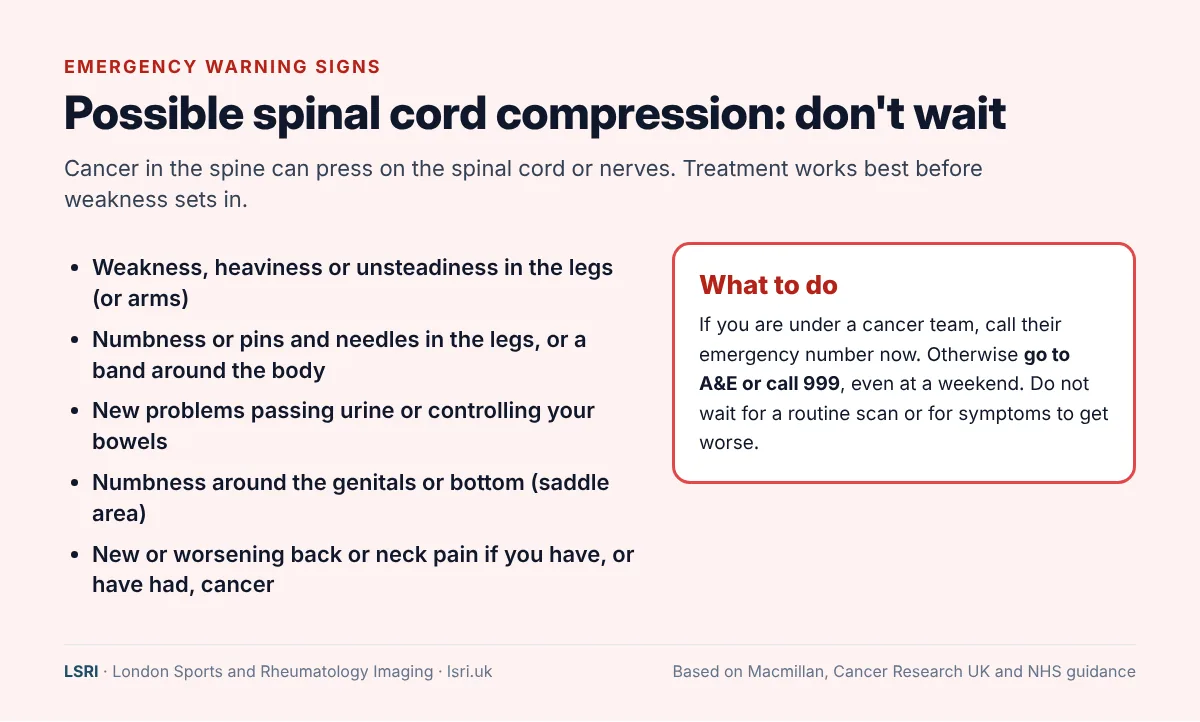
Get help immediately if you have back or neck pain with:
- weakness, heaviness or unsteadiness in your legs (or arms);
- numbness or pins and needles in your legs, or a band of numbness around your body;
- new problems passing urine or controlling your bowels;
- numbness around your genitals or bottom.
If you are under a cancer team, call their emergency contact number straight away, even at a weekend or on a bank holiday. If you cannot reach them, or you do not have a cancer team, go to A&E or call 999. Do not wait for further symptoms to develop, and do not wait for a routine scan.11,12
Why time matters
The research on spinal cord compression from cancer is consistent: the earlier it is found, the better people do.
- In the Scottish study, people had pain for a median of about three months before diagnosis, and even after their GP had referred them it took a median of about two months to reach a diagnosis. By the time of diagnosis, 82% could not walk or needed help to walk.7
- In a UK study of 301 patients, function in the legs got worse in a substantial proportion of patients while they were waiting, both in general practice and at their local hospital, and only a third could walk when treatment began. The author concluded that delays were causing preventable loss of function.13
- A meta-analysis of 25 studies (4,897 patients) found that being able to walk before treatment, a short interval between symptoms and treatment, and a slow onset of weakness were among the strongest predictors of being able to walk afterwards.14
- In a landmark randomised trial in selected patients, 84% were able to walk after surgery followed by radiotherapy, compared with 57% after radiotherapy alone. Options like these depend on catching the problem in time.15
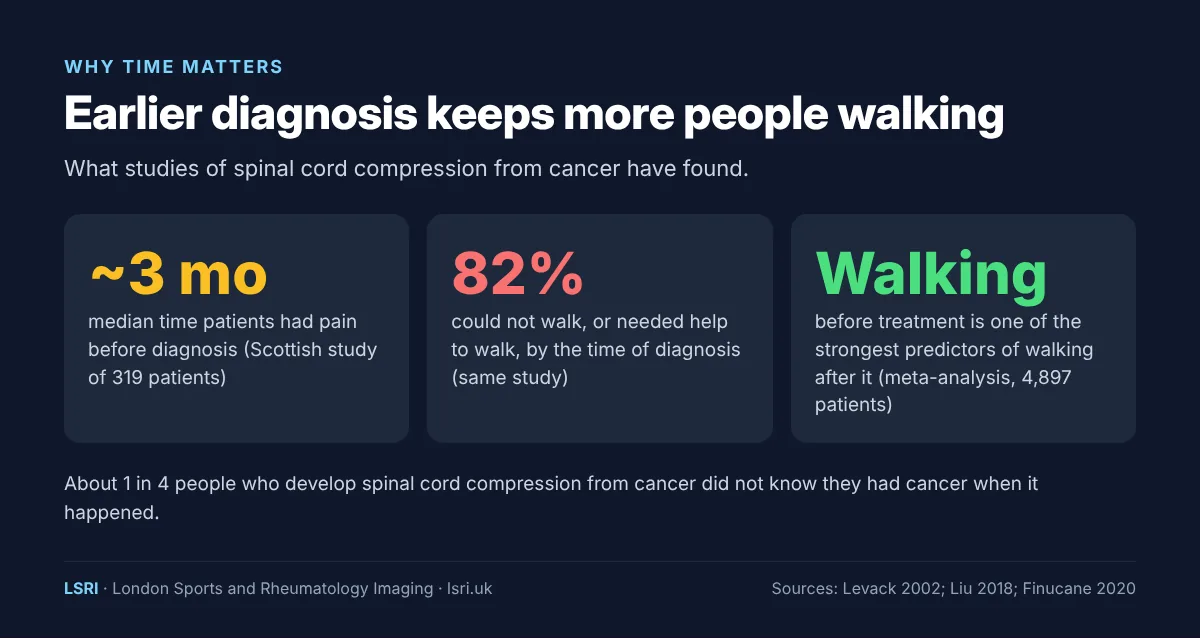
“Penny wise, pound foolish” sums it up. For the small number of people whose back pain is caused by cancer, the cost of a delayed diagnosis is not measured in money but in independence: the difference between walking out of hospital and not.
What to do if you are worried
- Emergency symptoms? Follow the red box above. Do not book a routine scan.
- Known or past cancer and new back pain? Contact your cancer team promptly, even if the pain seems minor. Tell any clinician you see about your cancer history, even if it was many years ago.
- Pain that is persistent, worsening, worse at night, or in the mid-back? Ask your GP or physiotherapist to review the diagnosis and consider imaging.
- If you have an MRI, check it will cover the whole spine if metastases are a concern, and that it will be reported by a specialist who has your full history.
How LSRI can help
- Fast, specialist-reported MRI. Your MRI is reported by a consultant musculoskeletal radiologist within 24 hours.
- The right scan for the question. When metastases are a concern, we image the whole spine. We will tell you if you should go to A&E instead of waiting for an appointment.
- Clear next steps. If the scan shows something serious, we make sure you and your GP know quickly so that urgent referral is not delayed.
- Clear pricing. MRI from £375 per body part, including the scan, a specialist report and access to your images, or from £425 with a consultation to go through the results.
See our private MRI scans page, our guide to what decides MRI quality, or our second opinion service if you have already had a scan.
Frequently asked questions
What does back pain from spinal metastases feel like?
It is often constant and gradually worsening, present at night or when lying down, and sometimes band-like around the chest or abdomen. It may be worse with coughing or straining. But there is no pain pattern that is unique to cancer, so the overall picture, including any history of cancer, matters most.
Can spinal metastases be the first sign of cancer?
Yes. About 1 in 4 people who develop spinal cord compression from cancer did not know they had cancer when it happened.
Will an X-ray show spinal metastases?
Not reliably. An X-ray may look normal until a large part of the bone has been destroyed. MRI is much more sensitive and also shows the spinal cord and nerves.
Why scan the whole spine and not just where it hurts?
Spinal metastases are often found at more than one level, and some may not yet cause symptoms. Imaging the whole spine gives the full picture needed to plan treatment.
Are spinal metastases treatable?
Yes. Depending on the type of cancer and the extent of disease, treatment may include radiotherapy, surgery to stabilise the spine or relieve pressure on the cord, cancer drug treatments and bone-strengthening medicines. Outcomes are best when treatment starts before nerve damage occurs.
Book an appointment
Call 0203 633 5040 or book online. Clinics at Harley Street (W1G 9QJ) and Harrow (HA2 7SJ). If you have emergency symptoms, go to A&E or call 999 instead.
References
- Wicker K, Tran R, Ablove R. Diagnostic errors in spinal metastases: a systematic review of contributing clinical and systemic factors. European Spine Journal 2026;35(2):732–740. doi:10.1007/s00586-025-09584-4
- Cook AM, Lau TN, Tomlinson MJ, et al. Magnetic resonance imaging of the whole spine in suspected malignant spinal cord compression: impact on management. Clinical Oncology 1998;10(1):39–43. doi:10.1016/S0936-6555(98)80111-8
- Finucane LM, Downie A, Mercer C, et al. International framework for red flags for potential serious spinal pathologies. Journal of Orthopaedic & Sports Physical Therapy 2020;50(7):350–372. doi:10.2519/jospt.2020.9971
- Shah LM, Salzman KL. Imaging of spinal metastatic disease. International Journal of Surgical Oncology 2011;2011:769753. doi:10.1155/2011/769753
- Cancer Research UK. About secondary bone cancer. cancerresearchuk.org
- Cancer Research UK. Spinal cord compression. cancerresearchuk.org
- Levack P, Graham J, Collie D, et al. Don’t wait for a sensory level: listen to the symptoms. A prospective audit of the delays in diagnosis of malignant cord compression. Clinical Oncology 2002;14(6):472–480. doi:10.1053/clon.2002.0098
- Downie A, Williams CM, Henschke N, et al. Red flags to screen for malignancy and fracture in patients with low back pain: systematic review. BMJ 2013;347:f7095. doi:10.1136/bmj.f7095
- Beaufort Q, Lefevre V, Carsuzaa T. Imaging of spinal metastases: modality performance, complications, and differential diagnosis. Neurochirurgie 2026;72(3):101804. doi:10.1016/j.neuchi.2026.101804
- Yang HL, Liu T, Wang XM, et al. Diagnosis of bone metastases: a meta-analysis comparing 18FDG PET, CT, MRI and bone scintigraphy. European Radiology 2011;21(12):2604–2617. doi:10.1007/s00330-011-2221-4
- Macmillan Cancer Support. Metastatic spinal cord compression (MSCC). macmillan.org.uk
- NHS. Back pain. nhs.uk
- Husband DJ. Malignant spinal cord compression: prospective study of delays in referral and treatment. BMJ 1998;317:18–21. doi:10.1136/bmj.317.7150.18
- Liu YH, Hu YC, Yang XG, et al. Prognostic factors of ambulatory status for patients with metastatic spinal cord compression: a systematic review and meta-analysis. World Neurosurgery 2018;116:e278–e290. doi:10.1016/j.wneu.2018.04.188
- Patchell RA, Tibbs PA, Regine WF, et al. Direct decompressive surgical resection in the treatment of spinal cord compression caused by metastatic cancer: a randomised trial. The Lancet 2005;366(9486):643–648. doi:10.1016/S0140-6736(05)66954-1
About this case study
Patient privacy: the images are anonymised, with no names, dates or other identifying details, and non-essential details of the case have been left out. They are shared for education. Purpose: written by the LSRI clinical team to help the public recognise the warning signs of spinal metastases and spinal cord compression, based on the research and guidance listed above. It is general information, not a diagnosis; if you are worried about your own symptoms, speak to your GP or cancer team, or in an emergency go to A&E. The case is not a criticism of any clinician.