Written by: LSRI Editorial Team
Medically reviewed by Dr Prashant Sankaye, Consultant MSK Radiologist ·
Last Updated: October 14, 2026
Read Time: 13 Minutes
Written by the LSRI clinical team and medically reviewed by Dr Prashant Sankaye, Consultant MSK Radiologist, on 11 October 2026.
Radiologists sometimes say that their work is never really finished: every scan and every report is archived. Images and reports are stored, often for many years, and they can be opened again later. When they are, the person looking usually already knows the answer: what the patient turned out to have. That means a radiologist’s work is unusually easy to look at again, and it is why fair, expert review matters so much, both for patients who want honest answers and for the radiologists whose work is being judged.
This article explains why findings can look obvious in hindsight, how radiology learns from its errors, and how second opinions and arbitration should work. If you think a radiologist missed something on your scan, the questions at the end explain where to start.
Key points
- Scans and reports are kept as part of your health record. NHS guidance in England says adult health records, including X-rays and scans, should be kept for at least 8 years after treatment ends.1
- Once you know where an abnormality is, it is much easier to see. In one classic study, 90% of a group of lung cancers were visible in retrospect on earlier X-rays.2
- Knowing the outcome changes how experts judge care: in one study, outcome changed reviewers’ judgements in 15 of 21 matched pairs of cases.3
- UK radiology standards say hindsight bias is inevitable when cases are reviewed, and that learning meetings are “not to criticise”, but “to learn”.4
- A missed finding is not automatically negligence. The question is whether the reading fell below the standard of reasonable skill and care.5
- If you are worried something was missed, talk to the clinician looking after you, ask for your images and report, and consider an independent second opinion.
Scans are kept, and can be looked at again
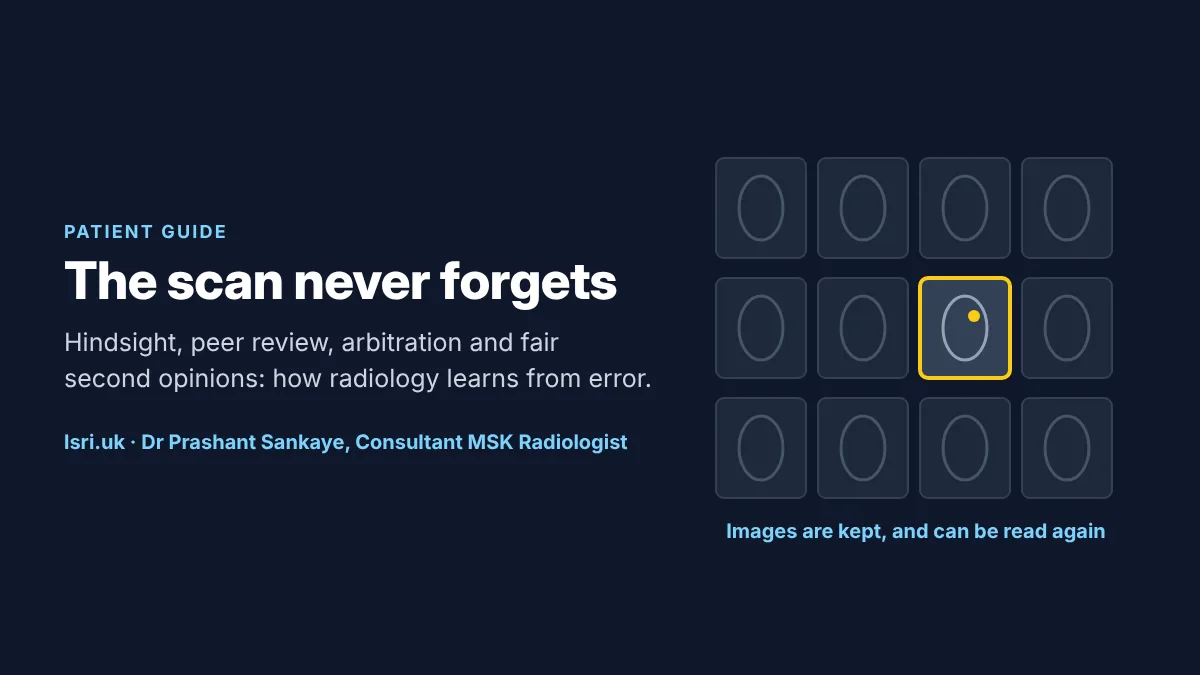
Most medical decisions leave a written note behind. Radiology leaves the evidence itself. The images that were reported are stored in the hospital or clinic’s imaging system, alongside the report, as part of your health record. NHS guidance in England says adult health records, which “includes medical illustration records such as x-rays and scans”, should be kept for at least 8 years after treatment ends, and children’s records for longer.1
That is good for patients. It means a later scan can be compared with an earlier one, a second opinion can look at exactly what the first radiologist saw, and a missed finding can be found and acted on. But it also means every radiologist’s work can be re-examined, years later, by someone who already knows how the story ended.
Hindsight: why a finding looks obvious once you know it is there
Radiologists have studied this effect for decades. In a lung cancer screening study published in 1983, 50 cancers were found in the outer parts of the lungs on chest X-rays. Looking back at the earlier X-rays, 90% of them “were visible in retrospect for months or even years”.2 The cancers had not appeared from nowhere: they were there, but small and subtle, and much easier to see once the radiologist knew where to look.
The same pattern shows up in error rates. When radiologists’ everyday reports are checked, the error rate is about 3.5 to 4%. When only scans already known to be abnormal are reviewed, the miss rate averages around 30%.6 We explain the common reasons findings get missed in Can an MRI miss something? A 2023 study found that expert radiologists show not just a tendency to judge in hindsight, but “visual hindsight bias”: once they have seen an abnormality, they find it easier to see, so it seems more obvious.7
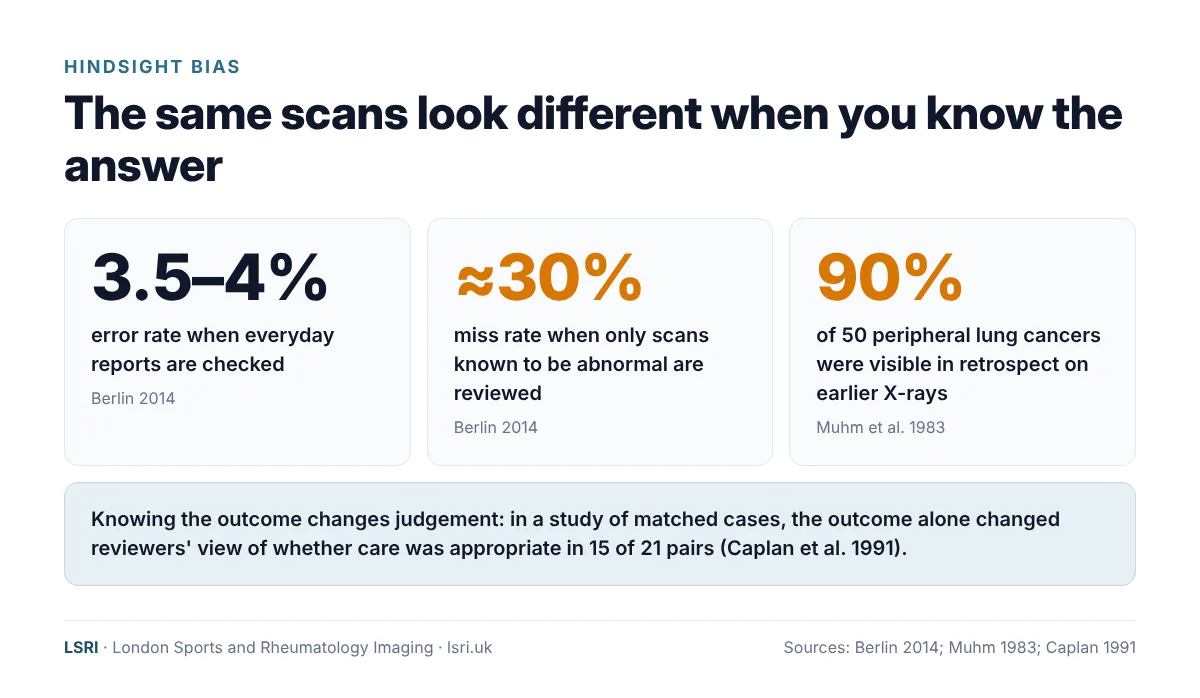
Knowing the outcome also changes how care is judged. In a well-known study, 112 anaesthetists rated 21 cases, each written in two versions that were identical except for how things turned out. The outcome changed their judgement of whether care was appropriate in 15 of the 21 pairs, and ratings of “appropriate” care fell by 31 percentage points when the outcome was made permanent harm.3 Writing about medicolegal reports, two Australian authors concluded that “Hindsight bias is almost inevitable in retrospective peer-review reports”, and that simply warning experts about it is not enough.8
The Royal College of Radiologists says the same about its own learning meetings: hindsight bias is “an inevitable result” of reviewing a case after the event, and there is “a recognised tendency to attribute blame more readily when the clinical outcome is serious”.4
Not every miss is negligence
A finding that was missed is not, on its own, proof that anyone was careless. In an English High Court case about a misread pathology slide, the judge quoted an earlier ruling that “the fact that with the benefit of hindsight that judgment was exercised wrongly is not itself proof of negligence”.5 The test is whether the interpretation fell below the standard of reasonable skill and care expected of a competent specialist at the time, with the information and images that were available, not with what is known now.
A claim must also show that the missed finding caused harm that would otherwise have been avoided. In practice, careful review often shows that a finding was genuinely difficult to see, or that the report was reasonable on the information given; sometimes it shows the opposite.
Expert witnesses have a clear duty here. Under the Civil Procedure Rules, an expert’s duty to the court “overrides any obligation” to the person instructing or paying them, and experts must give objective, unbiased opinions rather than act as advocates.9
How radiology learns from its errors
Radiology is open about error because it has to be. The Royal College of Radiologists puts it simply: “Humans will always make errors and radiologists are no different.” It notes that reporting discrepancies are found in between 3 and 30% of reports in published studies, depending on how they are measured.4
Learning meetings
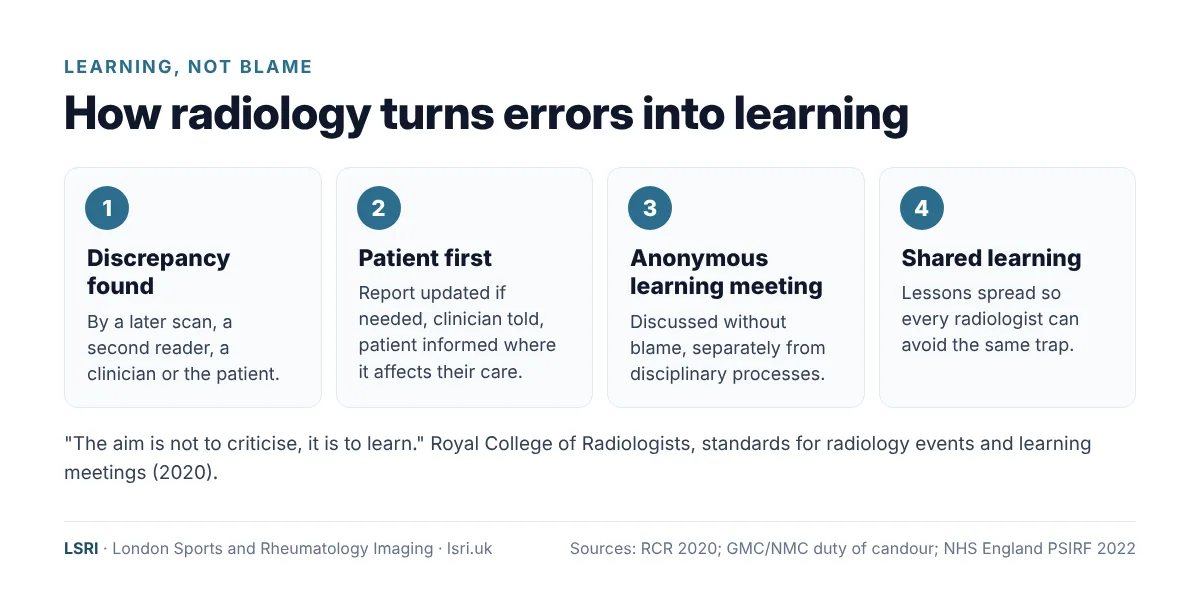
UK radiology departments hold regular radiology events and learning meetings (REALMs), where discrepancies are discussed anonymously. The standards are clear about their purpose: “The aim is not to criticise, it is to learn”, and “The chair must avoid a blame culture at all costs”. REALMs run separately from disciplinary and legal processes, and the cases discussed cannot be used to work out error rates for individual radiologists.4
From scoring to peer learning
Some systems used to score radiologists’ reports against each other. Researchers found that “scoring-based peer review tends to drive radiologists inward, against each other, and against practice leaders”.10 A 2020 international summit concluded that score-based peer review has not been shown to improve performance in a meaningful way, and recommended “peer learning” instead: sharing cases openly so that everyone learns from them.11
Double reading
Having a second radiologist read a scan catches findings that one reader alone can miss. In one study of abdominal CT, a second read led to clinically important changes in 14% of reports.12 In breast screening, where double reading is routine in the UK, reviews show that a second reader increases cancer detection.13 The RCR standards recognise “the established value of double reporting”.4
Openness when things go wrong
Doctors in the UK have a professional duty of candour: “Every health and care professional must be open and honest with patients” when something goes wrong.14 Health and care providers in England also have a legal duty of candour. The NHS approach to patient safety incidents focuses on “understanding how incidents happen rather than attributing blame or liability”, with compassionate engagement with patients and families.15
This openness matters for patients, and it matters for radiologists too. In a survey of radiologists, those who viewed their quality assurance process more positively reported less negative emotion after making an error.16 A fair, learning-focused culture helps everyone.
Second opinions, arbitration and fair review
When a report is questioned, by a patient, a clinician or an organisation, an independent expert review is often the fairest way to find the answer. Depending on the situation, that may be:
- a second opinion: an independent specialist reads the images afresh;
- a tertiary opinion: a further specialist view when earlier opinions disagree, or in complex or disputed cases;
- arbitration: an independent decision when a reporting provider and the clinician or organisation that commissioned the report disagree about it;
- an expert witness report: an objective opinion for a court, where the expert’s duty is to the court.9
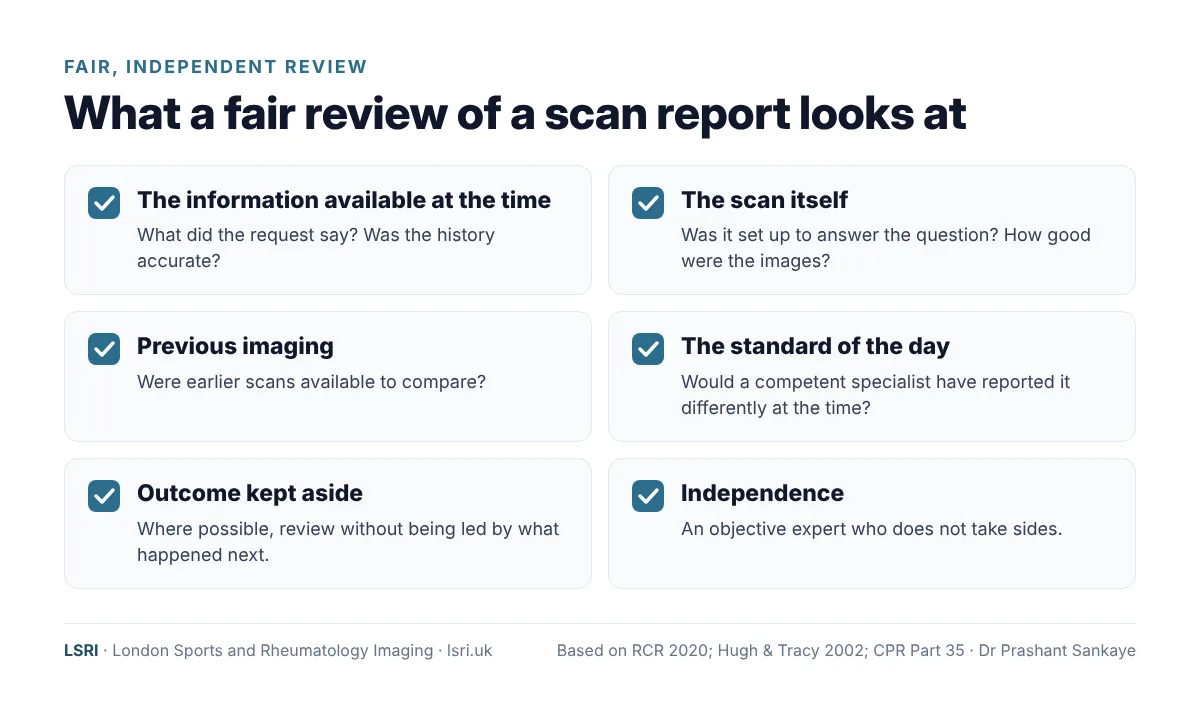
A fair review looks at the scan as the original radiologist saw it. It asks what clinical information they had, whether the scan was set up to answer the question, how good the images were, whether previous scans were available, and whether a competent specialist would have reported it differently at the time. Where possible, it avoids being led by the outcome: both medicolegal experts and the RCR suggest withholding information about what happened next when cases are reviewed.4,8
Dr Sankaye’s experience
Dr Prashant Sankaye, Consultant MSK Radiologist and Clinical Director of LSRI, has spent many years reviewing scans that other radiologists have already reported. He has provided second and tertiary opinions, and independent arbitration in disputes about radiology reports. As a former Head of Specialty at Imperial College Healthcare NHS Trust, his responsibilities included handling complaints and reviewing reporting discrepancies, and as a former Expert Advisor to the Parliamentary and Health Service Ombudsman he gave expert radiology advice on complaints about NHS care.
“Every radiologist will miss something at some point, and I am no exception. When I review another radiologist’s work, I try to see the scan as they saw it: with the information they had, on the day they reported it. That is fair to them, and it is the fairest way to give the patient a clear, honest answer.”
Dr Prashant Sankaye, Consultant MSK Radiologist
That experience shapes how LSRI works day to day: hearing each patient’s story before reporting, planning each scan around the clinical question, comparing previous imaging, and reporting as a musculoskeletal specialist. Read more in the radiology consultation and who reports your MRI matters.
How LSRI can help
- Independent second opinions on MRI, CT, X-ray and ultrasound from NHS and private providers, reviewed by a consultant musculoskeletal radiologist. See MRI second opinion.
- Specialist reporting. Every LSRI report is written by a UK-governed consultant musculoskeletal radiologist, usually within 24 hours.
- Clear pricing. MRI from £375 per body part, including the scan, a specialist report and access to your images.
Read more: Can an MRI miss something?
Frequently asked questions
What should I do if I think a radiologist missed something on my scan?
Start with the clinician looking after you, ask for your images and report, and consider an independent second opinion. If you have new or worsening symptoms, get medical help first.
Is a missed finding on a scan always negligence?
No. Some findings are genuinely difficult to see, and many are much easier to spot in hindsight. The question is whether the reading fell below the standard of a reasonably competent specialist, at the time, with the information and images available.5
How long are my scans kept?
Under NHS guidance in England, adult health records including X-rays and scans should be kept for at least 8 years after treatment ends, and children’s records for longer. Some types of imaging, such as cancer-related records, may be kept much longer.1
Can a second opinion be used in a complaint or legal claim?
A second opinion can help you and your clinicians understand what the scan shows. If you are making a legal claim, your solicitor will usually instruct an independent expert, whose duty is to the court, to prepare a formal report.9
What is arbitration in radiology?
Arbitration is an independent decision on a disputed report, usually when the organisation that commissioned a report and the provider that wrote it disagree about whether something was missed or misinterpreted. The arbitrator reviews the images and the information available at the time and gives an impartial view.
Will the original radiologist find out?
It depends on the setting. In the NHS, discrepancies are usually fed back to the reporting radiologist and may be discussed anonymously in a learning meeting, so that everyone can learn from them.4
Book an appointment
Call 0203 633 5040 or book online. Clinics at Harley Street (W1G 9QJ) and Harrow (HA2 7SJ). If you have emergency symptoms, go to A&E or call 999 instead.
References
- NHS England. Records Management Code of Practice 2021 (current online version). transform.england.nhs.uk
- Muhm JR, Miller WE, Fontana RS, et al. Lung cancer detected during a screening program using four-month chest radiographs. Radiology 1983;148(3):609–615. doi:10.1148/radiology.148.3.6308709
- Caplan RA, Posner KL, Cheney FW. Effect of outcome on physician judgments of appropriateness of care. JAMA 1991;265(15):1957–1960. doi:10.1001/jama.1991.03460150061024
- The Royal College of Radiologists. Standards for radiology events and learning meetings. January 2020. rcr.ac.uk
- Muller v King’s College Hospital NHS Foundation Trust [2017] EWHC 128 (QB). nationalarchives.gov.uk
- Berlin L. Radiologic errors, past, present and future. Diagnosis 2014;1(1):79–84. doi:10.1515/dx-2013-0012
- Schill HM, Gray SM, Brady TF. Visual hindsight bias for abnormal mammograms in radiologists. Journal of Medical Imaging 2023;10(Suppl 1):S11910. doi:10.1117/1.JMI.10.S1.S11910
- Hugh TB, Tracy GD. Hindsight bias in medicolegal expert reports. Medical Journal of Australia 2002;176(6):277–278. doi:10.5694/j.1326-5377.2002.tb04407.x
- Ministry of Justice. Civil Procedure Rules, Part 35 (experts and assessors) and Practice Direction 35. justice.gov.uk
- Larson DB, Donnelly LF, Podberesky DJ, et al. Peer feedback, learning, and improvement: answering the call of the Institute of Medicine report on diagnostic error. Radiology 2017;283(1):231–241. doi:10.1148/radiol.2016161254
- Larson DB, Broder JC, Bhargavan-Chatfield M, et al. Transitioning from peer review to peer learning: report of the 2020 Peer Learning Summit. Journal of the American College of Radiology 2020;17(11):1499–1508. doi:10.1016/j.jacr.2020.07.016
- Lauritzen PM, Andersen JG, Stokke MV, et al. Radiologist-initiated double reading of abdominal CT: retrospective analysis of the clinical importance of changes to radiology reports. BMJ Quality & Safety 2016;25(8):595–603. doi:10.1136/bmjqs-2015-004536
- Taylor P, Potts HWW. Computer aids and human second reading as interventions in screening mammography: two systematic reviews to compare effects on cancer detection and recall rate. European Journal of Cancer 2008;44(6):798–807. doi:10.1016/j.ejca.2008.02.016
- General Medical Council and Nursing and Midwifery Council. Openness and honesty when things go wrong: the professional duty of candour. gmc-uk.org
- NHS England. Patient Safety Incident Response Framework. 2022. england.nhs.uk
- Lamoureux C, Mahoney J, Weber S, et al. Radiologist opinions of a quality assurance program: the interaction between error, emotion, and preventative action. Academic Radiology 2021;28(2):e54–e61. doi:10.1016/j.acra.2020.01.027
About this article
Written by the LSRI clinical team to explain how radiology errors are reviewed and learned from, based on the research, guidance and case law listed above. It is general information, not medical or legal advice. Nothing in this article is a criticism of any individual radiologist, clinician, hospital or provider. Dr Sankaye’s second-opinion, arbitration and complaints work is described in general terms only; no case, patient or organisation is identified.