Written by: LSRI Editorial Team
Medically reviewed by Dr Prashant Sankaye, Consultant MSK Radiologist ·
Last Updated: October 14, 2026
Read Time: 16 Minutes
Written by the LSRI clinical team and medically reviewed by Dr Prashant Sankaye, Consultant MSK Radiologist, on 10 October 2026.
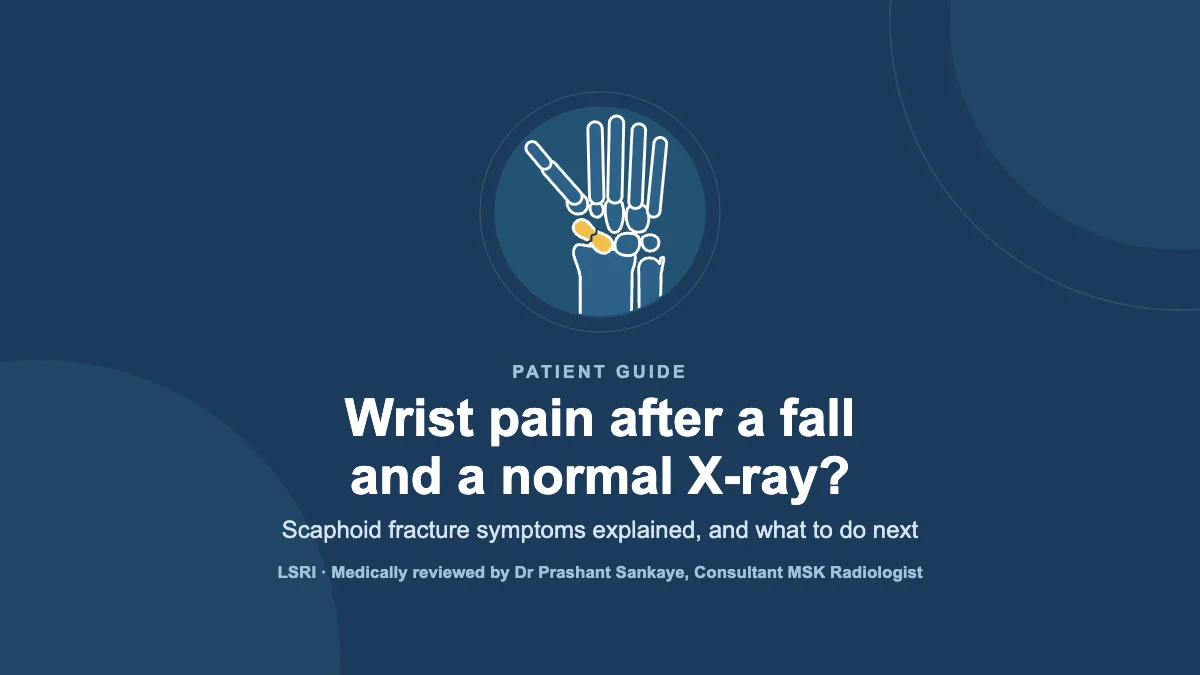
You fall onto an outstretched hand, the wrist hurts on the thumb side, and the X-ray is normal. Usually that is the end of it: most people in this position do not have a fracture1,2. But the scaphoid, a small bone on the thumb side of the wrist, can break with a crack so fine that the first X-ray looks normal3.
That matters because an unprotected scaphoid fracture can fail to heal, and a scaphoid that does not heal can lead to wrist arthritis over the years4,5. This guide explains scaphoid fracture symptoms, why a normal X-ray does not always rule a fracture out, and what to do next. For the bigger picture, see why early imaging matters in musculoskeletal injuries.
Key points
- The scaphoid usually breaks in a fall onto an outstretched hand, most often in young men1,6.
- Of people with signs of a scaphoid fracture but a normal first X-ray, roughly 1 in 10 to 1 in 5 turn out to have one2,7.
- A scaphoid fracture can fail to heal (non-union), a break near the top of the bone can lose its blood supply, and a long-standing non-union can lead to wrist arthritis4,5.
- A splint while the diagnosis is confirmed is the usual approach1,8. In older studies, healing problems were linked mainly to fractures left unprotected for weeks4,9.
- MRI is the recommended test for a suspected hidden scaphoid fracture8 and, in one randomised trial, gave a definite answer in about 2 days instead of about 1010.
What is the scaphoid and how does it break?
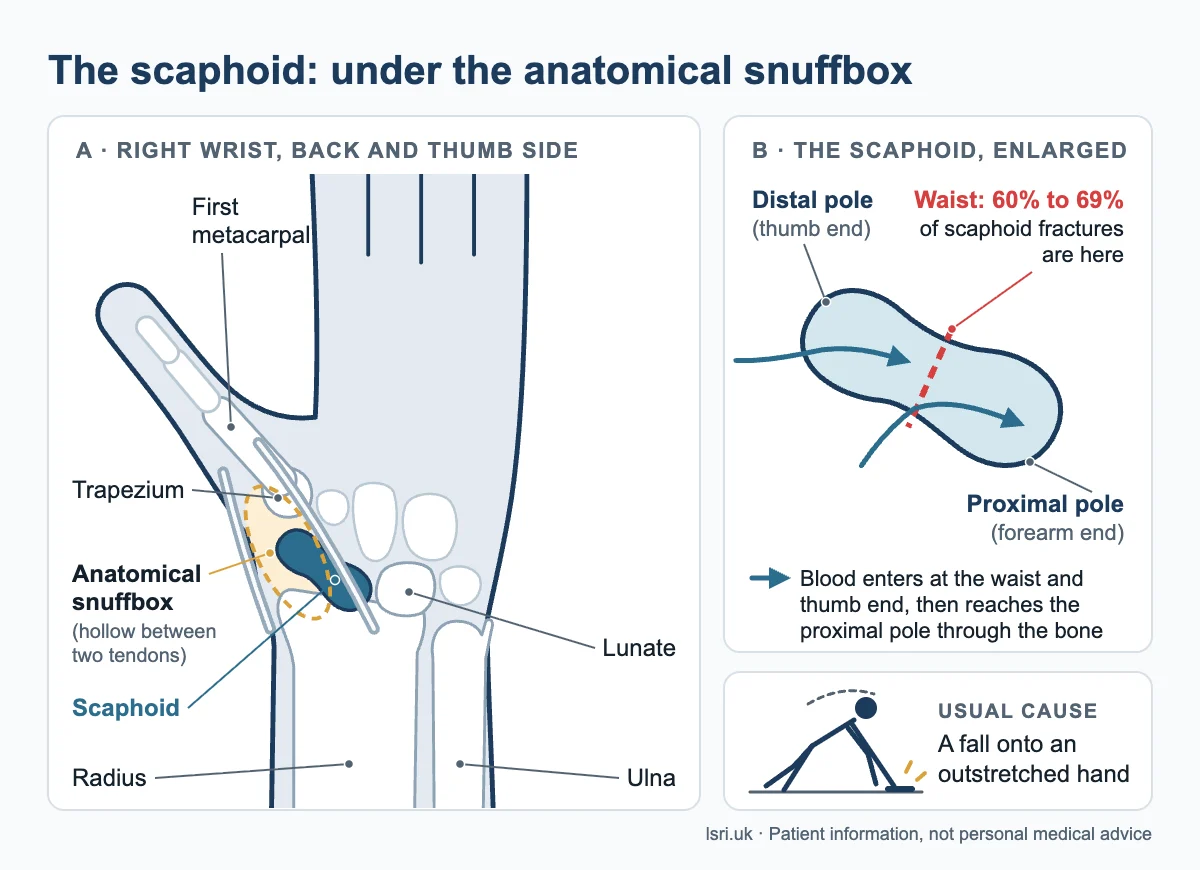
The scaphoid is one of the small carpal (wrist) bones, on the thumb side of the wrist3. It usually breaks in a fall onto an outstretched hand that forces the wrist backwards1.
It is the most commonly broken carpal bone6. A systematic review (a study that pools all the good research on a question) found it is far more common in men than in women, peaking in men aged 20 to 29, and that 60% to 69% of breaks are in the narrow middle of the bone, called the waist6.
The blood supply is unusual. Blood vessels enter the bone mainly around the waist and from the thumb end, so the upper end nearest the forearm (the proximal pole) depends on blood travelling through the bone itself3,4. A break can cut that route, which is why fractures near the top of the bone cause the most trouble1,4.
What are the symptoms of a scaphoid fracture?
Typical symptoms are pain, tenderness and swelling on the thumb side of the wrist, with difficulty gripping or twisting the wrist or thumb11. Most scaphoid fractures do not make the wrist look broken, and many cause only minor symptoms11.
On examination, a clinician looks for1:
- tenderness in the anatomical snuffbox, the hollow at the base of the thumb that appears when you stretch your thumb out
- tenderness over the scaphoid tubercle, a bony point at the base of the thumb on the palm side
- pain when the thumb is pressed along its length towards the wrist.
None of these signs is perfect. In a 2023 systematic review, snuffbox tenderness was present in 92% of people with a hidden scaphoid fracture but also in about half of those without one7.
Other injuries can feel similar, including other wrist fractures and ligament injuries1,10. Tendon problems such as De Quervain’s tenosynovitis also cause thumb-side wrist pain.
Why can a normal X-ray miss a scaphoid fracture?
A scaphoid fracture can be a fine crack with the pieces still lying together, so no fracture line shows on the first X-ray3. One guideline review estimates that X-rays detect no more than about 70% of scaphoid fractures1. The same problem arises with heel fractures, stress fractures and some hip fractures after a fall.
How often does a normal X-ray hide a fracture?
The useful question is: of people with signs of a scaphoid fracture but a normal first X-ray, how many have one? Results vary widely between studies:
- A Cochrane review (an independent, rigorous review of the evidence) found a median of 20% across its studies2.
- A 2023 systematic review of 8 prospective studies (1,685 wrists) found 9% (95% confidence interval 5% to 13%)7.
So the answer is about 1 in 10 to 1 in 5 in most studies: most people with a sore wrist and a normal X-ray do not have a scaphoid fracture. That is the dilemma: protecting the few with a hidden fracture means restricting many who do not have one12.
Can an X-ray miss other wrist injuries?
Yes. A wrist that stays painful after a fall can have other injuries instead of, or as well as, a scaphoid fracture. In our experience, an X-ray can miss other injuries that MRI can show: fractures of other wrist bones or of the end of the forearm bone (the distal radius), bone bruising, ligament tears and other soft-tissue injuries. In the SMaRT trial, described below, immediate MRI found other fractures, most often of the distal radius, in 22% of people, compared with 8% with usual care10.
What can a missed scaphoid fracture cost?
Most scaphoid fractures heal well once recognised and protected1,6. The risks come mainly from fractures that are unprotected, displaced, or where the blood supply is poorest1,4.
- Non-union (the bone does not heal). A systematic review put the overall risk after a scaphoid fracture in adults at 2% to 5%, although it rated the evidence as low6. An older review quotes up to 12% when a hidden fracture is not identified and not immobilised4. Proximal pole fractures are more vulnerable: 10% to 14% of non-displaced ones treated in a cast fail to heal, and up to 50% of displaced ones1.
- Avascular necrosis. This means part of the bone dies because its blood supply is cut off. It is a recognised complication3,4. Reported rates vary widely and are higher when the break is in the proximal fifth of the bone4.
- Arthritis years later. An unhealed scaphoid can lead to progressive wear and collapse of the wrist, known as scaphoid non-union advanced collapse (SNAC)1. In a classic study of 47 non-unions in people with symptoms, more advanced arthritis was found in non-unions that had been present longer, in some cases for decades5.
Does a short delay matter?
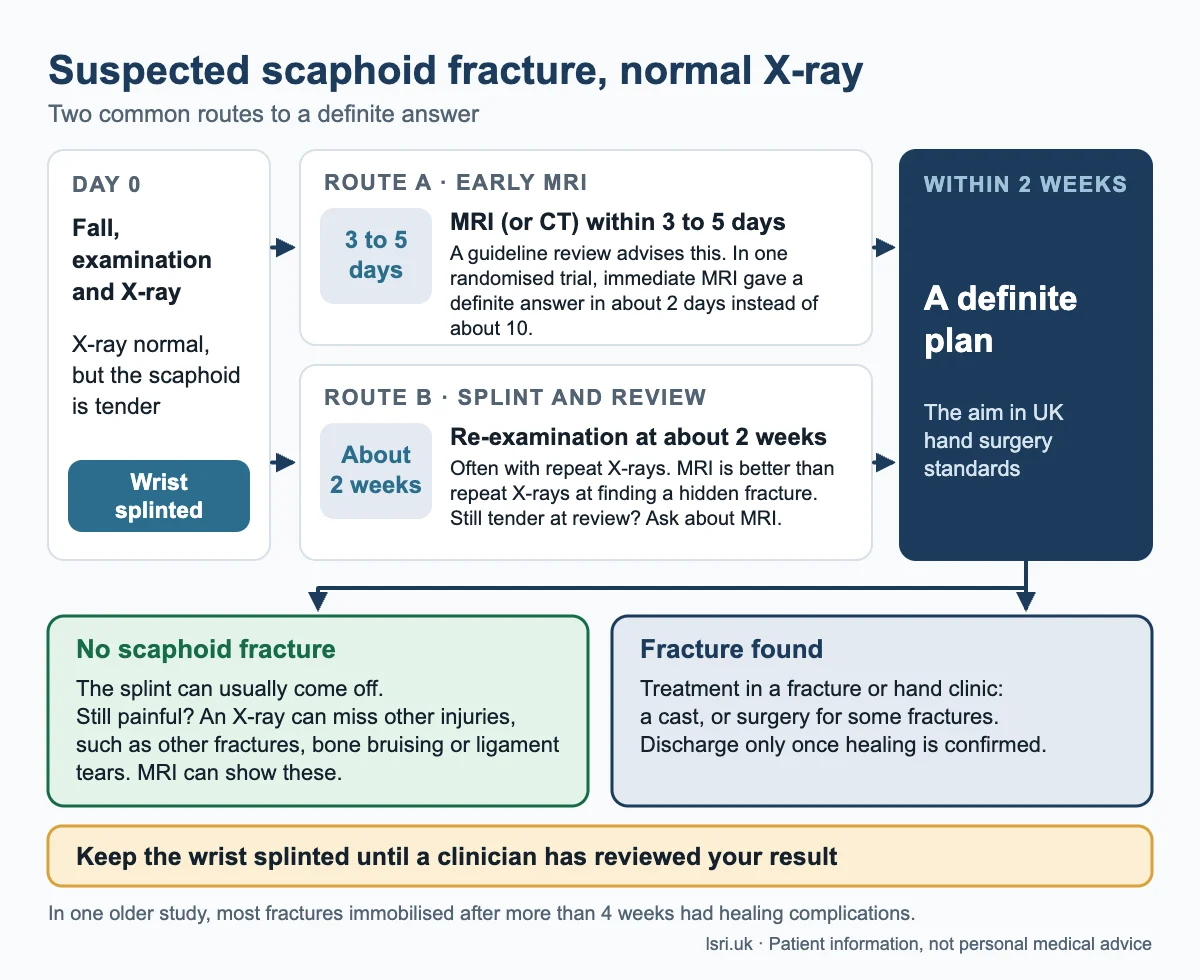
A short delay appears to matter much less than a long one, provided the wrist is protected. In an older review of the records of 285 scaphoid fractures, a delay of less than four weeks before immobilisation was not linked to slower healing or more non-union, but most fractures immobilised after more than four weeks had healing complications9. In a small series, 23 of 28 fractures (82%) first seen 6 weeks to 6 months after injury still healed in a cast, although casting took about 11 to 14 weeks13.
What are the options when the X-ray is normal?
If a scaphoid fracture is suspected but the X-ray is normal, the wrist is usually splinted and the diagnosis confirmed either by review at about two weeks or by MRI1,8. UK hand surgery standards recommend MRI8, and a guideline review advises MRI, or CT, within three to five days1.
- Splint, then review. Traditionally the wrist is immobilised for two weeks and re-examined, often with repeat X-rays1. MRI is better than repeat X-rays at finding a hidden fracture4.
- Early MRI. MRI uses a strong magnet and radio waves, not X-rays. It can show fractures that X-rays miss, plus other fractures and ligament injuries, and if it is clear the splint can usually come off early1.
Other tests are used in some hospitals. Sensitivity is the share of real fractures a test finds; specificity is the share of people without a fracture whom it correctly clears.
| Test | Accuracy for a hidden scaphoid fracture | Main limits |
|---|---|---|
| MRI | Sensitivity 88% to 94%; specificity 98% to 100%2,14 | A bone bruise can be mistaken for a fracture1 |
| CT (detailed X-ray scan) | Sensitivity 72% to 82%; specificity 96% to 99%2,14 | Radiation; these reviews found it picks up fewer hidden fractures than MRI. Used to measure displacement and healing1 |
| Bone scan (radioactive tracer) | Sensitivity 99%; specificity 86%2 | Radiation; delay before it can be done; more false alarms2 |
| Ultrasound | Sensitivity about 82%; specificity about 77%14 | Less accurate than MRI14 |
These are pooled figures from small, varied studies, and the Cochrane review’s confidence intervals were wide2. No test is perfect: when few of the people scanned have a fracture, only about 88% of positive MRI results are true, and the rest are false alarms12. Scans must be read alongside the examination.
What the SMaRT trial showed
The SMaRT trial, run in one London emergency department, randomly assigned adults with a suspected scaphoid fracture and normal X-rays to immediate MRI or usual care, and 132 were analysed. MRI gave a more accurate diagnosis after about 2 days rather than about 1010. The authors judged that no clinically important injury appeared to have been missed with usual care10. In this trial, the main gains of early MRI were speed and certainty.
Who may want a faster answer?
For sportspeople, manual workers and others who rely on their hands, two weeks in a splint without a diagnosis can be costly. Restricting an active person has to be balanced against the risk of non-union12, and early MRI shortens the wait for an answer10.
When you may not need a scan
Not every sore wrist after a fall needs an MRI. If a clinician finds no tenderness in the anatomical snuffbox, a hidden fracture is less likely, although no single sign rules it out7. In one study of 223 people, none of the 72 without snuffbox pain when the wrist was tilted towards the little finger in the first 72 hours had a fracture15. A group that size cannot show the sign is safe on its own.
Many such injuries are sprains11, but a wrist that stays painful can have a ligament tear, bone bruising or another fracture, and MRI can show these. Whether a scan is needed is a decision for the examining clinician. And if a fracture is clear on X-ray, MRI is not needed to find it; CT is used if displacement or healing needs measuring1,8.
What should you do if your wrist hurts after a fall?
- Go to A&E or call 999 if the injury is severe. For example, the wrist is numb or tingling, has changed shape, a bone is sticking out, or a cut is bleeding heavily. Do not drive yourself16.
- Get it checked as soon as possible. The NHS advises getting medical advice promptly if you think you have broken your wrist16. In the UK, contact NHS 111 if it is very painful, you cannot use it, or swelling or bruising is getting worse16.
- Protect it meanwhile. Support the arm, use an ice pack wrapped in a tea towel for up to 20 minutes every 2 to 3 hours, and remove rings and watches16.
- If the X-ray is normal but a scaphoid fracture is suspected, wear the splint as advised until you have the result of further assessment3,8.
- Avoid sport, the gym, manual work with that hand and driving while you wait3.
- Know your follow-up plan. Ask when you will be reviewed or scanned; standards aim for a definite plan within two weeks8.
- If you are still tender at review, ask about MRI. It is the recommended test8, and it can also show other injuries, such as other fractures or ligament injuries1.
- Seek urgent advice if problems develop in a splint or cast, such as worsening pain, numb, swollen, blue or white fingers, or a cast that feels too tight16.
What does treatment look like once a fracture is found?
Most scaphoid waist fractures with little or no displacement heal in a cast. Surgery is mainly for displaced fractures, proximal pole fractures and fractures that fail to heal1,17.
- Cast. About 90% of non-displaced or minimally displaced (0.5 mm or less) waist fractures unite by six weeks with adequate cast treatment1.
- Surgery. Fixing the bone surgically (internal fixation) is generally advised for proximal pole fractures1 and, in UK hand surgery standards, for waist fractures displaced by more than 2 mm8.
- Confirming healing. UK standards advise that patients are discharged only once healing is confirmed on CT, although delayed X-rays at six months can also confirm it8. If a CT scan is needed, LSRI can arrange one through a partner imaging centre.
How LSRI can help
LSRI is not an emergency service. After a significant injury, or if your wrist looks deformed, go to A&E or an urgent care centre first.
If your X-ray was normal but your wrist still hurts on the thumb side, or you need a faster answer, we offer wrist MRI scans reported by a consultant musculoskeletal (MSK) radiologist, a doctor who specialises in bone, joint and soft-tissue imaging. Reports are usually ready within 24 hours. MRI starts from £375 per body part, including the scan, a specialist report and access to your images, or from £425 with a consultation. We also offer X-rays, and if you need a CT scan, we can arrange one. Keep the wrist splinted until a clinician has reviewed your result.
If a fracture is found, you will need a fracture or hand clinic for treatment, and you can take your report and images with you. For a review of existing scans, see our second opinion page. Our approach is to diagnose first, diagnose accurately, then treat. Our clinics are on Harley Street (W1G 9QJ) and in Harrow (HA2 7SJ); call 0203 633 5040.
Reading this from outside the UK?
The medical content applies wherever you live. Pathways vary between countries, but the principles are the same: protect the wrist and confirm the diagnosis promptly1,8. A&E means the emergency department, and NHS 111 is a UK-only advice line. In an emergency, call 999 or 112 in the UK, 112 in the EU, 911 in the US and Canada, 000 in Australia, or your local emergency number.
Frequently asked questions
Can you break your scaphoid and still move your wrist?
Yes, it is possible. Most scaphoid fractures do not make the wrist look broken, and many cause only minor symptoms11. Being able to move the wrist does not rule out a fracture, so thumb-side tenderness after a fall should be checked.
How long does a scaphoid fracture take to show on an X-ray?
There is no fixed time that suits everyone. Traditionally the wrist is protected for about two weeks and re-examined, often with repeat X-rays1, but MRI is better than repeat X-rays at finding a hidden fracture4.
My X-ray was normal but my wrist still hurts. Should I have an MRI?
If you are still tender over the scaphoid at review, MRI is the recommended next test in UK hand surgery standards8. In our experience, a wrist that stays painful may also have another injury that an X-ray can miss, such as another fracture, bone bruising or a torn ligament, and MRI can show these too. If the examining clinician finds no tenderness over the scaphoid and you are improving, a fracture is less likely and a scan may not be needed, although no single sign rules a fracture out7.
What happens if a scaphoid fracture is not treated?
Many heal, but an unprotected fracture is more likely to fail to heal4, and a non-union that persists for years can lead to wrist arthritis5.
References
- Clementson M, Björkman A, Thomsen NOB. Acute scaphoid fractures: guidelines for diagnosis and treatment. EFORT Open Rev 2020;5(2):96-103. doi:10.1302/2058-5241.5.190025
- Mallee WH, Wang J, Poolman RW, Kloen P, Maas M, de Vet HCW, et al. Computed tomography versus magnetic resonance imaging versus bone scintigraphy for clinically suspected scaphoid fractures in patients with negative plain radiographs. Cochrane Database Syst Rev 2015;(6):CD010023. doi:10.1002/14651858.CD010023.pub2
- Leeds Teaching Hospitals NHS Trust. Suspected scaphoid fracture advice (patient information, edition 3, reviewed June 2025). leedsth.nhs.uk
- Steinmann SP, Adams JE. Scaphoid fractures and nonunions: diagnosis and treatment. J Orthop Sci 2006;11(4):424-431. doi:10.1007/s00776-006-1025-x
- Mack GR, Bosse MJ, Gelberman RH, Yu E. The natural history of scaphoid non-union. J Bone Joint Surg Am 1984;66(4):504-509. doi:10.2106/00004623-198466040-00003
- Jørgsholm P, Ossowski D, Thomsen N, Björkman A. Epidemiology of scaphoid fractures and non-unions: a systematic review. Handchir Mikrochir Plast Chir 2020;52(5):374-381. doi:10.1055/a-1250-8190
- Coventry L, Oldrini I, Dean B, Novak A, Duckworth A, Metcalfe D. Which clinical features best predict occult scaphoid fractures? A systematic review of diagnostic test accuracy studies. Emerg Med J 2023;40(8):576-582. doi:10.1136/emermed-2023-213119
- British Society for Surgery of the Hand (BSSH) Trauma Committee. Scaphoid fracture management. BSSH Standards of Care in Hand Trauma (document due for revision 2027). bssh.ac.uk
- Langhoff O, Andersen JL. Consequences of late immobilization of scaphoid fractures. J Hand Surg Br 1988;13(1):77-79. doi:10.1016/0266-7681_88_90058-7
- Rua T, Malhotra B, Vijayanathan S, Hunter L, Peacock J, Shearer J, et al. Clinical and cost implications of using immediate MRI in the management of patients with a suspected scaphoid fracture and negative radiographs: results from the SMaRT trial. Bone Joint J 2019;101-B(8):984-994. doi:10.1302/0301-620X.101B8.BJJ-2018-1590.R1
- Gateshead Health NHS Foundation Trust. Suspected scaphoid fracture (patient information, updated July 2025). gatesheadhealth.nhs.uk
- Duckworth AD, Ring D, McQueen MM. Assessment of the suspected fracture of the scaphoid. J Bone Joint Surg Br 2011;93-B(6):713-719. doi:10.1302/0301-620X.93B6.26506
- Suh N, MacDermid JC, Grewal R. The missed scaphoid fracture: outcomes of delayed cast treatment. J Wrist Surg 2015;4(4):278-283. doi:10.1055/s-0035-1564983
- Bäcker HC, Wu CH, Strauch RJ. Systematic review of diagnosis of clinically suspected scaphoid fractures. J Wrist Surg 2020;9(1):81-89. doi:10.1055/s-0039-1693147
- Duckworth AD, Buijze GA, Moran M, Gray A, Court-Brown CM, Ring D, et al. Predictors of fracture following suspected injury to the scaphoid. J Bone Joint Surg Br 2012;94-B(7):961-968. doi:10.1302/0301-620X.94B7.28704
- NHS. Broken arm or wrist (page last reviewed 26 May 2023). nhs.uk
- Dias JJ, Brealey SD, Fairhurst C, Amirfeyz R, Bhowal B, Blewitt N, et al. Surgery versus cast immobilisation for adults with a bicortical fracture of the scaphoid waist (SWIFFT): a pragmatic, multicentre, open-label, randomised superiority trial. Lancet 2020;396(10248):390-401. doi:10.1016/S0140-6736(20)30931-4
Book an appointment
Call 0203 633 5040 or book online. Clinics at Harley Street (W1G 9QJ) and Harrow (HA2 7SJ). If you have emergency symptoms, go to A&E or call 999 instead.
About this article
Purpose: written by the LSRI clinical team to help the public recognise the symptoms of a scaphoid fracture after a fall, why a normal first X-ray does not always rule one out, and what to do next, based on the research and guidance listed above. It is general information, not a diagnosis. If you are worried about your own symptoms, speak to your GP or, in an emergency, go to A&E. This article does not describe any individual patient and is not a criticism of any clinician.