Written by: LSRI Editorial Team
Medically reviewed by Dr Prashant Sankaye, Consultant MSK Radiologist ·
Last Updated: October 14, 2026
Read Time: 18 Minutes
Written by the LSRI clinical team and medically reviewed by Dr Prashant Sankaye, Consultant MSK Radiologist, on 9 October 2026.
Back pain is very common, and most of it is not caused by anything serious: it usually improves within a few weeks1. But some people, mostly young adults, have a different kind of back pain. It creeps in slowly, lasts for months, is worst after rest and eases with movement. This is inflammatory back pain, the typical back pain of axial spondyloarthritis (axSpA).
AxSpA is treatable, yet people wait on average 6.7 years from first symptoms to diagnosis2. This article explains how to recognise inflammatory back pain symptoms, why diagnosis is late, what delay costs and what scans can and cannot show. If you have been told you have sacroiliitis (inflammation of the sacroiliac joints at the base of the spine), our guide to sacroiliitis and SI joint MRI is a useful companion.
Key points
- Across 64 studies worldwide, the average delay to diagnosis of axSpA was 6.7 years, with no improvement over time2.
- Inflammatory back pain usually starts before about 40 to 45, builds gradually, lasts 3 months or more and eases with exercise, not rest3,4.
- X-rays are often normal early on, while MRI can show active inflammation even when X-rays look normal5,6,7.
- MRI is not a stand-alone test: similar changes are seen in some healthy people, runners and women after childbirth8,9.
- Longer delays are linked with worse function, more structural damage and more work disability10.
- Effective treatment exists, from exercise and anti-inflammatory painkillers to biologic medicines, coordinated by a rheumatologist (a specialist in inflammatory joint conditions)11.
What is axial spondyloarthritis?
Axial spondyloarthritis is a long-term inflammatory arthritis of the spine and the sacroiliac (SI) joints, where the spine meets the pelvis. It is an umbrella term for two forms6,12:
- Ankylosing spondylitis (AS), or radiographic axSpA: changes can be seen on X-ray.
- Non-radiographic axSpA: X-rays do not show these changes, but inflammation may show on MRI (a scan using a strong magnet and radio waves).
It usually begins in a person’s twenties12. AS is about twice as common in men, but the non-radiographic form affects men and women about equally12. In one UK primary care study, axSpA was estimated to affect about 0.3% to 1.2% of adults, depending on the criteria used13.
How is inflammatory back pain different from ordinary back pain?
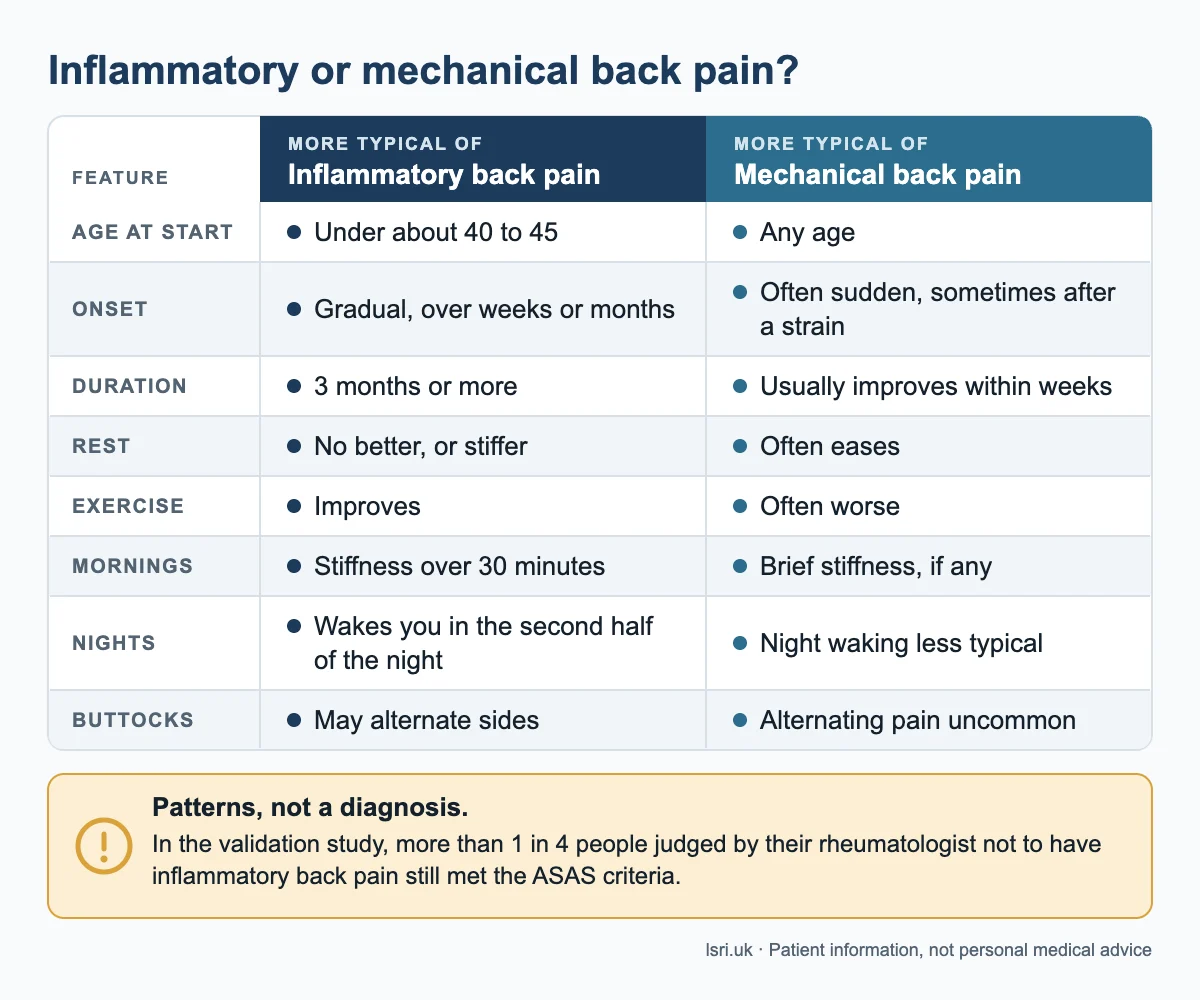
Inflammatory back pain starts gradually in early adult life, lasts for months, is worst after rest and in the morning, and eases with movement. Common mechanical back pain usually behaves the other way round and settles within weeks1,14.
In 1977, Calin and colleagues showed that five features could help pick out ankylosing spondylitis: onset before 40, a slow start, pain for at least 3 months, morning stiffness and improvement with exercise15. Later work added waking in the second half of the night and pain that alternates between the buttocks14.
A widely used definition comes from ASAS, the Assessment of SpondyloArthritis international Society. In the ASAS expert criteria, inflammatory back pain is present if at least four of five features are met: onset before age 40, insidious (gradual) onset, improvement with exercise, no improvement with rest, and pain at night that improves on getting up3.
| Feature | More typical of inflammatory back pain | More typical of mechanical back pain |
|---|---|---|
| Age at start | Under about 40 to 45 | Any age |
| Onset | Gradual, over weeks or months | Often sudden, sometimes after a strain |
| Duration | 3 months or more | Usually improves within weeks |
| Rest | No better, or stiffer | Often eases |
| Exercise | Improves | Often worse |
| Mornings | Stiffness over 30 minutes | Brief stiffness, if any |
| Nights | Wakes you in the second half of the night | Night waking less typical |
| Buttocks | May alternate sides | Alternating pain uncommon |
Checklists help, but they do not make the diagnosis
None of these features proves axSpA. The ASAS checklist was tested against rheumatologists’ own judgement of whether back pain was inflammatory, not against a final diagnosis. In a validation group of 648 people with chronic back pain that began before 45 (about 6 in 10 of whom had axSpA), about 8 in 10 people judged to have inflammatory back pain met the criteria3. But more than 1 in 4 people judged not to have inflammatory back pain also met them3.
In one UK primary care study, 75 people met the ASAS inflammatory back pain criteria on a questionnaire. Of the 38 who attended for assessment, only 3 met the ASAS classification criteria for axSpA, although 23 met older, broader criteria13.
Other clues make axSpA more likely. ASAS guidance on early referral says that when back pain has lasted 3 months or more and began before 45, having at least one clue, such as inflammatory back pain itself or any of the following, is a reason to see a rheumatologist16:
- arthritis in other joints, or enthesitis (pain where a tendon joins bone, such as the heel)
- dactylitis, a whole finger or toe swollen like a sausage
- psoriasis, inflammatory bowel disease (Crohn’s disease or ulcerative colitis) or uveitis (inflammation inside the eye)
- a family history of spondyloarthritis, or a good response to anti-inflammatory painkillers (NSAIDs, such as ibuprofen)
- a positive blood test for HLA-B27 (a gene variant found in most people with ankylosing spondylitis), or a raised CRP (C-reactive protein, a blood marker of inflammation)
How long does it take to be diagnosed?
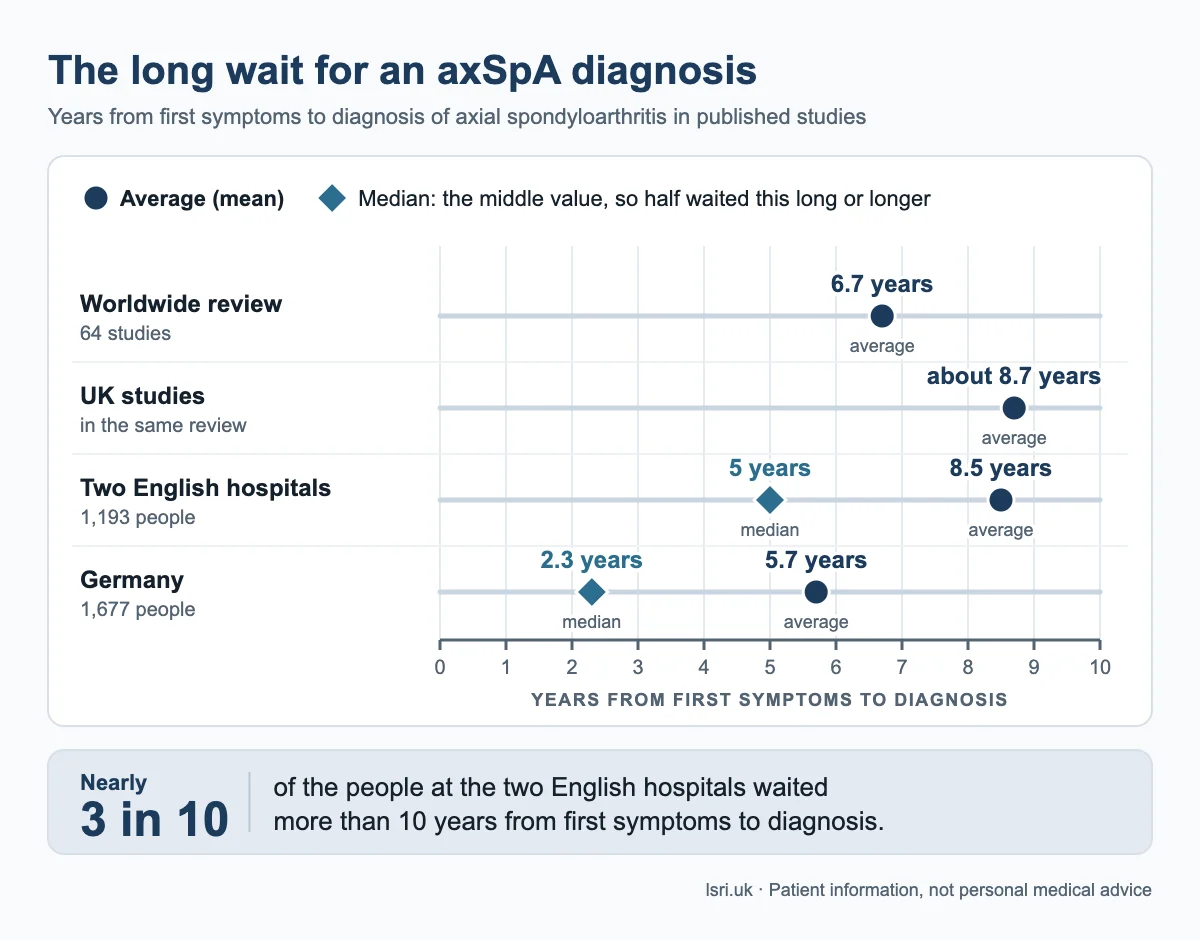
Usually several years. A 2021 systematic review and meta-analysis of 64 studies found an average delay of 6.7 years from first symptoms to diagnosis2. UK studies averaged about 8.7 years, and delays did not shorten in more recent studies2.
In 1,193 people with axSpA at two English hospitals, the average delay was 8.5 years and the median was 5 years17. So half waited 5 years or longer, and nearly 3 in 10 waited more than 10 years17. A German study of 1,677 people found an average of 5.7 years and a median of 2.3 years18.
Why is axial spondyloarthritis diagnosed so late?
Because its early signs look like common back pain, there is no single test, and X-rays can stay normal for years.
- Back pain is common; axSpA is not. In one UK primary care study, an estimated 1 to 5 in 100 people with chronic back pain had axSpA, depending on the criteria13. Inflammatory back pain can be missed because it looks like the common kind.
- Symptoms build slowly. They tend to develop over months or years and may come and go19.
- There is no definitive test. The NHS describes confirming the diagnosis as often “a long process that can take years”5.
- Blood tests can be normal. A normal inflammation test may not rule out AS5.
- HLA-B27 is not decisive. Most people with AS carry this gene variant, but not all do. Some people carry it without ever developing AS5.
- X-rays can look normal early. Spinal damage cannot always be seen in the early stages5. In a long-term study of 83 people with non-radiographic axSpA in one US county, 16 (about 1 in 5) went on to develop X-ray changes of ankylosing spondylitis over an average of about 10.6 years of follow-up20.
- Some groups wait longer. In the German study, delays were longer for women, people without HLA-B27, people with psoriasis and those with younger onset18. Across studies, evidence on sex differences was mixed2.
The meta-analysis authors suggest that better education about back pain, for doctors and patients, may help shorten the delay2.
What can a late diagnosis cost?
Years of untreated inflammation can mean ongoing pain and stiffness, lost work and, in some people, permanent spinal changes10,19. A systematic review of 21 studies found that people diagnosed late generally had worse function and more structural damage, and in some studies higher disease activity10. Delay was also linked with work disability, higher healthcare costs and poorer quality of life, and in some studies with depression10. Most of these studies were cross-sectional or retrospective, so they show a link but cannot prove that delay caused every difference.
AS has no cure, and the damage it causes cannot be reversed19. In some people, bones in the spine fuse in a fixed position, which can cause severe disability19. Treatment aims to control symptoms and inflammation, prevent structural damage and protect long-term function11. For more on why timing matters across bone and joint conditions, read why early imaging matters and the cost of delayed diagnosis.
How is axial spondyloarthritis diagnosed, and what can scans show?
A rheumatologist makes or confirms the diagnosis by combining your story, an examination, blood tests and imaging5,11.
The ASAS classification criteria apply to people with back pain for 3 months or more that began before 454. They are met by sacroiliitis on X-ray or MRI plus at least one other feature, or by HLA-B27 plus at least two4. They were designed to group patients for studies, so they guide but do not replace a specialist’s judgement11.
What an X-ray can and cannot show
An X-ray can show the structural changes of sacroiliitis: long-standing damage to the SI joints, such as erosions (small areas of worn-away bone), hardening of the bone edges or fusion, where the bones join together across the joint. With the right clinical features, an X-ray can confirm AS5. But X-ray changes build up slowly, as the follow-up study above shows20. A normal X-ray does not rule axSpA out.
What MRI adds
If an X-ray cannot confirm AS, an MRI is usually offered5. MRI can show active inflammation as bone marrow oedema: extra fluid in the bone just beneath the joint surface. The ASAS MRI working group’s definition of active sacroiliitis, written for classifying axSpA, rests on the clear presence of this oedema7. Structural changes such as erosions can help the reader decide that the inflammation is due to axSpA, but they are not required to meet the definition7.
MRI can also be normal in axSpA. The charity NASS reports that around 3 in 10 people with non-radiographic axSpA may have no inflammation visible on MRI despite symptoms6. Our guide to spine MRI for back pain explains more about what spinal MRI shows.
The honest limit: MRI “inflammation” without axSpA
Bone marrow oedema in the SI joints is not unique to axSpA. In one study, MRI scans meeting the ASAS definition of sacroiliitis were found in8:
- 11 of 47 healthy volunteers (23%)
- 3 of 24 runners
- 4 of 7 women with back pain after childbirth
- 43 of 47 people with axSpA
Deep, extensive lesions were found almost only in axSpA8. In another study, oedema was seen in 33% of women within 12 months of giving birth, against 14% of women who had never given birth9. About three-quarters of the women with oedema met the ASAS MRI definition, and the authors warned that SI joint MRI should not be interpreted in isolation9.
So the extent and pattern of oedema matter8. In our view, the scan should be reported by a specialist musculoskeletal (MSK) radiologist: a doctor who specialises in scans of bones, joints and muscles. Experience of SI joint MRI matters, because it helps the radiologist judge the extent and pattern of any oedema with confidence. A rheumatologist should then interpret the findings alongside your symptoms, examination and blood tests, because SI joint MRI should not be read in isolation and other causes of MRI changes need to be excluded9,11.
When you do not need a scan
- New back pain that is settling. Most back pain improves within a few weeks1. If yours is improving, a scan is unlikely to change what you do.
- As a stand-alone test for axSpA. A “positive” MRI without the clinical picture can mislead8,9.
- Routine monitoring once diagnosed. MRI is not routinely recommended for this, though it can help when there is doubt about the cause of symptoms or whether inflammation is active11.
If you have given birth in the past year, tell the doctor requesting an SI joint MRI, because oedema is more common then9.
What should you do if this sounds like you?
Most long-lasting back pain is not axSpA13, but if yours has lasted 3 months or more and started before 45, it is reasonable to ask your GP whether it could be inflammatory. Even if it turns out not to be axSpA, getting it checked can give you peace of mind.
- Write down your pattern. Note when it started, how long morning stiffness lasts, what exercise and rest do, and whether pain wakes you.
- See your GP if symptoms persist. If AS is suspected, your GP should refer you to a rheumatologist19. ASAS guidance on early referral suggests seeing a rheumatologist when back pain has lasted 3 months or more, began before 45 and at least one clue is present, such as inflammatory back pain, HLA-B27 or psoriasis16.
- Mention clues outside your back. Eye inflammation, psoriasis, bowel disease, heel pain, swollen fingers or toes and family history all matter16.
- Do not be put off by one normal result. Normal inflammation tests and early X-rays do not always rule out AS5.
- Get scans interpreted in context. Discuss any MRI report with your GP or rheumatologist alongside your symptoms and blood tests11.
- Know the urgent signs. Call 999 or go to A&E if back pain comes with numbness or weakness in both legs1. The same applies to numbness around the genitals or bottom, or new bladder or bowel problems1. Ask for an urgent GP appointment or contact NHS 111 if you feel hot, cold, shivery or generally unwell with back pain1.
What does treatment look like after diagnosis?
Treatment combines exercise with medicines and is coordinated by a rheumatologist. The 2022 ASAS and EULAR (European Alliance of Associations for Rheumatology) recommendations include11:
- Education, regular exercise and stopping smoking, with physiotherapy considered, especially for people who struggle to exercise alone.
- NSAIDs as first-line medicine, up to the maximum dose if needed.
- No long-term steroid tablets for spinal disease, though a local steroid injection may be considered.
- Biologic or targeted medicines (drugs that block specific inflammation signals, such as TNF inhibitors, IL-17 inhibitors or JAK inhibitors) when disease stays highly active despite standard treatment. Doctors take a raised CRP and inflammation on SI joint MRI into account, as both help predict who will respond, and the approvals for some medicines have required sacroiliitis on X-ray.
- Surgery, such as hip replacement, for severe damage, which is uncommon11,19.
With modern treatment, AS does not normally affect life expectancy significantly19. The National Axial Spondyloarthritis Society (NASS) is a UK charity that offers information and a helpline6. If your pain is mainly in swollen hand or foot joints, read about the first three months of inflammatory arthritis and osteoarthritis versus rheumatoid arthritis.
How LSRI can help
LSRI is a specialist musculoskeletal (MSK) imaging clinic. Our approach is to diagnose first, diagnose accurately, then treat. We do not replace a rheumatologist, and we do not diagnose axSpA from a scan alone. The diagnosis needs a clinical assessment and blood tests, as well as imaging.
- MRI of the SI joints. If an MRI has been suggested, or you want one privately, our MRI scans start from £375 per body part. The SI joints and the pelvis are separate body parts. In our experience, a dedicated SI joint scan shows these joints in more detail than a pelvis scan, which covers a much larger area. The price includes the scan, a consultant MSK radiologist’s report and access to your images; MRI with a consultation is from £425. Reports are usually ready within 24 hours.
- Second opinions. If you already have a scan or report and are unsure what it means, see our second opinion page.
- Joined-up care. Blood tests such as CRP and HLA-B27, and the diagnosis itself, come from your GP or rheumatologist. Please share your MRI report with them. For other inflammatory joint disease, see our page on imaging in rheumatoid arthritis.
Our clinics are at Harley Street (W1G 9QJ) and Harrow (HA2 7SJ). Call 0203 633 5040.
Reading this from outside the UK? The medical information here applies wherever you live, and long delays to diagnosis are reported worldwide2. Routes to a rheumatologist differ, so ask your family doctor how referral works locally. For sudden numbness or weakness in both legs, numbness around the genitals or new bladder or bowel problems, call your local emergency number at once: 999 or 112 (UK), 112 (EU), 911 (US and Canada) or 000 (Australia).
Frequently asked questions
What are the early signs of inflammatory back pain?
It usually starts before about 40, comes on gradually and lasts for months. It tends to be worse after rest, better with exercise, and can wake you at night, easing when you get up3. Morning stiffness over 30 minutes and pain alternating between the buttocks are other clues14.
Can you have axial spondyloarthritis with a normal X-ray?
Yes. This is non-radiographic axSpA, where inflammation may show on MRI instead6. X-ray changes can take years to appear: in one long-term study, most people with the non-radiographic form had not developed them after about 10 years20.
Does a positive HLA-B27 test mean I have ankylosing spondylitis?
No. Most people with AS carry HLA-B27, but not all do, and some people carry it without ever developing the condition5.
Can an MRI scan rule axial spondyloarthritis in or out?
Not on its own. Changes meeting the MRI definition of sacroiliitis appear in some healthy people, runners and women after childbirth8,9. NASS reports that around 3 in 10 people with non-radiographic axSpA may have no inflammation visible on MRI6.
How long does it take to get diagnosed with axial spondyloarthritis?
On average 6.7 years worldwide, and about 8.7 years in UK studies2. In one English study, half of patients waited 5 years or more17.
References
- NHS. Back pain. nhs.uk
- Zhao SS, Pittam B, Harrison NL, Ahmed AE, Goodson NJ, Hughes DM. Diagnostic delay in axial spondyloarthritis: a systematic review and meta-analysis. Rheumatology (Oxford) 2021;60(4):1620-1628. doi:10.1093/rheumatology/keaa807
- Sieper J, van der Heijde D, Landewé R, Brandt J, Burgos-Vargas R, Collantes-Estevez E, et al. New criteria for inflammatory back pain in patients with chronic back pain: a real patient exercise by experts from the Assessment of SpondyloArthritis international Society (ASAS). Ann Rheum Dis 2009;68(6):784-788. doi:10.1136/ard.2008.101501
- Rudwaleit M, van der Heijde D, Landewé R, Listing J, Akkoc N, Brandt J, et al. The development of Assessment of SpondyloArthritis international Society classification criteria for axial spondyloarthritis (part II): validation and final selection. Ann Rheum Dis 2009;68(6):777-783. doi:10.1136/ard.2009.108233
- NHS. Diagnosis: ankylosing spondylitis. nhs.uk
- National Axial Spondyloarthritis Society (NASS). What is axial SpA? nass.co.uk
- Lambert RGW, Bakker PAC, van der Heijde D, Weber U, Rudwaleit M, Hermann KGA, et al. Defining active sacroiliitis on MRI for classification of axial spondyloarthritis: update by the ASAS MRI working group. Ann Rheum Dis 2016;75(11):1958-1963. doi:10.1136/annrheumdis-2015-208642
- de Winter J, de Hooge M, van de Sande M, de Jong H, van Hoeven L, de Koning A, et al. Magnetic resonance imaging of the sacroiliac joints indicating sacroiliitis according to the Assessment of SpondyloArthritis international Society definition in healthy individuals, runners, and women with postpartum back pain. Arthritis Rheumatol 2018;70(7):1042-1048. doi:10.1002/art.40475
- Hoballah A, Lukas C, Leplat C, Taourel P, Pialat JB, Sans N, et al. MRI of sacroiliac joints for the diagnosis of axial SpA: prevalence of inflammatory and structural lesions in nulliparous, early postpartum and late postpartum women. Ann Rheum Dis 2020;79(8):1063-1069. doi:10.1136/annrheumdis-2020-217208
- Yi E, Ahuja A, Rajput T, George AT, Park Y. Clinical, economic, and humanistic burden associated with delayed diagnosis of axial spondyloarthritis: a systematic review. Rheumatol Ther 2020;7(1):65-87. doi:10.1007/s40744-020-00194-8
- Ramiro S, Nikiphorou E, Sepriano A, Ortolan A, Webers C, Baraliakos X, et al. ASAS-EULAR recommendations for the management of axial spondyloarthritis: 2022 update. Ann Rheum Dis 2023;82(1):19-34. doi:10.1136/ard-2022-223296
- Sieper J, Poddubnyy D. Axial spondyloarthritis. Lancet 2017;390(10089):73-84. doi:10.1016/S0140-6736(16)31591-4
- Hamilton L, MacGregor AJ, Toms AP, Warmington V, Pinch E, Gaffney K. The prevalence of axial spondyloarthritis in the UK: a cross-sectional cohort study. BMC Musculoskelet Disord 2015;16:392. doi:10.1186/s12891-015-0853-2
- Rudwaleit M, Metter A, Listing J, Sieper J, Braun J. Inflammatory back pain in ankylosing spondylitis: a reassessment of the clinical history for application as classification and diagnostic criteria. Arthritis Rheum 2006;54(2):569-578. doi:10.1002/art.21619
- Calin A, Porta J, Fries JF, Schurman DJ. Clinical history as a screening test for ankylosing spondylitis. JAMA 1977;237(24):2613-2614. doi:10.1001/jama.1977.03270510035017
- Poddubnyy D, van Tubergen A, Landewé R, Sieper J, van der Heijde D; Assessment of SpondyloArthritis international Society. Development of an ASAS-endorsed recommendation for the early referral of patients with a suspicion of axial spondyloarthritis. Ann Rheum Dis 2015;74(8):1483-1487. doi:10.1136/annrheumdis-2014-207151
- Sykes MP, Doll H, Sengupta R, Gaffney K. Delay to diagnosis in axial spondyloarthritis: are we improving in the UK? Rheumatology (Oxford) 2015;54(12):2283-2284. doi:10.1093/rheumatology/kev288
- Redeker I, Callhoff J, Hoffmann F, Haibel H, Sieper J, Zink A, et al. Determinants of diagnostic delay in axial spondyloarthritis: an analysis based on linked claims and patient-reported survey data. Rheumatology (Oxford) 2019;58(9):1634-1638. doi:10.1093/rheumatology/kez090
- NHS. Ankylosing spondylitis. nhs.uk
- Wang R, Gabriel SE, Ward MM. Progression of nonradiographic axial spondyloarthritis to ankylosing spondylitis: a population-based cohort study. Arthritis Rheumatol 2016;68(6):1415-1421. doi:10.1002/art.39542
Book an appointment
Call 0203 633 5040 or book online. Clinics at Harley Street (W1G 9QJ) and Harrow (HA2 7SJ). If you have emergency symptoms, go to A&E or call 999 instead.
About this article
Purpose: written by the LSRI clinical team to help the public recognise the signs of inflammatory back pain and why axial spondyloarthritis is so often diagnosed years after symptoms start, based on the research and guidance listed above. It is general information, not a diagnosis. If you are worried about your own symptoms, speak to your GP or, in an emergency, go to A&E. This article does not describe any individual patient and is not a criticism of any clinician.