Written by: LSRI Editorial Team
Medically reviewed by Dr Prashant Sankaye, Consultant MSK Radiologist ·
Last Updated: October 14, 2026
Read Time: 13 Minutes
Written by the LSRI clinical team and medically reviewed by Dr Prashant Sankaye, Consultant MSK Radiologist, on 11 October 2026.
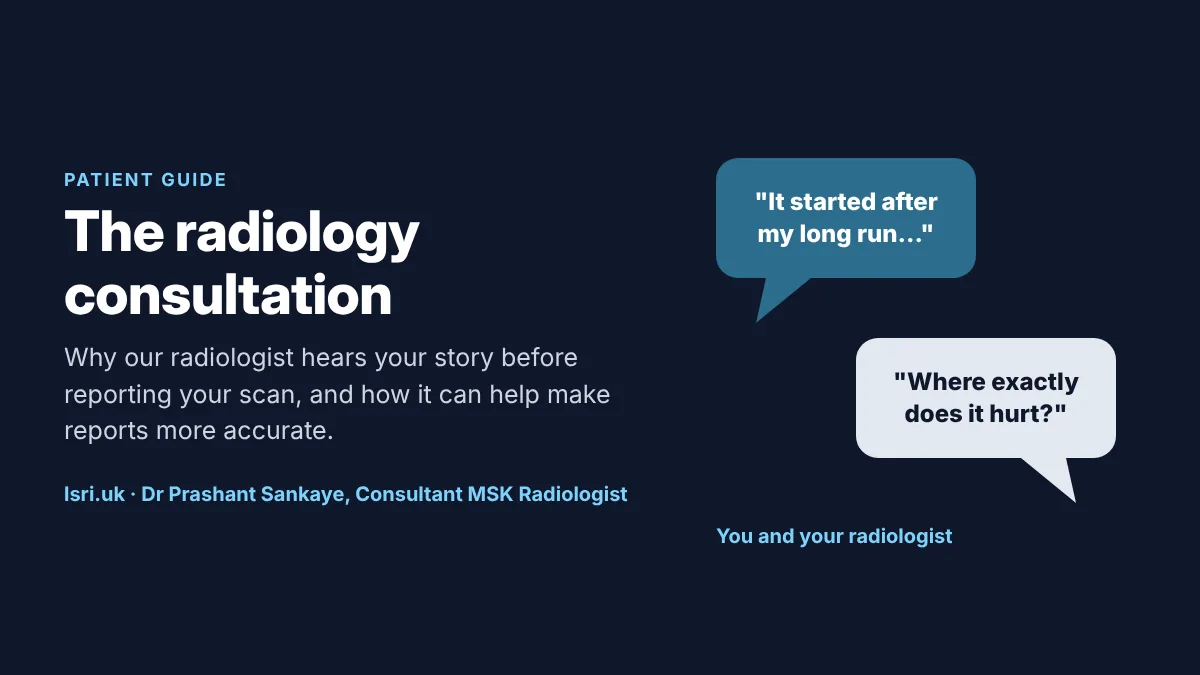
Most people never meet the radiologist who reports their scan. You lie in the scanner, the images are sent off, and a few days later a report arrives, written by a doctor who has never heard your story. For much of its history, radiology has been a “behind the scenes” specialty: radiologists usually work away from patients, in reporting rooms, relying on the clinical details written on the request form. At LSRI, we hear your story first: how your problem started and what it stops you doing. Your radiologist uses that to plan and read your scan. We call this a radiology consultation. This article explains what it is, why the evidence supports it, and what to expect.
Key points
- A radiology consultation is a conversation between you and the radiologist about your symptoms, history and scan, rather than a report written without ever meeting you.
- Clinical information improves the accuracy of scan reading. In a systematic review, there were no instances in which it significantly reduced accuracy.1
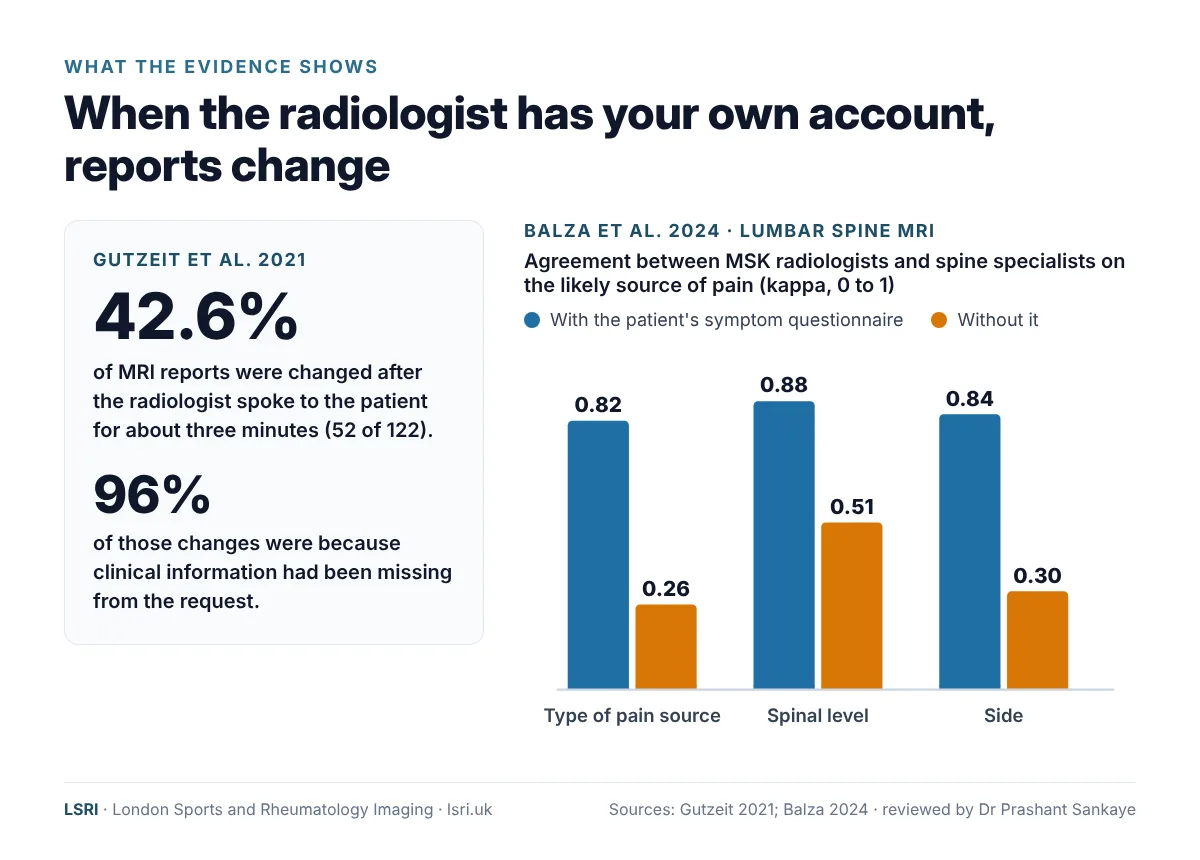
- In one study, a conversation of about three minutes between a radiologist and the patient led to changes in 42.6% of MRI reports, almost all because clinical information had been missing.2
- In one survey of radiologists, many supported talking to patients more directly, but 73% said time or workload frequently stopped them.3
- A radiology consultation works alongside your GP, consultant or physiotherapist. It does not replace them.
What is a radiology consultation?
A radiology consultation is time with the radiologist: the specialist doctor who plans your scan, interprets the images and writes the report. It can happen before the scan, after it, or both. In it, the radiologist:
- hears your history first-hand: where it hurts, how and when it started, what makes it worse, what you have already tried, and your past injuries, operations and medical conditions;
- uses that information to choose the right test and set up the scan to answer your question;
- reads the images with your story in mind, and compares them with any previous scans;
- explains what the scan shows, and what it does not, in plain language.
Radiology consultation clinics have been piloted in a few hospitals elsewhere. In one small pilot at a large US hospital (22 patients), patients rated reviewing their scans with a radiologist as very helpful (4.8 out of 5), and all of them said they would do it again.4
Why radiologists usually don’t meet their patients
Radiologists are doctors, and most of us chose medicine to help patients. But radiology departments are under enormous pressure. The Royal College of Radiologists’ 2025 census found a 32% shortfall of consultant radiologists in the UK, and only around one in five clinical directors said they had enough consultant radiologists for safe and effective patient care.5 When the priority is getting through the list, conversations with patients are usually the first thing to go. In a survey of radiologists, 73% said time or workload frequently prevented them from communicating directly with patients, even though many supported the idea.3
More and more scans are also reported remotely. NHS spending on outsourced radiology reporting across the UK rose to over £241 million in 2025, and the reporting of around a quarter of NHS MRI scans is now outsourced.5 The Royal College of Radiologists has noted that teleradiology reporters often lack access to patients’ previous imaging and electronic records, and may not be able to speak to the clinician looking after the patient.6
Remote reporting services, especially if based outside the UK, may not have the full context of your case. None of this is a criticism of the many skilled radiologists who report remotely. It is a limitation of a system in which the person reading the scan is cut off from the person in it.
Why your story changes what the radiologist sees
Clinical information makes reading more accurate
The research on this is consistent. A systematic review in JAMA found that, overall, clinical information improved the accuracy of reading tests, sometimes by improving sensitivity without any loss of specificity.1 A later review of 20 studies concluded that clinical information improved accuracy, clinical relevance and confidence in the report.7 In musculoskeletal imaging, simply knowing where the pain and tenderness were helped radiologists find subtle fractures, without increasing false alarms.8
Hearing it from you is better than reading it second-hand
Request forms are often brief, and details can be lost along the way. In one US study, the clinical information on imaging requests was incomplete in 81% of cases when compared with the clinician’s own notes.9 Wrong information can be worse than none: in one study of CT reports, clinical information improved accuracy when it was correct, and reduced it when it was not.10
Imagine a request that says “knee pain after a fall”, when in fact the pain came on slowly with no injury at all. The radiologist would be looking for very different things. This is not a criticism of referrers: request forms have limited space, and the person referring you cannot know every detail the radiologist will need.
The most direct evidence comes from a study of 122 outpatients having MRI. Radiologists first reported each scan in the usual way, using only the information on the request; a radiologist then spoke to the patient for about three minutes, and the scan was read again. After that conversation, 52 reports (42.6%) were changed, and in 96.2% of these the reason was clinical information missing from the request. In about a third of the changed reports, the change was judged highly relevant.2
It helps decide which finding matters
Musculoskeletal scans often show more than one abnormality, and many changes are a normal part of ageing. Disc degeneration, for example, is seen on the scans of 37% of 20-year-olds and 96% of 80-year-olds who have no back pain at all.11 The question is not “is there anything abnormal?” but “what is causing this person’s symptoms?” In a study of lumbar spine MRI, musculoskeletal radiologists who had the patient’s own symptom questionnaire agreed closely with spine specialists about the likely source of pain (agreement statistics of 0.82 to 0.88). Without it, agreement was only fair to moderate (0.26 to 0.51).12
Many scan reports end with the phrase “clinical correlation recommended”. It means: the radiologist has described what the images show, and someone who knows the patient now needs to decide what it means. In a radiology consultation, the radiologist does as much of that correlation as possible before writing the report.
How a radiology consultation works at LSRI
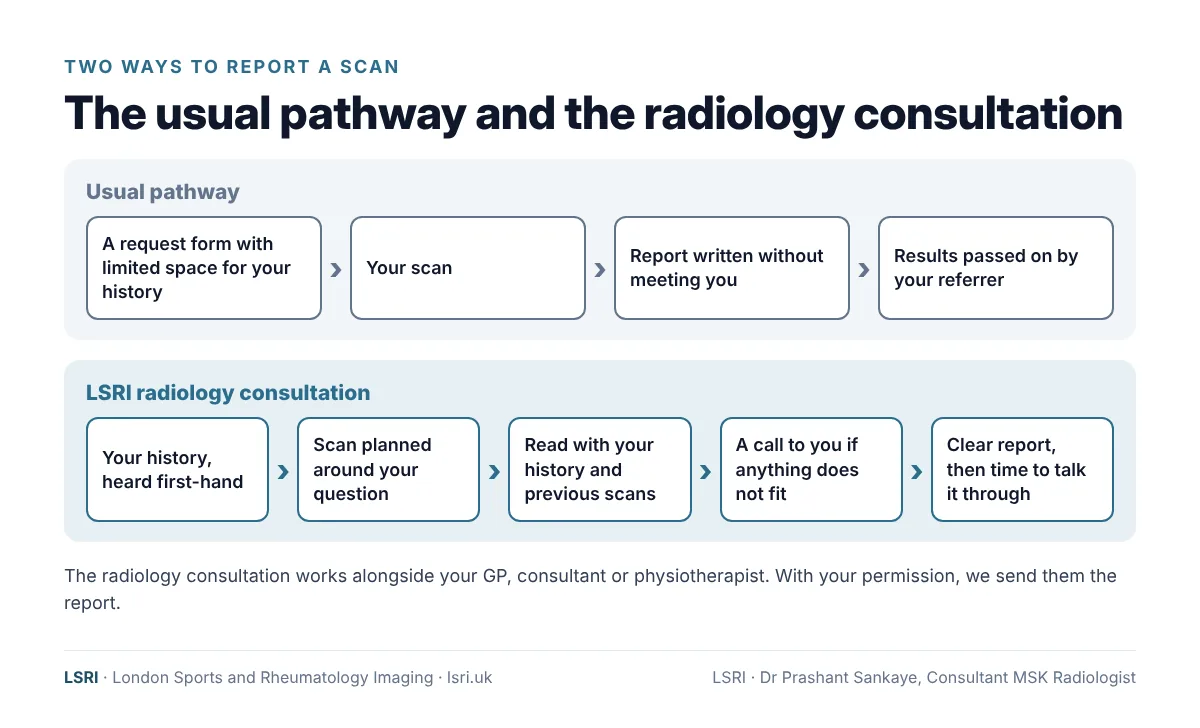
- Before your scan, we listen. We ask about your symptoms, how they started, your previous injuries, operations and scans, and any other medical conditions. If you have had scans elsewhere, we ask you to bring or send them.
- We choose and plan the right test. Sometimes that is MRI, sometimes ultrasound, and sometimes both. See MRI or ultrasound for joint pain? The MRI protocol is set up around your symptoms and your question.
- Your scan. At our Harley Street or Harrow clinic (for patients seen in Harrow, MRI is arranged at a partner centre).
- Reading with the full picture. Dr Prashant Sankaye, Consultant MSK Radiologist, reads your images alongside your history and any previous imaging. If something does not fit, he may call you to ask more questions before finalising the report.
- A report that answers your question. Your report describes what is relevant to your symptoms, with a clear conclusion. It is usually ready within 24 hours.
- Talking it through. MRI with a consultation, to go through the results and next steps, is from £425. Consultations can also be booked on their own.
- Working with your clinicians. With your permission, we send the report to your GP, consultant or physiotherapist, so that everyone is working from the same diagnosis.
“We are clinical radiologists, and that comes with a duty of care to every patient. Before I write a report, I want to understand the person: how their pain started, what it stops them doing, what has already been tried. Very often the answer to a difficult scan is in the history. It’s why so many of our patients come back to us.”
Dr Prashant Sankaye, Consultant MSK Radiologist
Who benefits most from a radiology consultation?
- People with long-standing pain that has not been explained, or has not improved with treatment.
- People whose previous scan report does not seem to match their symptoms.
- Anyone with several problems in the same area, previous surgery, or a complicated medical history.
- Athletes and active people who need a precise diagnosis to plan their return to sport.
- People with a lump, a bone abnormality or a possible tumour that needs careful characterisation.
- People with inflammatory arthritis, where the pattern of findings matters.
- Clinicians, solicitors and insurers who need a detailed, independent opinion. See our medicolegal services.
If you have a lump that is growing or painful, or bone pain that is worse at night, see your GP promptly. A private scan or second opinion should not replace or delay an urgent referral.
What a radiology consultation is not
A radiology consultation does not replace your GP, consultant, surgeon or physiotherapist. Many patients prefer to receive their results from the doctor who referred them,13 and UK standards make the referring clinician responsible for acting on the result.14 What the radiology consultation adds is an accurate, clearly explained diagnosis that your clinicians can build on. Where treatment is needed, we will explain the options, offer image-guided treatment where appropriate, and point you to the right specialist if you need one.
Patients also value the conversation for its own sake. In a randomised study of MRI outpatients, those who talked their results through with the radiologist rated the radiology department as more competent, and 93% of them (compared with 75% of those who did not have it) wanted the same kind of conversation after future scans.15
How LSRI can help
- Advice before you book. Call us to discuss whether a scan is likely to help, and which one.
- Specialist reporting. Your MRI is reported by a consultant musculoskeletal radiologist within 24 hours.
- Clear pricing. MRI from £375 per body part, including the scan, a specialist report and access to your images.
- Time to talk. MRI with a consultation, to go through the results and next steps, is from £425.
- Second opinions. If you have had a scan elsewhere and are not sure about the result, ask about an independent MRI second opinion.
Read more: Can an MRI miss something? and why it matters who reports your MRI.
Frequently asked questions
Can I speak to the radiologist who reported my scan?
At LSRI, yes: choose MRI with a consultation (from £425), or book a consultation, to go through the results with a consultant MSK radiologist. In other services, ask the clinician who referred you; in many hospitals, radiologists are available to discuss scans with referring clinicians.
Do I need a referral?
Not usually, if you are paying for yourself. If you are claiming through private medical insurance, your insurer may ask for a referral, so check with them first. We always recommend sharing your results with your GP.
What should I bring?
A short written history (when it started, how, what makes it worse, what has been tried), a list of your medicines and medical conditions, and any previous scans and reports. Images are more useful than reports alone, and can usually be shared by secure link, CD or USB.
Will the radiologist tell me what treatment I need?
We will explain what the scan shows and what it means for you, discuss the options, and tell you if image-guided treatment such as an ultrasound-guided injection might help. Decisions about surgery or long-term management are made with the clinician who leads your care.
Is a radiology consultation the same as a second opinion?
Not quite. A radiology consultation is part of how we perform and report every scan. A second opinion is an independent review of a scan you have already had elsewhere, and it also starts with hearing your history.
Book an appointment
Call 0203 633 5040 or book online. Clinics at Harley Street (W1G 9QJ) and Harrow (HA2 7SJ). If you have emergency symptoms, go to A&E or call 999 instead.
References
- Loy CT, Irwig L. Accuracy of diagnostic tests read with and without clinical information: a systematic review. JAMA 2004;292(13):1602–1609. doi:10.1001/jama.292.13.1602
- Gutzeit A, Sartoretti E, Reisinger C, et al. Direct communication between radiologists and patients improves the quality of imaging reports. European Radiology 2021;31(11):8725–8732. doi:10.1007/s00330-021-07933-7
- Kemp JL, Mahoney MC, Mathews VP, et al. Patient-centered radiology: where are we, where do we want to be, and how do we get there? Radiology 2017;285(2):601–608. doi:10.1148/radiol.2017162056
- Mangano MD, Bennett SE, Gunn AJ, et al. Creating a patient-centered radiology practice through the establishment of a diagnostic radiology consultation clinic. American Journal of Roentgenology 2015;205(1):95–99. doi:10.2214/AJR.14.14165
- The Royal College of Radiologists. Clinical radiology workforce census 2025. 2026. rcr.ac.uk
- The Royal College of Radiologists. Clinical radiology workforce census 2024. 2025. rcr.ac.uk
- Castillo C, Steffens T, Sim L, Caffery LJ. The effect of clinical information on radiology reporting: a systematic review. Journal of Medical Radiation Sciences 2021;68(1):60–74. doi:10.1002/jmrs.424
- Berbaum KS, el-Khoury GY, Franken EA Jr, et al. Impact of clinical history on fracture detection with radiography. Radiology 1988;168(2):507–511. doi:10.1148/radiology.168.2.3393672
- Lacson R, Laroya R, Wang A, et al. Integrity of clinical information in computerized order requisitions for diagnostic imaging. Journal of the American Medical Informatics Association 2018;25(12):1651–1656. doi:10.1093/jamia/ocy133
- Leslie A, Jones AJ, Goddard PR. The influence of clinical information on the reporting of CT by radiologists. British Journal of Radiology 2000;73(874):1052–1055. doi:10.1259/bjr.73.874.11271897
- Brinjikji W, Luetmer PH, Comstock B, et al. Systematic literature review of imaging features of spinal degeneration in asymptomatic populations. American Journal of Neuroradiology 2015;36(4):811–816. doi:10.3174/ajnr.A4173
- Balza R, Mercaldo SF, Huang AJ, et al. Impact of patient-reported symptom information on the interpretation of MRI of the lumbar spine. Radiology 2024;313(1):e233487. doi:10.1148/radiol.233487
- Mangano MD, Rahman A, Choy G, et al. Radiologists’ role in the communication of imaging examination results to patients: perceptions and preferences of patients. American Journal of Roentgenology 2014;203(5):1034–1039. doi:10.2214/AJR.14.12470
- The Royal College of Radiologists. Standards for interpretation and reporting of imaging investigations, third edition. October 2025. rcr.ac.uk
- Gutzeit A, Heiland R, Sudarski S, et al. Direct communication between radiologists and patients following imaging examinations. Should radiologists rethink their patient care? European Radiology 2019;29(1):224–231. doi:10.1007/s00330-018-5503-2
About this article
Written by the LSRI clinical team to explain how and why our radiologist talks to patients, based on the research and guidance listed above. It is general information, not a diagnosis; if you are worried about your own symptoms, speak to your GP or the clinician looking after you. Nothing in this article is a criticism of any individual radiologist, hospital or reporting provider: radiology services across the UK are under real pressure, and the limits described here are limits of the system, not of the people working in it.