Written by: LSRI Editorial Team
Medically reviewed by Dr Prashant Sankaye, Consultant MSK Radiologist ·
Last Updated: October 14, 2026
Read Time: 12 Minutes
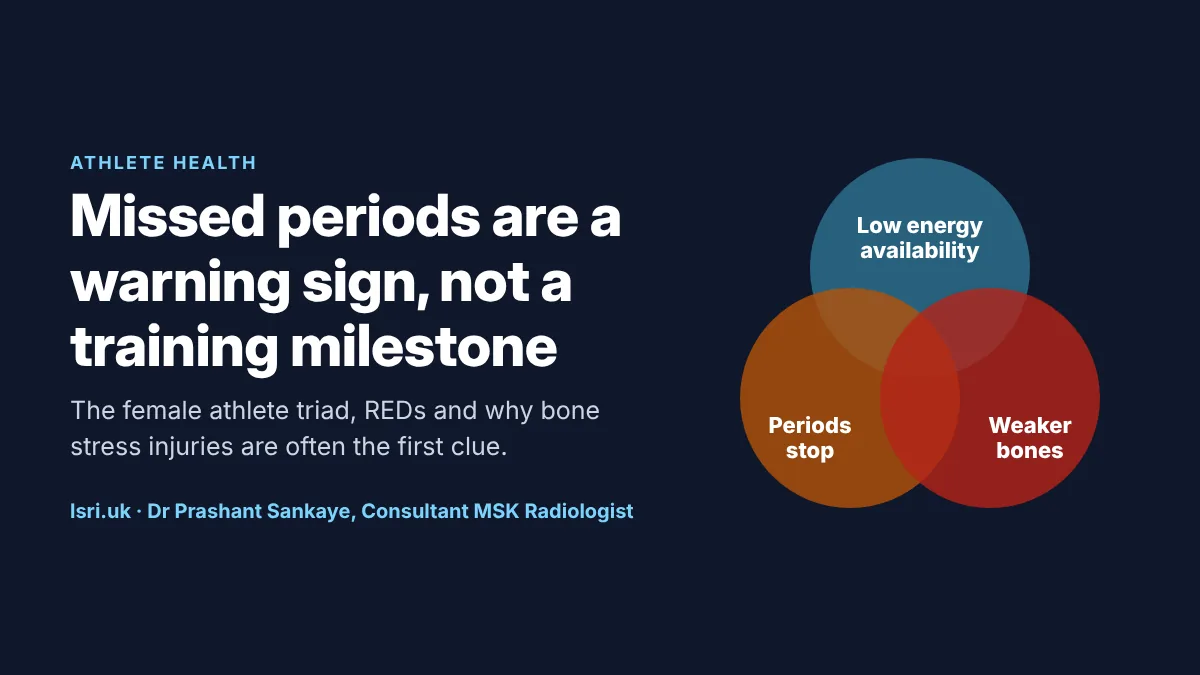
Many athletes, parents and even coaches still see missed periods as a normal, even expected, part of hard training. They are not. Periods stopping is one of the clearest signals that the body is not getting enough energy for what is being asked of it, and that signal is often linked to weaker bones and bone stress injuries. In sports medicine this pattern is known as the female athlete triad, and it is now understood as part of a wider condition called Relative Energy Deficiency in Sport (REDs), which can affect men too. As musculoskeletal radiologists, we often see the end result on MRI: a stress fracture in a young athlete, sometimes in the hip, pelvis or sacrum, sometimes after months of pain. This guide explains the triad and REDs, the warning signs not to ignore, and what to do about them.
Key points
- It is never normal for training to stop your periods. If your periods have stopped for three months or more, see a doctor.1,2
- The female athlete triad links three things: low energy availability, changes to periods, and low bone density.3
- REDs is the broader picture. Low energy availability can affect hormones, bones, immunity, the heart, mood and performance, in women and men.4,5
- Bone stress injuries become more likely as triad risk factors add up. In one study, rates rose from about 15–20% with one risk factor to 30–50% with several.6
- Hormonal contraception can hide the problem: a bleed on the pill is not a natural period, and the pill is not a reliable way to protect bone in this situation.7
What is the female athlete triad?
The term was first used in the 1990s and was updated by the American College of Sports Medicine in 2007. It describes three linked conditions, each of which sits on a spectrum from healthy to unhealthy:3
- Energy availability. This is the energy left over for the body’s essential functions after the energy used in exercise has been taken away. It can be low because of an eating disorder, because of intentional dieting or restrictive eating, or simply by accident, when someone does not realise how much more they need to eat to match their training.
- Menstrual function. When energy is low, the brain turns down the hormones that drive the menstrual cycle. Periods may become irregular, lighter or stop altogether (amenorrhoea). Oestrogen levels fall.
- Bone health. Oestrogen and adequate nutrition are both needed to build and maintain bone. Without them, bone density falls, and the risk of bone stress injuries rises.
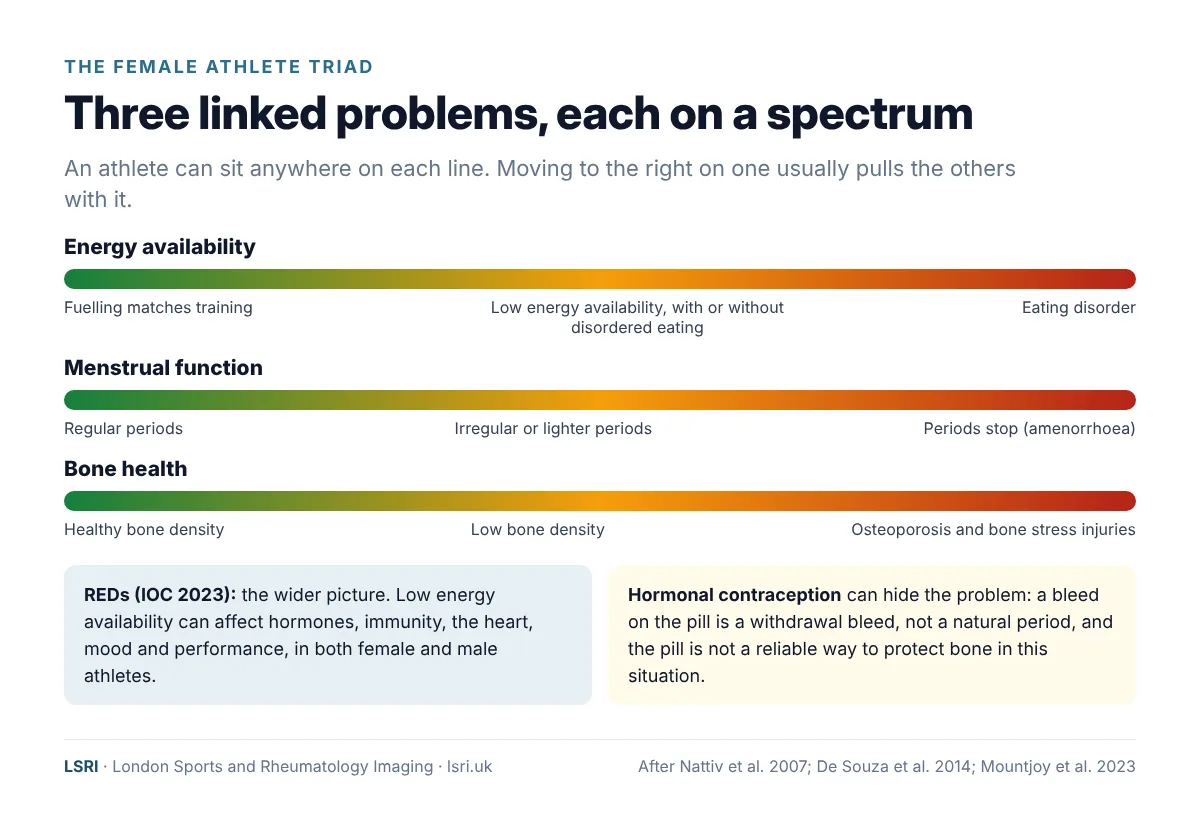
An athlete does not need to be at the extreme end of all three to be affected. A review of studies of exercising women found that only a small minority (up to about 16% across studies) had all three conditions at once, while between 16% and 60% had one of them.8
From the triad to REDs
In 2014, and again in 2023, the International Olympic Committee widened the concept and called it Relative Energy Deficiency in Sport, now abbreviated to REDs.4,5 The key changes were:
- It is not only about periods and bones. Problematic low energy availability can affect metabolism, the heart and blood vessels, the immune system, gut health, mental health, growth and development, and athletic performance.
- Men are affected too. In men, low energy availability can lower testosterone and reduce bone density. Signs can include a low sex drive and fewer morning erections, and bone stress injuries.5,9
- Not every dip in energy is harmful. Short periods of lower energy availability can be adaptable and reversible. It is prolonged or severe low energy availability that causes problems.5
Why missed periods matter for bones
Periods stopping is not a sign of fitness. It is a sign that the body is conserving energy by switching off non-essential systems, and reproduction is one of the first to go. The UK Sports Institute is clear that it is never normal for an athlete to stop menstruating.2
Without enough oestrogen and energy, bone is not built and maintained properly. That matters especially in the teenage years and twenties, when most peak bone mass is laid down. The result can be bone that breaks under training loads that it should be able to handle.
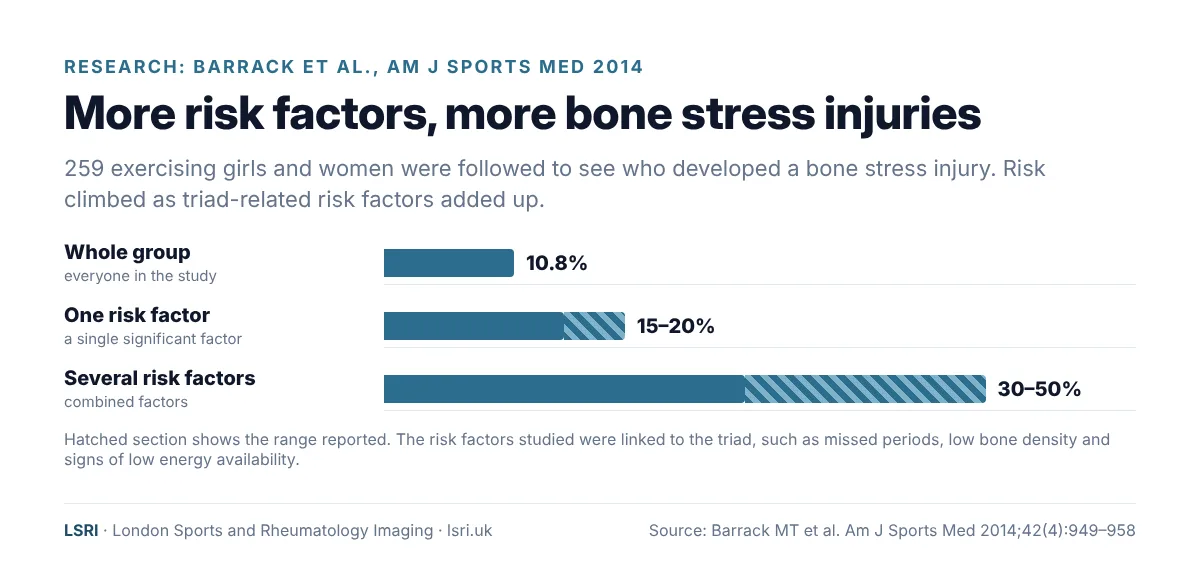
A study following 259 exercising girls and women showed this clearly. Overall, about 11% developed a bone stress injury during the study, but the risk rose steeply as triad-related risk factors added up, reaching 30–50% in those with several.6 A study of college athletes found similar results: a higher triad risk score predicted a higher chance of developing a bone stress injury.10
Where the injuries happen gives a clue
Triad and REDs risk factors, especially low bone density, are more strongly linked to bone stress injuries in bones rich in spongy, “trabecular” bone, such as the femoral neck (the top of the thigh bone) and the pelvis, than to injuries in the shin.11 The same pattern has been seen in male athletes with low bone density.12 These are also some of the more serious stress fracture sites, so a stress fracture in the hip, pelvis or sacrum in a young athlete should always prompt the question: is low energy availability part of the story? Our case study on a hip stress fracture that would not settle shows why these injuries need prompt diagnosis.
The pill can hide the problem
Many athletes take hormonal contraception, which can produce a regular monthly bleed. That bleed is a withdrawal bleed caused by the pill, not a natural period, so it can mask the fact that natural periods have stopped. The Female Athlete Triad Coalition points out that the combined pill does not restore natural periods, can give a false sense of security, and has not been shown to reliably improve bone density in athletes whose periods have stopped.7 The real treatment is to address the energy deficit. This does not mean anyone should stop their contraception without talking to their doctor first.
Signs not to ignore
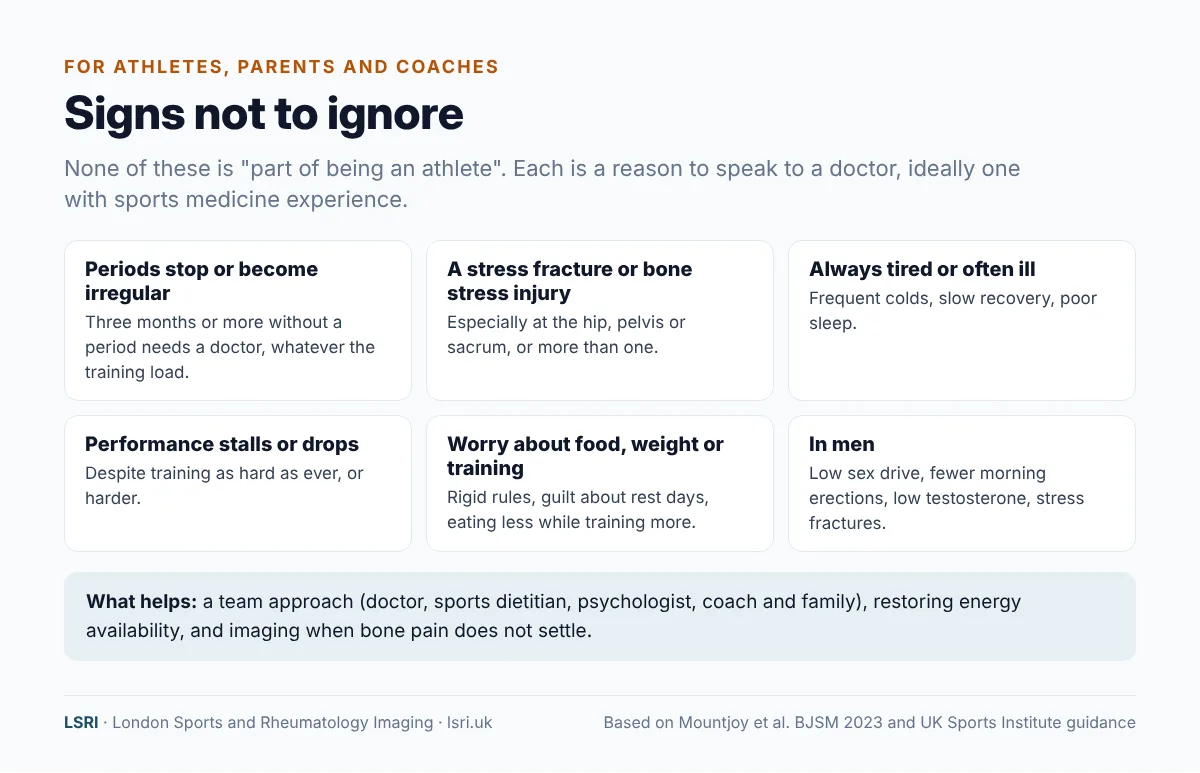
- Periods that stop, become irregular, or have not started by the expected age. The NHS advises seeing a GP if you have missed 3 periods in a row, if your periods have become irregular, or if your periods have not started by the age of 15.1
- A bone stress injury or stress fracture, especially more than one, or one in the hip, pelvis or sacrum.
- Persistent tiredness, frequent illness or slow recovery from training.
- Performance that stalls or falls despite training as hard as ever.
- Worry about food, weight or training: rigid rules, guilt about rest days, or eating less while training more.
- In men: low sex drive, fewer morning erections, or bone stress injuries.
What to do
- See your GP or a sports medicine doctor. Explain your training and your periods honestly. Tests may include blood tests and a check of other causes of missed periods, such as pregnancy or thyroid problems.
- Ask about bone health. A bone density (DEXA) scan is often recommended for athletes who have had fewer than six periods in a 12-month period, who have had an eating disorder, who have had two or more bone stress injuries, one at a high-risk site or a fracture from a minor fall, or whose periods started at 16 or later.7
- Get specialist nutrition advice. A sports dietitian can help match fuelling to training. The aim is enough energy, not a diet.
- Use a team approach. Guidance recommends a doctor, dietitian, psychologist or counsellor, coach and family working together, with the athlete at the centre.5,7
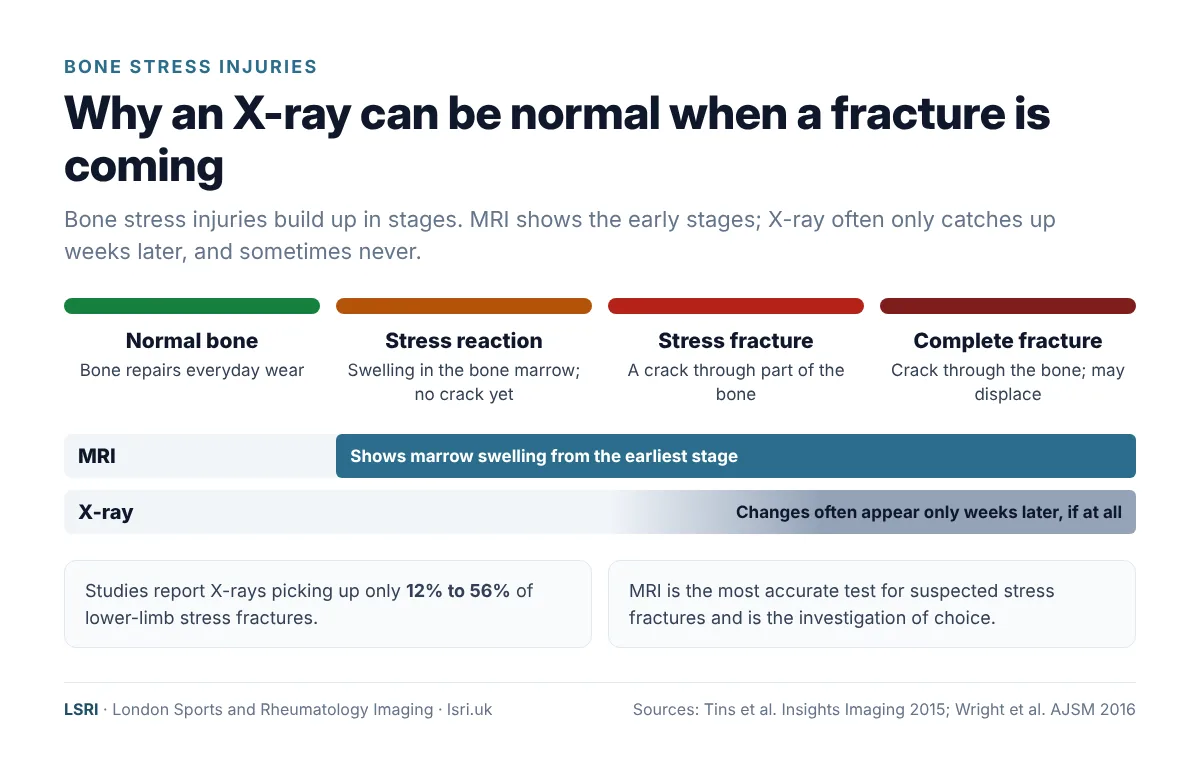
- Do not train through bone pain. Pain in a bone that builds with activity, especially in the hip, groin, pelvis, lower back or foot, needs assessment. If it is not settling, MRI is the most accurate way to find a bone stress injury early.13
If disordered eating or an eating disorder is part of the picture, specialist support is important. Your GP can refer you, and Beat, the UK’s eating disorder charity, has helplines and information for athletes, families and coaches at beateatingdisorders.org.uk. Our article on anorexia nervosa and the bone marrow explains some of the effects of severe undernutrition on the skeleton.
For coaches and parents
- Make periods a normal topic. Athletes are more likely to mention problems if menstrual health is talked about routinely, in a matter-of-fact way.
- Avoid comments about weight or body shape. Focus on fuelling, recovery and performance instead.
- Treat bone pain seriously. A young athlete with a stress fracture needs more than rest: they need someone to ask why it happened.
- Know where to go. Have a plan for who an athlete can be referred to: GP, sports medicine doctor, sports dietitian and, where needed, eating disorder services.
How LSRI can help
LSRI is a specialist musculoskeletal imaging clinic. We do not treat the triad or REDs ourselves; that is the role of your GP, sports medicine doctor and support team. Where imaging is needed, we can help find a bone stress injury early:
- Specialist reporting. Your MRI is reported by a consultant musculoskeletal radiologist within 24 hours, with the injury graded so your team can plan your return to sport.
- Advice before you book. Call us to discuss whether a scan is likely to help, and which one.
- Clear pricing. MRI from £375 per body part, including the scan, a specialist report and access to your images.
- Time to talk. MRI with a consultation, to go through the results and next steps, is from £425.
See our private MRI scans page, our guide on stress fractures that don’t show on X-ray, or read when runners need an MRI.
Frequently asked questions
Is it normal to lose your periods when training hard?
No. It is common, but it is not normal or healthy. It usually means the body is not getting enough energy for the training being done. See your GP if your periods have stopped for three months or more.
Can men get REDs?
Yes. Men can develop low energy availability, which can lower testosterone and bone density and lead to bone stress injuries. Endurance and weight-sensitive sports carry a higher risk.
I’m on the pill and have regular bleeds. Am I protected?
Not necessarily. The bleed on the pill is a withdrawal bleed, not a natural period, so it does not tell you whether your own hormones are working normally. The pill is also not a reliable way to protect bone in low energy availability. If you have other warning signs, speak to your doctor.
Do I need a bone density scan?
Possibly. A DEXA scan is often recommended if you have had fewer than six periods in the past year, if you have had an eating disorder, if your periods started at 16 or later, or if you have had two or more bone stress injuries or one at a high-risk site. Your doctor can advise.
Will an X-ray show a stress fracture?
Often not in the early weeks. X-ray changes can take weeks to appear, and some stress fractures never show. MRI is the most accurate test for a suspected bone stress injury.13
Book an appointment
Call 0203 633 5040 or book online. Clinics at Harley Street (W1G 9QJ) and Harrow (HA2 7SJ).
References
- NHS. Missed or late periods. nhs.uk
- English Institute of Sport (now UK Sports Institute). Supporting the developing female athlete. 2021. uksportsinstitute.co.uk (PDF)
- Nattiv A, Loucks AB, Manore MM, et al. American College of Sports Medicine position stand: the female athlete triad. Medicine & Science in Sports & Exercise 2007;39(10):1867–1882. doi:10.1249/mss.0b013e318149f111
- Mountjoy M, Sundgot-Borgen J, Burke L, et al. The IOC consensus statement: beyond the Female Athlete Triad, Relative Energy Deficiency in Sport (RED-S). British Journal of Sports Medicine 2014;48(7):491–497. doi:10.1136/bjsports-2014-093502
- Mountjoy M, Ackerman KE, Bailey DM, et al. 2023 International Olympic Committee’s (IOC) consensus statement on Relative Energy Deficiency in Sport (REDs). British Journal of Sports Medicine 2023;57(17):1073–1098. doi:10.1136/bjsports-2023-106994
- Barrack MT, Gibbs JC, De Souza MJ, et al. Higher incidence of bone stress injuries with increasing female athlete triad-related risk factors: a prospective multisite study of exercising girls and women. American Journal of Sports Medicine 2014;42(4):949–958. doi:10.1177/0363546513520295
- De Souza MJ, Nattiv A, Joy E, et al. 2014 Female Athlete Triad Coalition consensus statement on treatment and return to play of the female athlete triad. British Journal of Sports Medicine 2014;48(4):289. doi:10.1136/bjsports-2013-093218
- Gibbs JC, Williams NI, De Souza MJ. Prevalence of individual and combined components of the female athlete triad. Medicine & Science in Sports & Exercise 2013;45(5):985–996. doi:10.1249/MSS.0b013e31827e1bdc
- Keay N, Francis G, Hind K. Low energy availability assessed by a sport-specific questionnaire and clinical interview indicative of bone health, endocrine profile and cycling performance in competitive male cyclists. BMJ Open Sport & Exercise Medicine 2018;4(1):e000424. doi:10.1136/bmjsem-2018-000424
- Tenforde AS, Carlson JL, Chang A, et al. Association of the female athlete triad risk assessment stratification to the development of bone stress injuries in collegiate athletes. American Journal of Sports Medicine 2017;45(2):302–310. doi:10.1177/0363546516676262
- Tenforde AS, Katz NB, Sainani KL, et al. Female athlete triad risk factors are more strongly associated with trabecular-rich versus cortical-rich bone stress injuries in collegiate athletes. Orthopaedic Journal of Sports Medicine 2022;10(9):23259671221123588. doi:10.1177/23259671221123588
- Tenforde AS, Parziale AL, Popp KL, Ackerman KE. Low bone mineral density in male athletes is associated with bone stress injuries at anatomic sites with greater trabecular composition. American Journal of Sports Medicine 2018;46(1):30–36. doi:10.1177/0363546517730584
- Wright AA, Hegedus EJ, Lenchik L, et al. Diagnostic accuracy of various imaging modalities for suspected lower extremity stress fractures: a systematic review with evidence-based recommendations for clinical practice. American Journal of Sports Medicine 2016;44(1):255–263. doi:10.1177/0363546515574066
About this article
Written by the LSRI clinical team to help athletes, parents and coaches recognise the warning signs of low energy availability, based on the research and guidance listed above. It is general information, not a diagnosis or treatment plan. If you are worried about your own health, speak to your GP or a sports medicine doctor.