Written by: LSRI Editorial Team
Medically reviewed by Dr Prashant Sankaye, Consultant MSK Radiologist ·
Last Updated: October 14, 2026
Read Time: 18 Minutes
Written by the LSRI clinical team and medically reviewed by Dr Prashant Sankaye, Consultant MSK Radiologist, on 9 October 2026.
Most broken hips show clearly on an X-ray, but a small number do not. An occult hip fracture is a real break in the top of the thigh bone that the first X-ray misses. It is found later on a more sensitive scan, such as MRI or CT1,2. An unrecognised fracture cannot be treated, and a fine crack can shift into a more serious break3.
This guide covers who is at risk, which symptoms not to dismiss and what delay can cost. After a fall with severe hip or groin pain, or if you cannot put weight on the leg, go to A&E (the emergency department) or call 9994.
Key points
- X-rays detect at least 9 in 10 hip fractures. Still, about 3 to 4 in 100 emergency patients having a hip X-ray have a hidden fracture1.
- Some people with a hip fracture can still move the leg and bear weight, although it hurts. Being able to walk does not rule out a break5.
- When the X-ray is normal but a fracture is still suspected, MRI is the preferred next test. CT is a reasonable alternative when MRI is not possible, but it misses some fractures6,7,8.
- Waits beyond about 24 to 48 hours for surgery are linked with more deaths and complications. Operating within 6 hours added no clear benefit9,10,11.
- After a fall with severe hip or groin pain, or if you cannot put weight on the leg, go to A&E or call 9994,12. A private scan is not the right first step.
What is an occult hip fracture?
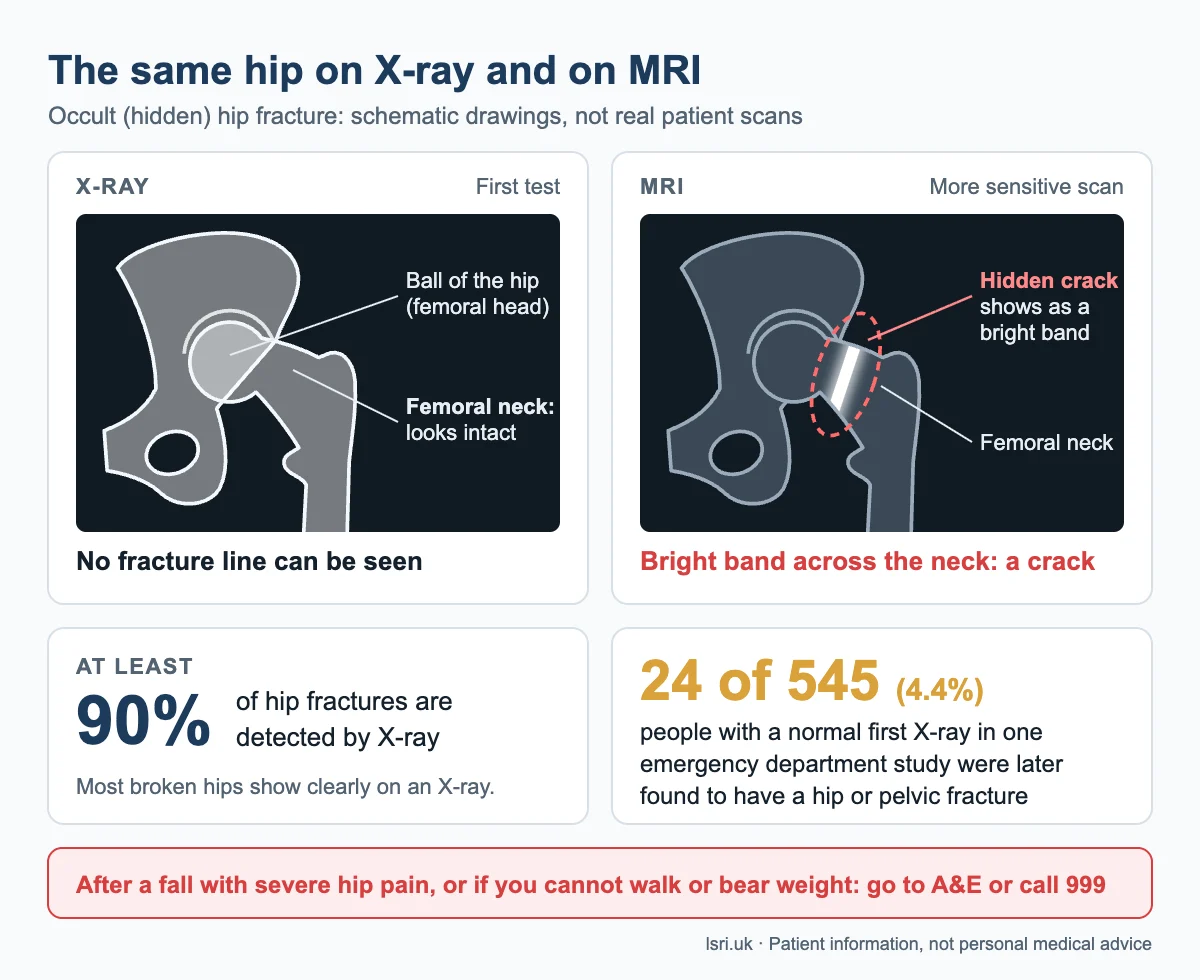
An occult hip fracture is a break in the upper thigh bone (the femur) that is present but not visible on the first X-ray2. Occult simply means hidden.
Most hip fractures involve the femoral neck, the narrow section just below the ball of the joint, or the bone slightly lower down. A displaced fracture, where the broken ends have moved apart, is usually obvious. A non-displaced fracture, a crack where the bone stays in line, can be invisible on X-ray2.
MRI (magnetic resonance imaging) uses a strong magnet and radio waves. It can sometimes detect a small or incomplete fracture that cannot be seen on an X-ray5. CT (computed tomography) uses X-rays and a computer to build detailed cross-sectional pictures. The wrist has the same problem: see scaphoid fractures with a normal X-ray.
How often does a normal X-ray miss a hip fracture?
Not often, but often enough to matter. X-rays detect at least 90% of hip fractures. About 3 to 4 in 100 emergency patients having a hip X-ray have an occult fracture1.
| Study | Who was studied | What was found |
|---|---|---|
| Dominguez 200513 | 764 emergency patients with hip or groin pain who had an X-ray and follow-up | 545 had a normal X-ray; 24 of these (4.4%) were later found to have a hip or pelvic fracture. Only 62 of the 545 had an MRI |
| Haubro 201514 | 67 older people (average age 80) unable to stand after a fall, with a normal X-ray | 15 (about 1 in 5) had a fracture of the upper femur on MRI |
| Haj-Mirzaian 2020, meta-analysis of 35 studies8 | 2,992 older people with suspected hip fracture who had advanced imaging; 2,835 had no definite fracture on X-ray | Of those 2,835, 39% had a hidden fracture needing surgery; 44% of those aged 80 or over; 58% when the X-ray report was uncertain |
A meta-analysis pools the results of many studies. The figures differ because the groups differ. The lower figure covers everyone with a normal X-ray, and most of them did not have an MRI. The higher figures come from people who still could not stand, or who were sent for advanced imaging8,13,14.
Put the other way round, about 96 in 100 people with hip pain and a normal X-ray in the emergency study had no hip or pelvic fracture found13. Still, severe pain or not walking normally after a fall should not be dismissed because one X-ray looks clear.
Who is most at risk?
Hip fractures are most common in older people and in people with osteoporosis, a condition in which bones become thinner and break more easily4. Most follow a low-energy fall in someone whose bones are already weakened5.
Hidden fractures are more frequent in people aged 80 or over8. A missed diagnosis is more likely in people who are confused or had poor mobility before the fall3. In one hospital review, 7 of 9 patients whose occult fracture was first missed had confusion, against none of 15 diagnosed promptly3.
Younger people can be affected too. A femoral neck stress fracture builds up from repeated loading, mostly in military recruits and endurance athletes. It causes gradual groin pain that eases with rest, and X-rays are often normal15. See our article on hip stress fractures and hip pain that is not improving.
What does an occult hip fracture feel like?
Usually pain in the groin, hip or upper thigh after a fall, often with difficulty standing. Signs of a broken hip include4:
- pain in the hip, groin or upper thigh
- not being able to stand or put weight on the leg
- difficulty moving the hip and leg
- the leg looking shorter, or lying at an odd angle
- swelling or bruising around the hip
Some fractures, usually non-displaced femoral neck fractures, hurt less at first, and a person may still bear weight5. Examination alone cannot reliably diagnose or exclude a hip fracture, so imaging is needed16.
Go to A&E or call 999 now if, after a fall or injury, you or someone with you has:
- severe pain in the hip, groin or upper thigh
- been unable to get up, stand or put weight on the leg
- a leg that looks shorter or lies at an odd angle
- tingling or loss of feeling in the hip or leg
Do not drive yourself. Ask someone to take you, or call 999 for an ambulance4,12.
Why can hidden hip fractures be missed?
Mainly because of the limits of X-ray and the way these fractures behave, not because anyone is careless.
- The crack has not moved, so the X-ray can look normal1,2.
- The person can still walk, so the injury looks less serious5.
- Confusion and frailty make assessment harder3.
- MRI is not always possible or quickly available, and CT, used instead, misses a minority of fractures7,14.
What can delay cost?
An unprotected crack can shift into a worse fracture, and later diagnosis means later surgery. In older people, longer waits for surgery are linked with more complications and deaths.
A crack can become a displaced fracture
In one review of 24 occult hip fractures, 9 were initially missed. Eight of the 9 were intracapsular fractures (inside the capsule that surrounds the hip joint), and 6 of those 8 later shifted out of position. Three of the 9 patients died within a year3. This was a small study, and the missed patients were also frailer, so not every death can be blamed on the delay.
Displacement changes the operation. For displaced femoral neck fractures, replacing part or all of the hip joint is recommended over fixing it with screws17. If a femoral neck stress fracture is left untreated, it can progress to a complete, displaced break. This can be followed by non-union (failure to heal) or by osteonecrosis, where part of the ball of the hip loses its blood supply and dies15.
Waiting longer for surgery is linked with worse outcomes
Hip fracture is serious: in one large study, 7.0% of adults died within 30 days of surgery10. Most evidence on delay comes from people already diagnosed and waiting for surgery, not occult fractures specifically. It still shows why time matters.
- In 35 studies (191,873 patients), earlier surgery was linked with lower odds of death (odds ratio 0.74). Most studies used a cut-off between 24 and 48 hours9.
- Earlier surgery was also linked with fewer pressure sores9,18 and, in unadjusted data, less pneumonia18.
- In 42,230 adults at 72 hospitals, complications rose once the wait passed 24 hours. In matched groups, 30-day mortality was 6.5% after longer waits and 5.8% with earlier surgery10.
- A review of 28 prospective studies linked surgery within 48 hours with a 20% lower risk of dying within 12 months. Within versus after 24 hours made no significant difference. The authors rated the certainty of this evidence as low19.
The honest message from the HIP ATTACK trial
These studies are observational: they show a link, not proof that delay causes harm. The HIP ATTACK trial tested it directly in 2,970 patients in 17 countries. Median time from diagnosis to surgery was 6 hours with accelerated surgery and 24 hours with standard care. Deaths at 90 days (9% versus 10%) and major complications (22% in both) did not differ significantly11.
The evidence therefore points towards surgery within a day or two, and avoiding delays of days, the kind a missed fracture can cause. The American Academy of Orthopaedic Surgeons (AAOS) 2021 guideline says surgery within 24 to 48 hours of admission may be associated with better outcomes17. In England, the hip fracture Best Practice Tariff, a national hospital payment standard, includes surgery within 36 hours. The clock starts at arrival in the emergency department, or at diagnosis for patients already in hospital20.
How is an occult hip fracture diagnosed?
An X-ray comes first. If it is normal or uncertain but a fracture is still suspected, MRI is the preferred next test. CT is the alternative when MRI is not possible6,7,16.
An earlier AAOS guideline (summarised in 2015) found moderate evidence for MRI as “the advanced imaging of choice” here6. The 2021 AAOS update covers treatment and makes no recommendation on imaging17. The American College of Radiology’s 2024 criteria rate MRI and CT both usually appropriate, and a bone scan usually not appropriate16.
| Test | Strengths | Limits |
|---|---|---|
| X-ray | Quick, widely available; detects at least 90% of hip fractures1 | Can miss a crack that has not moved2 |
| MRI | Preferred test in the earlier AAOS guideline and the 2020 meta-analysis6,8; in one small 1993 study, one short sequence took about 7 minutes and was correct in all 20 patients21 | Not suitable for everyone, and not always quickly available7 |
| CT | Fast; pooled sensitivity 94% across 13 studies7 | Missed 2 of 15 fractures in one study14; a 2020 meta-analysis found a lower pooled sensitivity of 79% (low-strength evidence)8; MRI is advised if concern continues after a normal CT7 |
| Bone scan | Older test using a small dose of radioactive tracer | Can be negative early: in one study of 62 patients, one fracture seen on MRI had a negative first bone scan and showed on a repeat scan 6 days later22 |
Sensitivity is the share of real fractures a test detects. MRI also shows other injuries: in one study, soft-tissue injuries in 39% of patients2.
When hip pain is probably not an occult fracture
Occult hip fractures are an injury problem. Hip pain that has built up over weeks without a fall has many possible causes, and follows a different, non-emergency route12.
Common causes include osteoarthritis, tendon problems and bursitis. See a GP (family doctor) if pain has not improved after two weeks of home treatment. Get urgent advice from a GP or NHS 111 for sudden severe hip pain without a fall, or a hot, swollen hip12.
A scan is not needed for every sore hip, but some causes without a fall do need proper imaging:
- stress fractures of the femoral neck in endurance athletes and military recruits15
- avascular necrosis of the hip, when the ball of the hip loses its blood supply
- sacral insufficiency fractures, cracks in the base of the spine in people with osteoporosis
- hip osteoarthritis, when the diagnosis is uncertain
What to do after a fall with hip or groin pain
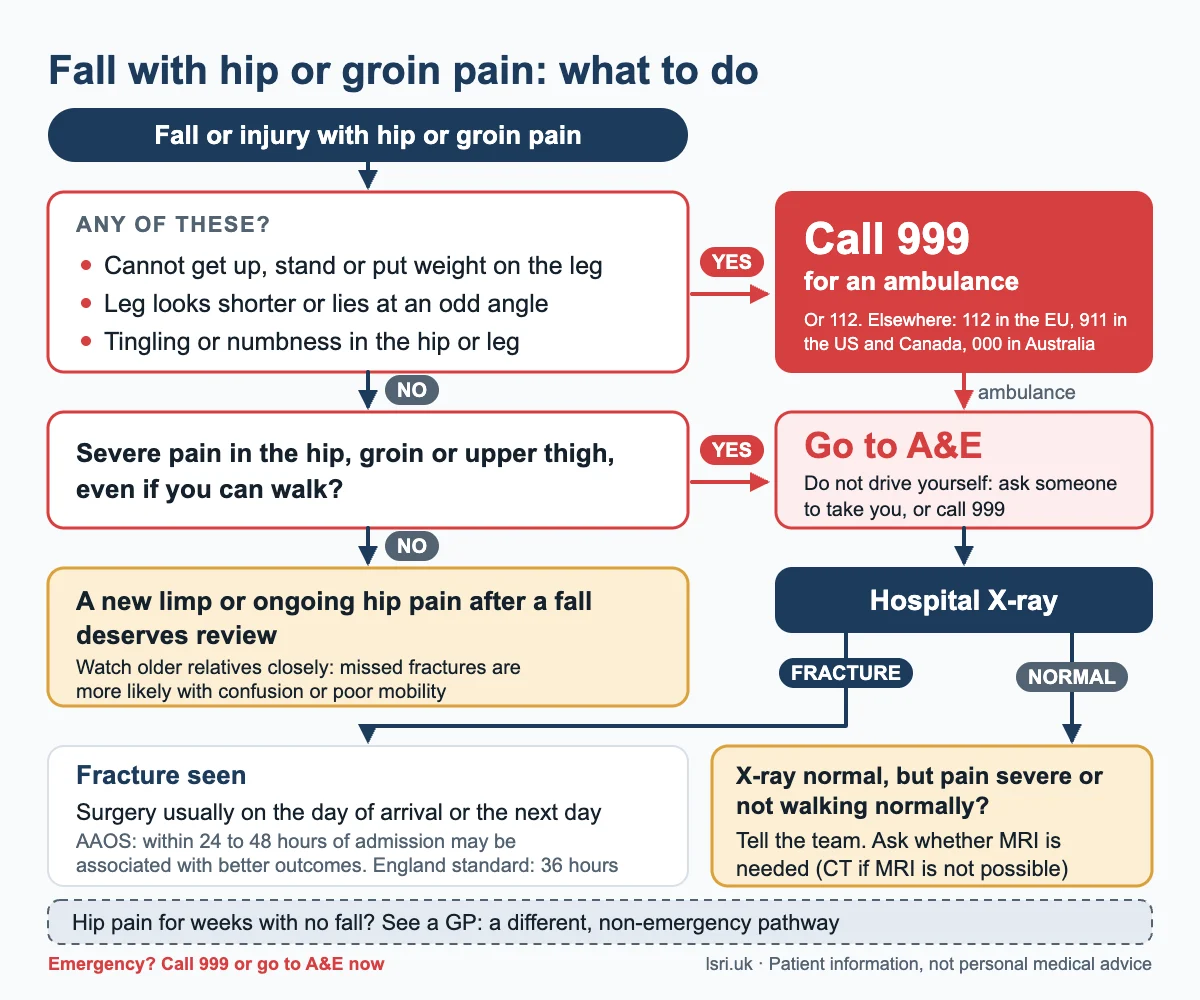
- Do not try to walk it off. If you cannot get up, stand or put weight on the leg, call 999 for an ambulance4.
- Go to A&E with severe pain after a fall, even if you can walk. Some people with a hip fracture can still bear weight5,12.
- Do not drive yourself. Ask someone to take you or call 999, and bring your medicines4.
- Say if you are still struggling after a normal X-ray. If you cannot walk normally or pain is severe, tell the team. MRI or CT may be needed6,16.
- Watch older relatives closely. Missed fractures are more likely with confusion or poor mobility, so a new limp or ongoing hip pain after a fall deserves review3.
- Call 999 for warning signs. These include being unable to bear weight, a leg that looks shorter or lies at an odd angle, or tingling or numbness4,12.
What happens once a hip fracture is diagnosed?
Most hip fractures are treated with an operation, then early mobilisation, rehabilitation, and a check of bone health and falls risk4.
- Surgery usually happens on the day of arrival or the next day. The bone is fixed with screws, nails or plates, or the joint is partly or fully replaced4.
- Getting moving. Most people get out of bed and start physiotherapy the day after surgery5. Interdisciplinary team care is strongly recommended17.
- Bone health and falls. Osteoporosis should be checked and treated6. English standards include falls and bone health assessments20, and a fracture liaison service may help prevent further fractures4.
- Recovery takes weeks or months, and some people do not regain their previous strength4.
What LSRI can and cannot do
LSRI is not an emergency service, and we do not provide emergency assessment, emergency CT or surgery. After a fall with severe hip or groin pain, or if you cannot put weight on your leg, go to A&E or call 999 now. Please do not wait for, or book, a private scan.
We can help later, when hip or groin pain persists after normal initial tests and the cause is unclear. An MRI scan reported by a Consultant MSK Radiologist can look for stress fractures, avascular necrosis, labral tears and tendon problems. MRI starts from £375 per body part, including the scan, a specialist report and access to your images, or from £425 with a consultation. Reports are usually ready within 24 hours.
Unsure about a hip MRI report from elsewhere? See our second opinion page. For the wider picture, read why early imaging matters in musculoskeletal injuries. Our clinics are at Harley Street (W1G 9QJ) and Harrow (HA2 7SJ). Call 0203 633 5040.
Reading this from outside the UK?
The medical facts here apply everywhere. Emergency numbers differ: 999 or 112 in the UK, 112 in the European Union, 911 in the US and Canada, 000 in Australia. The 36-hour standard is English and the AAOS guidance American, but both point the same way.
Frequently asked questions
Can you walk with a broken hip?
Sometimes. Not being able to stand or put weight on the leg is a typical sign of a broken hip4. With some fractures, usually non-displaced femoral neck fractures, a person can still move the leg and bear weight, although it hurts5. Being able to walk after a fall does not rule out a fracture.
Is MRI or CT better for a suspected hidden hip fracture?
MRI is generally the preferred test6,8. CT is faster and finds most fractures, with a pooled sensitivity of 94% in one meta-analysis7, although another found 79%8. In one study of 67 people, CT missed 2 of the 15 fractures seen on MRI14. Because CT misses some, MRI is advised if concern continues after a normal CT7.
How soon should a broken hip be operated on?
The AAOS guideline says surgery within 24 to 48 hours of admission may be associated with better outcomes17, and the English standard is 36 hours20. Operating within 6 hours rather than about 24 did not significantly reduce deaths or complications in a large trial11.
Can a hairline hip fracture heal without surgery?
Sometimes, but surgery is the usual treatment4. For stable, non-displaced femoral neck fractures, the AAOS guideline lists partial replacement, fixation or non-operative care as options that may be considered, with limited supporting evidence17. The risk is that an unprotected crack shifts: in one study, 6 of 8 missed intracapsular fractures later displaced3. The decision belongs with the orthopaedic team after proper imaging.
I have had hip pain for weeks without a fall. Could it be a fracture?
There are many possible causes, such as osteoarthritis, tendon problems or bursitis12. Stress fractures of the femoral neck are described as relatively rare, but they can develop without a fall in endurance athletes and military recruits and may not show on X-ray15. See a GP if the pain is not improving after two weeks, and get urgent advice for sudden severe pain12.
References
- Cannon J, Silvestri S, Munro M. Imaging choices in occult hip fracture. J Emerg Med 2009;37(2):144-152. doi:10.1016/j.jemermed.2007.12.039
- Verbeeten KM, Hermann KL, Hasselqvist M, Lausten GS, Joergensen P, Jensen CM, et al. The advantages of MRI in the detection of occult hip fractures. Eur Radiol 2005;15(1):165-169. doi:10.1007/s00330-004-2421-2
- Hossain M, Akbar SA, Andrew JG. Misdiagnosis of occult hip fracture is more likely in patients with poor mobility and cognitive impairment. Acta Orthop Belg 2010;76(3):341-346. PMID: 20698455
- NHS. Broken hip. Page last reviewed 29 July 2026. nhs.uk
- American Academy of Orthopaedic Surgeons. OrthoInfo: Hip fractures. Accessed 8 October 2026. orthoinfo.org
- Brox WT, Roberts KC, Taksali S, Wright DG, Wixted JJ, Tubb CC, et al. The American Academy of Orthopaedic Surgeons evidence-based guideline on management of hip fractures in the elderly. J Bone Joint Surg Am 2015;97(14):1196-1199. doi:10.2106/JBJS.O.00229
- Kellock TT, Khurana B, Mandell JC. Diagnostic performance of CT for occult proximal femoral fractures: a systematic review and meta-analysis. AJR Am J Roentgenol 2019;213(6):1324-1330. doi:10.2214/AJR.19.21510
- Haj-Mirzaian A, Eng J, Khorasani R, Raja AS, Levin AS, Smith SE, et al. Use of advanced imaging for radiographically occult hip fracture in elderly patients: a systematic review and meta-analysis. Radiology 2020;296(3):521-531. doi:10.1148/radiol.2020192167
- Moja L, Piatti A, Pecoraro V, Ricci C, Virgili G, Salanti G, et al. Timing matters in hip fracture surgery: patients operated within 48 hours have better outcomes. A meta-analysis and meta-regression of over 190,000 patients. PLoS One 2012;7(10):e46175. doi:10.1371/journal.pone.0046175
- Pincus D, Ravi B, Wasserstein D, Huang A, Paterson JM, Nathens AB, et al. Association between wait time and 30-day mortality in adults undergoing hip fracture surgery. JAMA 2017;318(20):1994-2003. doi:10.1001/jama.2017.17606
- HIP ATTACK Investigators. Accelerated surgery versus standard care in hip fracture (HIP ATTACK): an international, randomised, controlled trial. Lancet 2020;395(10225):698-708. doi:10.1016/S0140-6736(20)30058-1
- NHS. Hip pain in adults. Page last reviewed 20 November 2025. nhs.uk
- Dominguez S, Liu P, Roberts C, Mandell M, Richman PB. Prevalence of traumatic hip and pelvic fractures in patients with suspected hip fracture and negative initial standard radiographs: a study of emergency department patients. Acad Emerg Med 2005;12(4):366-369. doi:10.1197/j.aem.2004.10.024
- Haubro M, Stougaard C, Torfing T, Overgaard S. Sensitivity and specificity of CT- and MRI-scanning in evaluation of occult fracture of the proximal femur. Injury 2015;46(8):1557-1561. doi:10.1016/j.injury.2015.05.006
- Bernstein EM, Kelsey TJ, Cochran GK, Deafenbaugh BK, Kuhn KM. Femoral neck stress fractures: an updated review. J Am Acad Orthop Surg 2022;30(7):302-311. doi:10.5435/JAAOS-D-21-00398
- Expert Panel on Musculoskeletal Imaging; Bartolotta RJ, Ha AS, Bateni CP, Chen KC, Dvorzhinskiy A, Flug J, et al. ACR Appropriateness Criteria Acute Hip Pain: 2024 update. J Am Coll Radiol 2025;22(5S):S3-S13. doi:10.1016/j.jacr.2025.02.039
- American Academy of Orthopaedic Surgeons. Management of hip fractures in older adults: evidence-based clinical practice guideline. Adopted 3 December 2021. aaos.org
- Simunovic N, Devereaux PJ, Sprague S, Guyatt GH, Schemitsch E, DeBeer J, et al. Effect of early surgery after hip fracture on mortality and complications: systematic review and meta-analysis. CMAJ 2010;182(15):1609-1616. doi:10.1503/cmaj.092220
- Klestil T, Röder C, Stotter C, Winkler B, Nehrer S, Lutz M, et al. Impact of timing of surgery in elderly hip fracture patients: a systematic review and meta-analysis. Sci Rep 2018;8(1):13933. doi:10.1038/s41598-018-32098-7
- NHS England. 2022/23 National Tariff Payment System. Annex C: Guidance on best practice tariffs (fragility hip and femur fracture). 2022. england.nhs.uk
- Quinn SF, McCarthy JL. Prospective evaluation of patients with suspected hip fracture and indeterminate radiographs: use of T1-weighted MR images. Radiology 1993;187(2):469-471. doi:10.1148/radiology.187.2.8475292
- Rizzo PF, Gould ES, Lyden JP, Asnis SE. Diagnosis of occult fractures about the hip. Magnetic resonance imaging compared with bone-scanning. J Bone Joint Surg Am 1993;75(3):395-401. doi:10.2106/00004623-199303000-00011
Book an appointment
Call 0203 633 5040 or book online. Clinics at Harley Street (W1G 9QJ) and Harrow (HA2 7SJ). If you have emergency symptoms, go to A&E or call 999 instead.
About this article
Purpose: written by the LSRI clinical team to help the public recognise the warning signs of a hidden (occult) hip fracture after a fall and why it needs urgent hospital assessment, based on the research and guidance listed above. It is general information, not a diagnosis. If you are worried about your own symptoms, speak to your GP or, in an emergency, go to A&E. This article does not describe any individual patient and is not a criticism of any clinician.