Written by: LSRI Editorial Team
Medically reviewed by Dr Prashant Sankaye, Consultant MSK Radiologist ·
Last Updated: October 24, 2026
Read Time: 24 Minutes
Written by the LSRI clinical team and medically reviewed by Dr Prashant Sankaye, Consultant MSK Radiologist, on 24 October 2026.
Most people know botulinum toxin, often called Botox after one of its brand names, as a treatment for frown lines. Far fewer know that it is also a medical treatment, used by neurologists, rehabilitation doctors, dermatologists, urologists and musculoskeletal (MSK) specialists for muscle stiffness, spasms, excessive sweating and more. For some of these conditions it is a licensed, well-studied treatment. For others, the evidence is mixed, weak or negative.
This guide, written by the LSRI clinical team, led by a consultant MSK radiologist, explains how botulinum toxin works, what it is licensed for in the UK, what the research shows for each use, the risks, and why the way an injection is guided matters. It is a prescription-only medicine. Whether it is right for you depends on a proper assessment, and for most conditions it is one option among several, often not the first.
Key points
- It relaxes overactive muscles and glands by blocking the chemical signal from nerve endings. The effect starts within days and usually wears off over about three months.1,2
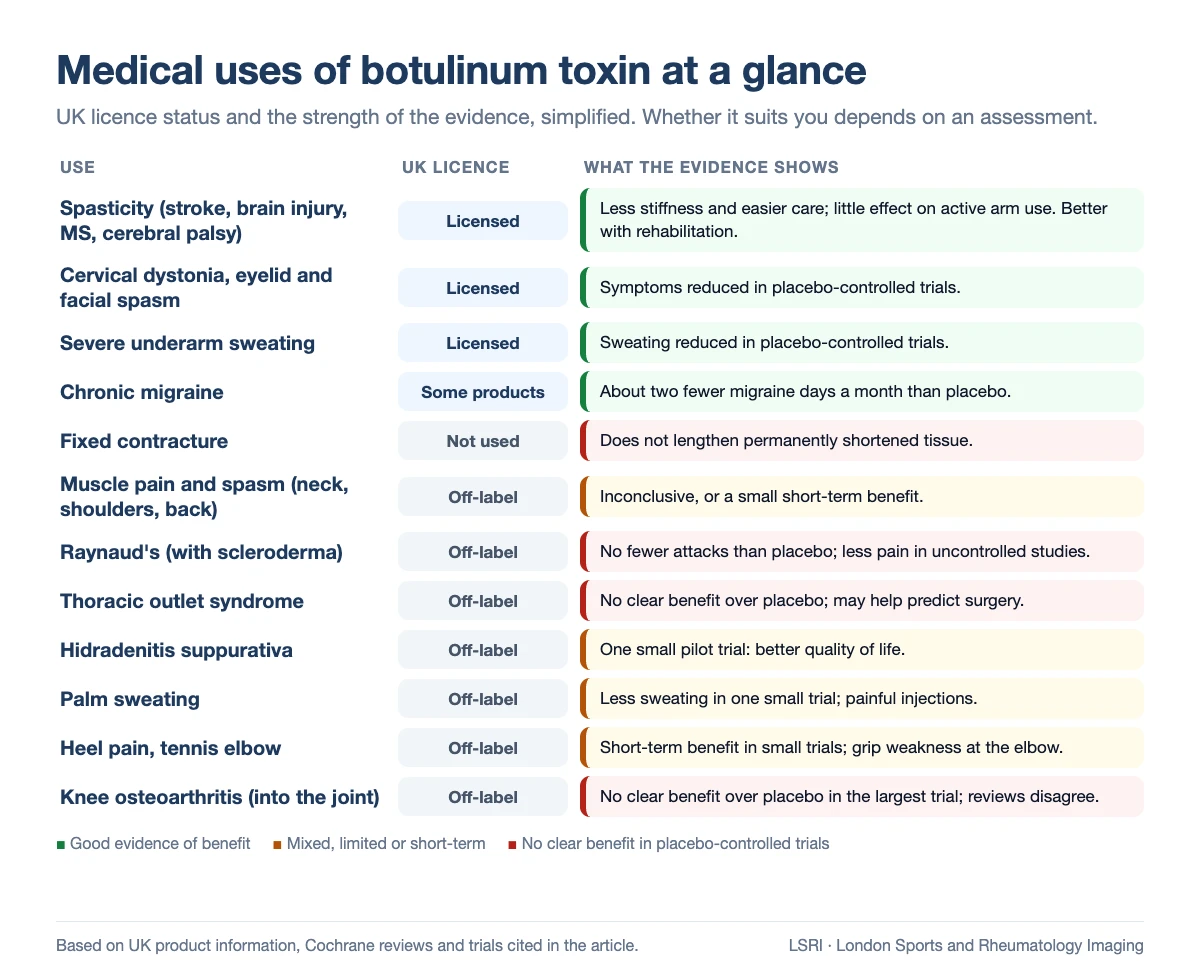
- In the UK it is licensed for limb spasticity, some types of dystonia, severe underarm sweating, chronic migraine, some bladder problems and drooling. Licences differ between products, and doses are not interchangeable.1,2,3
- It reduces muscle stiffness but does not treat a fixed contracture, and for spasticity it works better as part of a rehabilitation plan.1,4
- For Raynaud’s, thoracic outlet syndrome, hidradenitis suppurativa and muscle pain, it is used off-label and may or may not help. Some people report improvement, but placebo-controlled trials have so far shown limited or no clear benefit.5,6,7,8
- Side effects are usually mild and temporary, but the toxin can rarely spread and affect swallowing or breathing. This is a medical emergency.1,9
- Guided injections are more accurate. In small trials in limb spasticity, ultrasound or electrical stimulation guidance gave better short-term results than injecting by feel.10,11
How botulinum toxin works
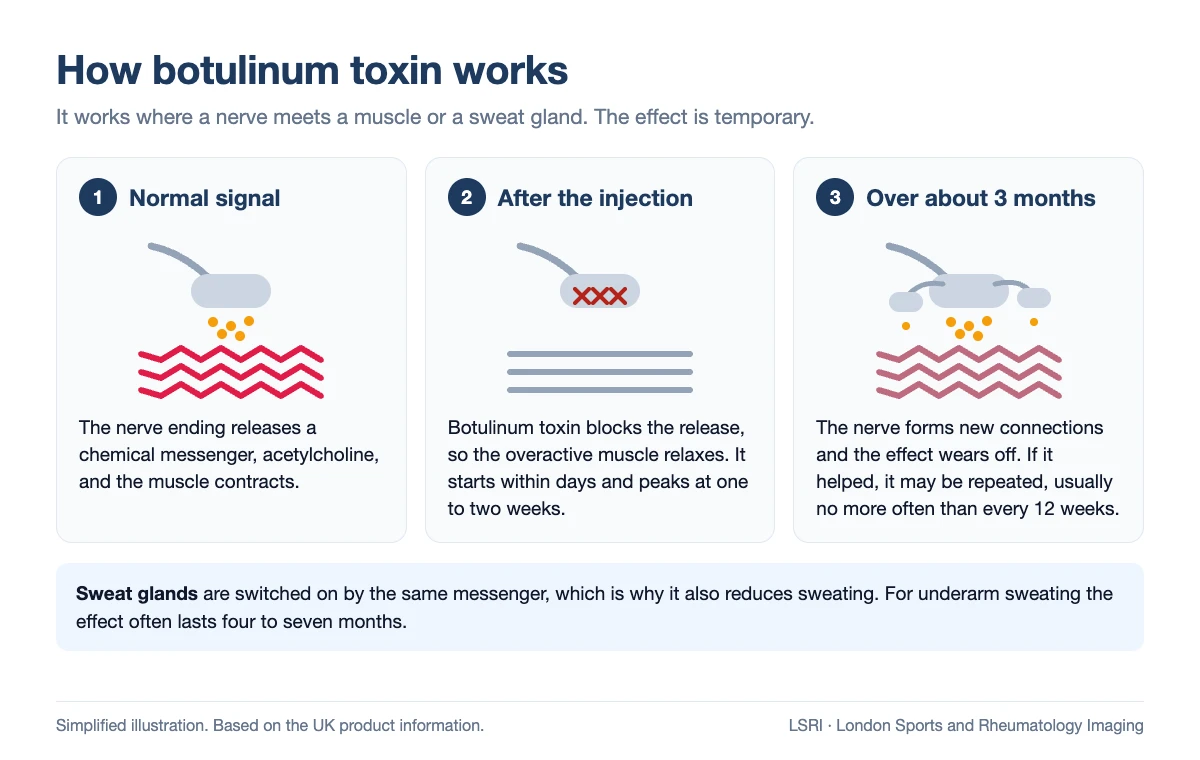
Muscles contract when a nerve ending releases a chemical messenger called acetylcholine. Sweat glands are switched on by the same messenger. Botulinum toxin blocks its release, so an overactive muscle relaxes and an overactive sweat gland produces less sweat.1
The effect is temporary. It usually starts within a few days, peaks at one to two weeks, and wears off as the nerve endings sprout new connections, normally within about 12 weeks for muscles.1,2 For underarm sweating it tends to last longer, often four to seven months.1 That is why treatment, if it helps, is repeated, usually no more often than every 12 weeks (16 weeks for underarm sweating).1,2,3,4
Licensed and off-label: what it means
A medicine’s licence (its marketing authorisation) lists the conditions it has been shown to treat, the doses and the warnings. In the UK, three botulinum toxin type A products are licensed for medical uses, and their licences are not the same.1,2,3 Between them, they cover:
- stiffness (spasticity) of the arm and of the ankle and foot in adults;
- stiffness of the arm, and of the ankle and foot, in children with cerebral palsy aged two and over, alongside rehabilitation (two of the three products);
- cervical dystonia (twisting of the neck), blepharospasm (eyelid spasm) and hemifacial spasm;
- prevention of chronic migraine in adults;
- severe underarm sweating that has not responded to antiperspirants;
- some bladder problems, including overactive bladder and bladder problems after spinal cord injury or multiple sclerosis;
- chronic drooling.
The units of one product are not interchangeable with those of another, so doses cannot be swapped between brands.1,2,3
Using a medicine for a condition outside its licence is called off-label use. It is common in medicine and can be the right choice, but the doctor takes more responsibility for it. UK medicines guidance says the prescriber should be satisfied that there is enough evidence to support it, should explain the reasons to you, and should tell you about the known side effects.12 If you are offered botulinum toxin for any of the conditions further down this page, ask whether it is licensed for your condition and what the evidence shows.
What the evidence shows, condition by condition
Spasticity after stroke, brain injury, MS or cerebral palsy
Spasticity is muscle stiffness caused by damage to the brain or spinal cord. Botulinum toxin is licensed for it, and the evidence is strong that it reduces stiffness. After a stroke, a review of 40 trials found robust evidence that it reduces resistance to movement and improves self-care with the affected arm, such as washing and dressing, but no effect on how well people can use the arm and hand actively.13 For the leg after stroke, there are too few trials to say whether it improves walking.14
UK guidance from the Royal College of Physicians and rehabilitation societies says botulinum toxin should not be used on its own, but alongside physiotherapy, stretching and splinting, with goals agreed in advance, such as easier hand hygiene, less pain or better splint fit. Weakness often limits how much active movement returns, but relieving stiffness can still make daily care easier.4 In children with cerebral palsy, reviews found it improved stiffness and walking pattern compared with placebo, worked for the arm only when combined with occupational therapy, and was no better than plaster casting for the leg.15,16
Contractures: dynamic or fixed?
A contracture is a joint that cannot be fully straightened. If the tightness comes from overactive muscle (a dynamic contracture), botulinum toxin can relax it. If the muscle and soft tissues have permanently shortened (a fixed contracture), it is unlikely to help, as the product information says.1,3 Before treatment, the team should check which kind it is.
Can early treatment prevent contractures? In one trial of 93 people treated within weeks of a stroke, botulinum toxin kept more movement at the elbow and wrist for about 12 weeks, and fewer people needed a splint, although arm function did not differ.17 In children with cerebral palsy, repeated injections, even combined with a brace, did not stop the hips from slowly moving out of joint.18 Stretching, casting, splints and sometimes surgery remain the main treatments for an established contracture.
Dystonia, eyelid spasm and facial spasm
These are licensed uses. For cervical dystonia and blepharospasm, placebo-controlled trials show a benefit. In cervical dystonia, a Cochrane review of nine trials found a single treatment session gave a clinically relevant improvement in symptoms and pain at four weeks. Neck weakness and swallowing difficulty were more common than with placebo.19 In blepharospasm, treatment reduced spasm severity, with effects lasting around ten weeks in one trial; a drooping eyelid and eye or vision complaints were more common than with placebo.20 These conditions are usually treated by neurologists or specialist eye doctors.
Ongoing muscle spasms and muscle pain (neck, shoulders and back)
People with persistent muscle tightness and trigger points in the neck, shoulders (trapezius) or back often ask about botulinum toxin. Here the evidence is weak. A Cochrane review of myofascial pain found it inconclusive.8 The 2026 Cochrane review of neck pain found it may give slight short-term pain relief, of about 6 points on a 0–100 pain scale, with no long-term benefit in function or quality of life, and more non-serious side effects than placebo.21 For low back pain, the evidence is low quality.22 Exercise and physiotherapy remain the first steps. If you are considering an injection for this kind of pain, it may or may not help: it is off-label, and the expected benefit is modest.
Raynaud’s phenomenon
Raynaud’s makes the fingers turn white or blue and painful in the cold. The usual first steps are keeping warm, not smoking, cutting down on caffeine and, if needed, a medicine such as nifedipine from your GP.23
Botulinum toxin injected into the palm is used off-label, mainly for severe Raynaud’s linked to scleroderma (systemic sclerosis). The two placebo-controlled trials so far have been disappointing. In one, blood flow was no better in the treated hand.24 In a larger French trial of 90 people, the number of attacks fell by the same amount with botulinum toxin and with placebo, and temporary hand weakness was more common with the toxin.5
A 2025 review, mostly of smaller uncontrolled studies, found less pain and better hand function, but no improvement in the overall Raynaud’s score, and concluded it should not be seen as a first-line treatment.25 We found no good trials in Raynaud’s without scleroderma. So it may or may not help: some people report less pain, but the trials so far have not shown fewer attacks than placebo, and it is usually considered only when standard treatments have not been enough.
Thoracic outlet syndrome
In neurogenic thoracic outlet syndrome, nerves to the arm are squeezed as they pass between the neck muscles and the first rib, causing pain, pins and needles and weakness. The idea is to relax the scalene muscles in the neck. In a double-blind trial of 38 patients, injections did not significantly improve pain, tingling or function compared with placebo.6
A Cochrane review, which re-analysed this same trial, found no benefit for pain or disability, although tingling and numbness were better at six months.26 Its more useful role may be as a test: in one study of 157 patients, people who responded well to an ultrasound-guided injection were very likely to do well after surgery, although a poor response did not rule out a good result from surgery.27 So it may or may not help your symptoms, and it can also help show whether surgery is likely to work. Physiotherapy is usually tried first.
Hidradenitis suppurativa
Hidradenitis suppurativa causes painful lumps and abscesses in the armpits and groin. It is usually managed by dermatologists, with lifestyle measures, antiseptic washes, antibiotics, other medicines and, in severe cases, biological treatments or surgery.28 The idea behind botulinum toxin is that less sweating in these areas may reduce flare-ups. One small pilot trial of 20 people, using botulinum toxin type B, found a bigger improvement in quality of life than with placebo, but the reduction in lumps was not significantly different.7 A review of all the published cases found only 31 patients.29 It may or may not help: it is an off-label, experimental option, not a standard treatment.
Excessive sweating (hyperhidrosis)
For severe underarm sweating that has not responded to strong antiperspirants, botulinum toxin is licensed and the evidence is strong. In large placebo-controlled trials, sweating fell sharply, and most people still had a good response four months later.30,31 For the palms and soles it is used off-label. A small placebo-controlled trial found less palm sweating after four weeks, but the injections are painful, which limits their use, and other treatments such as iontophoresis (a mild electric current through water) are usually tried first.32,33,34
Musculoskeletal and sports conditions
- Plantar fasciitis (heel pain). A 2024 review of seven trials found less pain at one month, but not at three, six or twelve months, and better function scores; the trials were small and of mixed quality.35 Tight calf muscles are linked with plantar fasciitis, and another approach is to relax the calf instead: in a trial of 32 people with long-standing plantar fasciitis, an ultrasound-guided injection into the calf muscle (gastrocnemius), followed by six weeks of physiotherapy, gave less pain and better foot function at one year than a placebo injection with the same physiotherapy.36 It was one small trial, and this use is off-label. Stretching, footwear and time help most people.
- Tennis elbow. In trials, it was better than placebo. It helped less than a steroid injection in the first few weeks, with similar results after about two months, and it often caused temporary weakness of grip.37
- Chronic exertional compartment syndrome (leg pain that comes on with running and settles with rest). Small case series reported less pain, but symptoms often came back within months, and we found no published randomised trials.38,39
- Piriformis syndrome (buttock pain with sciatica-like symptoms). A 2015 review found only two small randomised trials and called for larger, ultrasound-guided studies.40
- Knee osteoarthritis. Injected into the joint, the results are mixed: one meta-analysis favoured it, but the largest placebo-controlled trial found no significant difference, and a 2023 review found no clear advantage over other treatments.41,42,43
- Jaw pain (temporomandibular disorders). A review of 12 trials found a slight benefit over placebo at one month but none at three or six months, and judged the evidence insufficient.44
Other medical uses
Botulinum toxin is also licensed to help prevent chronic migraine, where it reduced migraine days by about two a month compared with placebo,45 for some bladder problems, and for chronic drooling.1,2 It is used off-label for anal fissure, where it works about as well as a medicated ointment but less well than surgery,46 and for some cases of achalasia (a swallowing disorder) and squint.47,48 These are treated by the relevant specialists.
Side effects and safety
Most side effects are mild and temporary. They include pain or bruising where the needle went in, flu-like symptoms, tiredness, and weakness of the treated muscle or of nearby muscles, which is part of how the medicine works.1,3 With neck injections, swallowing can be affected for a while.19
Rarely, the toxin spreads beyond the injection site and causes weakness elsewhere, difficulty swallowing, speaking or breathing. In July 2026 the UK medicines regulator updated its warnings about this, called iatrogenic botulism (botulism caused by the treatment). Symptoms usually start four to eight days after the injection but can take up to four weeks. The risk may be higher with high doses, with off-label use, in people with neurological conditions or previous swallowing problems, and with counterfeit or unauthorised products. If you develop difficulty swallowing, speaking or breathing after an injection, seek medical help immediately.9
Botulinum toxin is not usually given:
- if you have an infection at the injection site;
- if you have a condition affecting the nerve–muscle junction, such as myasthenia gravis or Lambert–Eaton syndrome, except with extreme caution;
- during pregnancy, unless clearly necessary, or while breastfeeding.1,2,3
With repeated treatment, some people develop antibodies that make it less effective. Using the lowest effective dose and leaving at least three months between treatments reduces this risk.1,4
Why the injection technique matters
Botulinum toxin works mainly in the muscle it is injected into. Injecting by feel is not always accurate: in one study of calf injections checked with ultrasound, neither injecting by feel nor electrical stimulation reached the right muscle every time.49 For deeper or smaller muscles, accuracy by feel can be much lower.50
In a trial in people with stiffness after a stroke, ultrasound-guided injections gave better results than injections placed by feel.11 A 2023 review ranked ultrasound and electrical stimulation guidance (a small current through the needle makes the muscle twitch) above injections by feel, and UK spasticity guidance says EMG (recording the muscle’s electrical activity), electrical stimulation or ultrasound should be used to locate the muscle.4,10 Ultrasound also lets the doctor avoid blood vessels and nerves, and see muscles that are hard to feel.50
Is it right for you? Questions to ask
- What is the goal? Less pain, easier care, better splint fit, less sweating? A clear, agreed goal makes it possible to judge whether it worked.4
- Is it licensed for my condition, and if not, what does the evidence show?
- What else could I try first, and what will happen alongside the injection, such as physiotherapy, stretching or splints?
- What are the risks for me, including weakness, swallowing problems and pregnancy?
- How will the injection be guided, and who will give it?
- When will we review it, and how often could it be repeated?
How we approach this at LSRI
At LSRI, a consultation with a consultant MSK radiologist starts with your symptoms, an examination and, where useful, an ultrasound scan, to find out what is causing the problem. We then explain the treatment options for your condition. If botulinum toxin might be one of them, we explain whether it is licensed for your condition, what the evidence shows, the risks and the alternatives, so that you can decide.
A consultation may or may not lead to treatment with botulinum toxin: it is prescribed only if it is clinically appropriate for you and you agree after discussing the alternatives. The conditions we most often assess where it may be one of the options are spasticity, tight calf muscles (which can contribute to heel pain from plantar fasciitis, and to equinus, where the ankle cannot bend upwards fully), Raynaud’s phenomenon and thoracic outlet syndrome. For Raynaud’s and thoracic outlet syndrome it may or may not help, because the trial evidence is limited, as explained above, and we go through this with you before any decision.
If an injection is given, it is guided by ultrasound, which shows the target muscle directly (we do not use EMG), and it is planned alongside your physiotherapy or rehabilitation. Some conditions, such as dystonia, migraine and bladder problems, are usually managed by other specialists, and we will tell you if that applies to you.
Our clinics are on Harley Street (W1G 9QJ) and in Harrow (HA2 7SJ); call 0203 633 5040. You can read more about our MSK specialist consultation.
Frequently asked questions
Is botulinum toxin only used for cosmetic treatment?
No. In the UK it is licensed for medical uses including limb spasticity, cervical dystonia, eyelid and facial spasm, severe underarm sweating, chronic migraine, some bladder problems and chronic drooling. Doctors also use it off-label for other conditions, where the evidence varies.
How long does a botulinum toxin injection last?
For muscle problems, the effect usually starts within a few days, peaks at one to two weeks and wears off over about three months, as the nerve endings form new connections. For underarm sweating it often lasts four to seven months. Treatments are usually repeated no more often than every 12 weeks.
Can botulinum toxin treat contractures?
It can relax a joint that is tight because of overactive muscle, but it does not help a fixed contracture, where the muscle and soft tissues have permanently shortened. Stretching, casting, splints and sometimes surgery are used for those.
Does botulinum toxin work for Raynaud’s?
It may or may not help. It is used off-label, mainly for severe Raynaud’s linked to scleroderma. Some studies reported less pain, but placebo-controlled trials have not shown fewer attacks or better blood flow. It is not a first-line treatment.
Can botulinum toxin help hidradenitis suppurativa?
Possibly, for some people, but the evidence is very limited: one small pilot trial and a few case reports. It is an off-label, experimental option, and standard treatments are managed by a dermatologist.
What are the risks of botulinum toxin?
Side effects are usually mild and temporary, such as soreness, bruising, flu-like symptoms or weakness near the injection. Rarely, the toxin spreads and affects swallowing, speech or breathing, which needs urgent medical help. It is not usually given in pregnancy, while breastfeeding, or to people with conditions such as myasthenia gravis.
References
- AbbVie Ltd. BOTOX 100 Allergan Units powder for solution for injection: Summary of Product Characteristics. Electronic medicines compendium, updated 15 May 2026. (accessed 24 October 2026) medicines.org.uk
- Merz Pharma UK Ltd. Xeomin 100 units powder for solution for injection: Summary of Product Characteristics. Electronic medicines compendium, text revised 19 January 2026. (accessed 24 October 2026) medicines.org.uk
- Ipsen Ltd. Dysport 500 units powder for solution for injection: Summary of Product Characteristics. Electronic medicines compendium, text revised 24 July 2026. (accessed 24 October 2026) medicines.org.uk
- Royal College of Physicians, British Society of Rehabilitation Medicine, Chartered Society of Physiotherapy, Association of Chartered Physiotherapists in Neurology, Royal College of Occupational Therapists. Spasticity in adults: management using botulinum toxin. National guidelines, 2nd edition. London: RCP, 2018. (accessed 24 October 2026) rcp.ac.uk
- Senet P, Maillard H, Diot E, et al. Efficacy and safety of botulinum toxin in adults with Raynaud’s phenomenon secondary to systemic sclerosis: a multicenter, randomized, double-blind, placebo-controlled study. Arthritis Rheumatol 2023;75(3):459-67. doi:10.1002/art.42342
- Finlayson HC, O’Connor RJ, Brasher PMA, Travlos A. Botulinum toxin injection for management of thoracic outlet syndrome: a double-blind, randomized, controlled trial. Pain 2011;152(9):2023-8. doi:10.1016/j.pain.2011.04.027
- Grimstad Ø, Kvammen BØ, Swartling C. Botulinum toxin type B for hidradenitis suppurativa: a randomised, double-blind, placebo-controlled pilot study. Am J Clin Dermatol 2020;21(5):741-8. doi:10.1007/s40257-020-00537-9
- Soares A, Andriolo RB, Atallah AN, da Silva EMK. Botulinum toxin for myofascial pain syndromes in adults. Cochrane Database Syst Rev 2014;(7):CD007533. doi:10.1002/14651858.CD007533.pub3
- Medicines and Healthcare products Regulatory Agency. Botulinum toxin type A products: updated warnings regarding risk of iatrogenic botulism. Drug Safety Update, 15 July 2026 (page updated 19 October 2026). (accessed 24 October 2026) gov.uk
- Asimakidou E, Sidiropoulos C. A Bayesian network meta-analysis and systematic review of guidance techniques in botulinum toxin injections and their hierarchy in the treatment of limb spasticity. Toxins (Basel) 2023;15(4):256. doi:10.3390/toxins15040256
- Picelli A, Tamburin S, Bonetti P, et al. Botulinum toxin type A injection into the gastrocnemius muscle for spastic equinus in adults with stroke: a randomized controlled trial comparing manual needle placement, electrical stimulation and ultrasonography-guided injection techniques. Am J Phys Med Rehabil 2012;91(11):957-64. doi:10.1097/PHM.0b013e318269d7f3
- Medicines and Healthcare products Regulatory Agency. Off-label or unlicensed use of medicines: prescribers’ responsibilities. Drug Safety Update, April 2009 (updated December 2014). (accessed 24 October 2026) gov.uk
- Andringa A, van de Port I, van Wegen E, Ket J, Meskers C, Kwakkel G. Effectiveness of botulinum toxin treatment for upper limb spasticity poststroke over different ICF domains: a systematic review and meta-analysis. Arch Phys Med Rehabil 2019;100(9):1703-25. doi:10.1016/j.apmr.2019.01.016
- Gupta AD, Chu WH, Howell S, et al. A systematic review: efficacy of botulinum toxin in walking and quality of life in post-stroke lower limb spasticity. Syst Rev 2018;7:1. doi:10.1186/s13643-017-0670-9
- Blumetti FC, Belloti JC, Tamaoki MJS, Pinto JA. Botulinum toxin type A in the treatment of lower limb spasticity in children with cerebral palsy. Cochrane Database Syst Rev 2019;(10):CD001408. doi:10.1002/14651858.CD001408.pub2
- Hoare BJ, Wallen MA, Imms C, Villanueva E, Rawicki HB, Carey L. Botulinum toxin A as an adjunct to treatment in the management of the upper limb in children with spastic cerebral palsy (UPDATE). Cochrane Database Syst Rev 2010;(1):CD003469. doi:10.1002/14651858.CD003469.pub4
- Lindsay C, Ispoglou S, Helliwell B, Hicklin D, Sturman S, Pandyan A. Can the early use of botulinum toxin in post stroke spasticity reduce contracture development? A randomised controlled trial. Clin Rehabil 2021;35(3):399-409. doi:10.1177/0269215520963855
- Graham HK, Boyd R, Carlin JB, et al. Does botulinum toxin A combined with bracing prevent hip displacement in children with cerebral palsy and “hips at risk”? A randomized, controlled trial. J Bone Joint Surg Am 2008;90(1):23-33. doi:10.2106/JBJS.F.01416
- Rodrigues FB, Duarte GS, Marques RE, et al. Botulinum toxin type A therapy for cervical dystonia. Cochrane Database Syst Rev 2020;(11):CD003633. doi:10.1002/14651858.CD003633.pub4
- Duarte GS, Rodrigues FB, Marques RE, et al. Botulinum toxin type A therapy for blepharospasm. Cochrane Database Syst Rev 2020;(11):CD004900. doi:10.1002/14651858.CD004900.pub3
- Gross AR, Lee H, Chacko N, et al. Botulinum toxin type A for subacute/chronic neck pain. Cochrane Database Syst Rev 2026;(5):CD008626. doi:10.1002/14651858.CD008626.pub4
- Waseem Z, Boulias C, Gordon A, Ismail F, Sheean G, Furlan AD. Botulinum toxin injections for low-back pain and sciatica. Cochrane Database Syst Rev 2011;(1):CD008257. doi:10.1002/14651858.CD008257.pub2
- NHS. Raynaud’s. (page last reviewed 20 July 2023; accessed 24 October 2026) nhs.uk
- Bello RJ, Cooney CM, Melamed E, et al. The therapeutic efficacy of botulinum toxin in treating scleroderma-associated Raynaud’s phenomenon: a randomized, double-blind, placebo-controlled clinical trial. Arthritis Rheumatol 2017;69(8):1661-9. doi:10.1002/art.40123
- Pang C, Iakovou D, Fraser D, et al. A systematic review of botulinum toxin as a treatment for Raynaud’s disease secondary to scleroderma. Clin Rheumatol 2025;44:81-96. doi:10.1007/s10067-024-07237-3
- Povlsen B, Hansson T, Povlsen SD. Treatment for thoracic outlet syndrome. Cochrane Database Syst Rev 2014;(11):CD007218. doi:10.1002/14651858.CD007218.pub3
- Donahue DM, Godoy IRB, Gupta R, Donahue JA, Torriani M. Sonographically guided botulinum toxin injections in patients with neurogenic thoracic outlet syndrome: correlation with surgical outcomes. Skeletal Radiol 2020;49(5):715-22. doi:10.1007/s00256-019-03331-9
- NHS. Hidradenitis suppurativa. (page last reviewed 17 March 2023; accessed 24 October 2026) nhs.uk
- Ravi M, Trinidad J. Botulinum toxin in hidradenitis suppurativa: a systematic review. J Drugs Dermatol 2022;21(4):408-12. doi:10.36849/JDD.5747
- Heckmann M, Ceballos-Baumann AO, Plewig G. Botulinum toxin A for axillary hyperhidrosis (excessive sweating). N Engl J Med 2001;344(7):488-93. doi:10.1056/NEJM200102153440704
- Naumann M, Lowe NJ. Botulinum toxin type A in treatment of bilateral primary axillary hyperhidrosis: randomised, parallel group, double blind, placebo controlled trial. BMJ 2001;323(7313):596-9. doi:10.1136/bmj.323.7313.596
- Lowe NJ, Yamauchi PS, Lask GP, Patnaik R, Iyer S. Efficacy and safety of botulinum toxin type A in the treatment of palmar hyperhidrosis: a double-blind, randomized, placebo-controlled study. Dermatol Surg 2002;28(9):822-7. doi:10.1046/j.1524-4725.2002.02039.x
- NHS Scotland Right Decisions (Centre for Sustainable Delivery; approved by the Scottish Dermatological Society). Hyperhidrosis. (last reviewed 9 June 2023; accessed 24 October 2026) rightdecisions.scot.nhs.uk
- NHS. Hyperhidrosis. (page last reviewed 7 November 2023; accessed 24 October 2026) nhs.uk
- Li Q, Zhang J, Sun J, Gao C, Zhao J. Therapeutic efficacy and safety of botulinum toxin A injection in plantar fasciitis: a systematic review and meta-analysis. PLoS One 2024;19(12):e0312908. doi:10.1371/journal.pone.0312908
- Abbasian M, Baghbani S, Barangi S, Fairhurst PG, Ebrahimpour A, Krause F, Hashemi M. Outcomes of ultrasound-guided gastrocnemius injection with botulinum toxin for chronic plantar fasciitis. Foot Ankle Int 2020;41(1):63-8. doi:10.1177/1071100719875220
- Lin YC, Wu WT, Hsu YC, Han DS, Chang KV. Comparative effectiveness of botulinum toxin versus non-surgical treatments for treating lateral epicondylitis: a systematic review and meta-analysis. Clin Rehabil 2018;32(2):131-45. doi:10.1177/0269215517702517
- Isner-Horobeti ME, Dufour SP, Blaes C, Lecocq J. Intramuscular pressure before and after botulinum toxin in chronic exertional compartment syndrome of the leg: a preliminary study. Am J Sports Med 2013;41(11):2558-66. doi:10.1177/0363546513499183
- Charvin M, Orta C, Laroche D, Raumel MA, Petit J, Casillas JM, et al. Botulinum toxin A for chronic exertional compartment syndrome: a retrospective study of 16 upper- and lower-limb cases. Clin J Sport Med 2022;32(4):e436-40. doi:10.1097/JSM.0000000000000958
- Santamato A, Micello MF, Valeno G, et al. Ultrasound-guided injection of botulinum toxin type A for piriformis muscle syndrome: a case report and review of the literature. Toxins (Basel) 2015;7(8):3045-56. doi:10.3390/toxins7083045
- Ismiarto YD, Prasetiyo GT. Efficacy and safety of intra-articular botulinum toxin A injection for knee osteoarthritis: a systematic review, meta-analysis, and meta-regression of clinical trials. JBJS Open Access 2023;8(1):e22.00121. doi:10.2106/JBJS.OA.22.00121
- McAlindon TE, Schmidt U, Bugarin D, et al. Efficacy and safety of single-dose onabotulinumtoxinA in the treatment of symptoms of osteoarthritis of the knee: results of a placebo-controlled, double-blind study. Osteoarthritis Cartilage 2018;26(10):1291-9. doi:10.1016/j.joca.2018.05.001
- Sconza C, Leonardi G, Carfì C, et al. Intra-articular injection of botulinum toxin for the treatment of knee osteoarthritis: a systematic review of randomized controlled trials. Int J Mol Sci 2023;24(2):1486. doi:10.3390/ijms24021486
- Machado D, Martimbianco ALC, Bussadori SK, Pacheco RL, Riera R, Santos EM. Botulinum toxin type A for painful temporomandibular disorders: systematic review and meta-analysis. J Pain 2020;21(3-4):281-93. doi:10.1016/j.jpain.2019.08.011
- Herd CP, Tomlinson CL, Rick C, et al. Botulinum toxins for the prevention of migraine in adults. Cochrane Database Syst Rev 2018;(6):CD011616. doi:10.1002/14651858.CD011616.pub2
- Nelson RL, Thomas K, Morgan J, Jones A. Non surgical therapy for anal fissure. Cochrane Database Syst Rev 2012;(2):CD003431. doi:10.1002/14651858.CD003431.pub3
- Leyden JE, Moss AC, MacMathuna P. Endoscopic pneumatic dilation versus botulinum toxin injection in the management of primary achalasia. Cochrane Database Syst Rev 2014;(12):CD005046. doi:10.1002/14651858.CD005046.pub3
- Bort-Martí AR, Rowe FJ, Ruiz Sifre L, Ng SM, Bort-Martí S, Ruiz Garcia V. Botulinum toxin for the treatment of strabismus. Cochrane Database Syst Rev 2023;(3):CD006499. doi:10.1002/14651858.CD006499.pub5
- Picelli A, Bonetti P, Fontana C, et al. Accuracy of botulinum toxin type A injection into the gastrocnemius muscle of adults with spastic equinus: manual needle placement and electrical stimulation guidance compared using ultrasonography. J Rehabil Med 2012;44(5):450-2. doi:10.2340/16501977-0970
- Alter KE, Karp BI. Ultrasound guidance for botulinum neurotoxin chemodenervation procedures. Toxins (Basel) 2018;10(1):18. doi:10.3390/toxins10010018
Book an appointment
Call 0203 633 5040 or book a consultation online. Clinics at Harley Street (W1G 9QJ) and Harrow (HA2 7SJ).
About this article
Purpose: written by the LSRI clinical team as a balanced overview of the medical uses of botulinum toxin, its UK licence status, the evidence for each use and its risks, based on the product information, guidance and research listed above. It is general information, not a recommendation of any treatment. Botulinum toxin is a prescription-only medicine, and whether it is suitable for you can only be decided after an assessment. If you have emergency symptoms, call 999 or go to A&E.