Written by: LSRI Editorial Team
Medically reviewed by Dr Prashant Sankaye, Consultant MSK Radiologist ·
Last Updated: October 24, 2026
Read Time: 19 Minutes
Written by the LSRI clinical team and medically reviewed by Dr Prashant Sankaye, Consultant MSK Radiologist, on 22 October 2026.
De Quervain’s tenosynovitis causes pain on the thumb side of the wrist that flares when you lift, grip, pinch or turn your wrist: picking up a baby, turning a key, opening a jar or using your phone. It is so common in new parents that it is often called “mummy thumb”, although it affects fathers, grandparents and carers too, and plenty of people who have never lifted a baby.
This guide explains what De Quervain’s tenosynovitis is, why it does not show on an X-ray, how long it lasts, and what the evidence says about splints, steroid injections and surgery, including why some injections fail and what to know if you are breastfeeding. It is written by the LSRI clinical team, led by a consultant musculoskeletal (MSK) radiologist who diagnoses De Quervain’s with ultrasound and treats it with ultrasound-guided injections.
Key points
- De Quervain’s affects two thumb tendons where they run through a tight tunnel on the thumb side of the wrist. In a UK survey of working-age adults, it affected 1.3% of women and 0.5% of men.1
- It does not show on an X-ray. In a study of 189 wrists, X-rays (taken in 110) did not change treatment for any patient.2 Ultrasound shows the thickened tunnel and swollen tendon sheath.3
- Mild cases can settle in a few weeks; resting the thumb and wearing a splint can help.4
- A steroid injection helps many people: in one series, about half needed only one injection and about three-quarters no more than two.5
- Many people with De Quervain’s have a thin wall (septum) dividing the tunnel, which can make an injection less likely to work. Ultrasound can show it.3,6,7
- If you are breastfeeding, an injection is usually fine: the steroid we use, methylprednisolone, is one the NHS Specialist Pharmacy Service lists as a preferred choice during breastfeeding.8
What is De Quervain’s tenosynovitis?
Two tendons that move your thumb, abductor pollicis longus and extensor pollicis brevis, run side by side through a narrow tunnel on the thumb side of the wrist, called the first extensor compartment.4,9 In De Quervain’s, the tunnel’s tough roof (the retinaculum) and the lining around the tendons (the tendon sheath) become thickened and swollen, so the tendons are squeezed every time the thumb moves.3
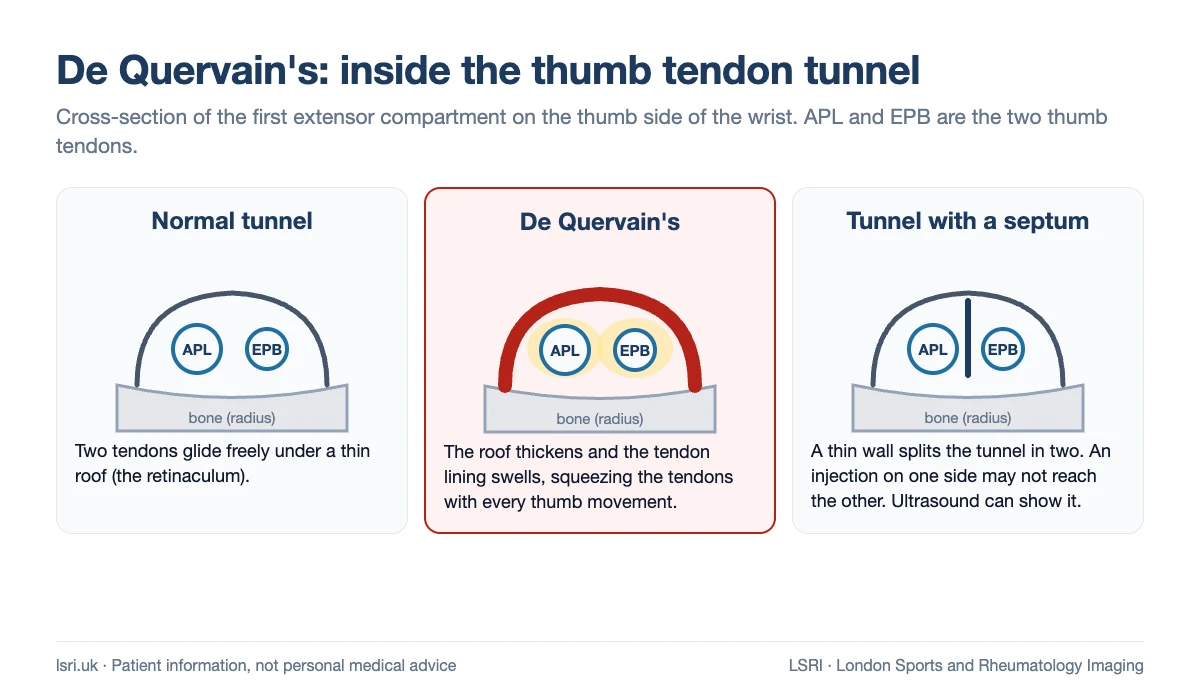
In many people, a thin wall of tissue, called a septum, divides the tunnel into two smaller tunnels, with one tendon in each. A septum is more common in people who need surgery for De Quervain’s than in cadaver studies of the general population: 67% compared with 35% in a review of the published studies.3 As we explain below, it matters for treatment.
Symptoms of De Quervain’s
- Pain and tenderness on the thumb side of the wrist and at the base of the thumb.4,10
- Pain when you grip, pinch, lift with your thumb or turn your wrist.
- Swelling over the thumb side of the wrist, and occasionally a clicking or catching feeling as the thumb moves.4
A doctor or physiotherapist will usually check for tenderness over the tunnel and do a simple stretch test: you tuck your thumb into your palm, make a fist and bend your wrist towards your little finger. This is often called Finkelstein’s test, though strictly it is Eichhoff’s test.11 A newer test (the WHAT test: wrist hyperflexion and abduction of the thumb) was positive in almost everyone with De Quervain’s in one study, but it was also positive in many people without it, so no single test is perfect.11
Who gets De Quervain’s, and why is it called “mummy thumb”?
It is more common in women than men, and more common after the age of 40.1,12 Pregnancy and the months after having a baby are a well-recognised trigger: in one series, a quarter of the women affected were pregnant or had recently given birth when it started, and caring for the baby made it worse in most of them.9 The British Society for Surgery of the Hand notes that mothers of small babies seem particularly prone, and that it is not clear whether hormones or repeated lifting matter more.4 Both probably play a part.9
Repetitive, forceful hand work is linked with De Quervain’s, but the evidence is not strong enough to say that work causes it.4,13 Any heavy hand use, at work, at home or in sport, can make it worse once it has started.4
Does De Quervain’s tenosynovitis show up on an X-ray?
No. X-rays show bone, not the soft tendon sheath. An X-ray is useful to look for other causes of thumb-side wrist pain, such as arthritis at the base of the thumb or a fracture,10 but in a study of 189 wrists with De Quervain’s, the X-rays taken of 110 of them did not change the treatment of a single patient.2 X-rays often show minor changes that are nothing to do with the pain, so they need to be read alongside your symptoms.2
Ultrasound is the scan that shows De Quervain’s itself. It shows the thickened retinaculum, the swollen tendon sheath, fluid around the tendons and enlarged tendons.3 It can also show whether a septum divides the tunnel: in a study of cadaver wrists, ultrasound identified a septum with 95% accuracy.6 MRI is rarely needed, but MRI or ultrasound can help if the pain is not settling with treatment.10
Is it De Quervain’s, or something else?
Several conditions cause pain on the thumb side of the wrist, and they are treated differently:10,14
- Arthritis at the base of the thumb (where the thumb joins the wrist), which is common in later life.
- Intersection syndrome, where pain is felt further up the back of the forearm, sometimes with a squeaking feeling as the wrist moves.
- A scaphoid fracture after a fall on an outstretched hand, which an early X-ray can miss. See our guide to wrist pain after a fall.
- Irritation of the nerve that runs over the thumb side of the wrist (the superficial radial nerve), which causes burning pain or tingling.
- A ganglion, a fluid-filled lump. Small ganglia can also form inside the tendon tunnel alongside De Quervain’s.15
If your wrist is hot, red and swollen and you feel unwell, or you cannot use it after a fall, get urgent help from NHS 111 or A&E.
How long does De Quervain’s last?
Mild cases can settle over a few weeks without treatment.4 Others last for months, especially if the thumb keeps being strained. In new parents, symptoms often ease as the baby grows and needs lifting less often.16 There is little good research on how long untreated De Quervain’s lasts, so if the pain is stopping you working, sleeping or caring for your baby, it is reasonable to get it assessed rather than wait.
De Quervain’s treatments: what helps
Rest the thumb, change how you grip, and wear a splint
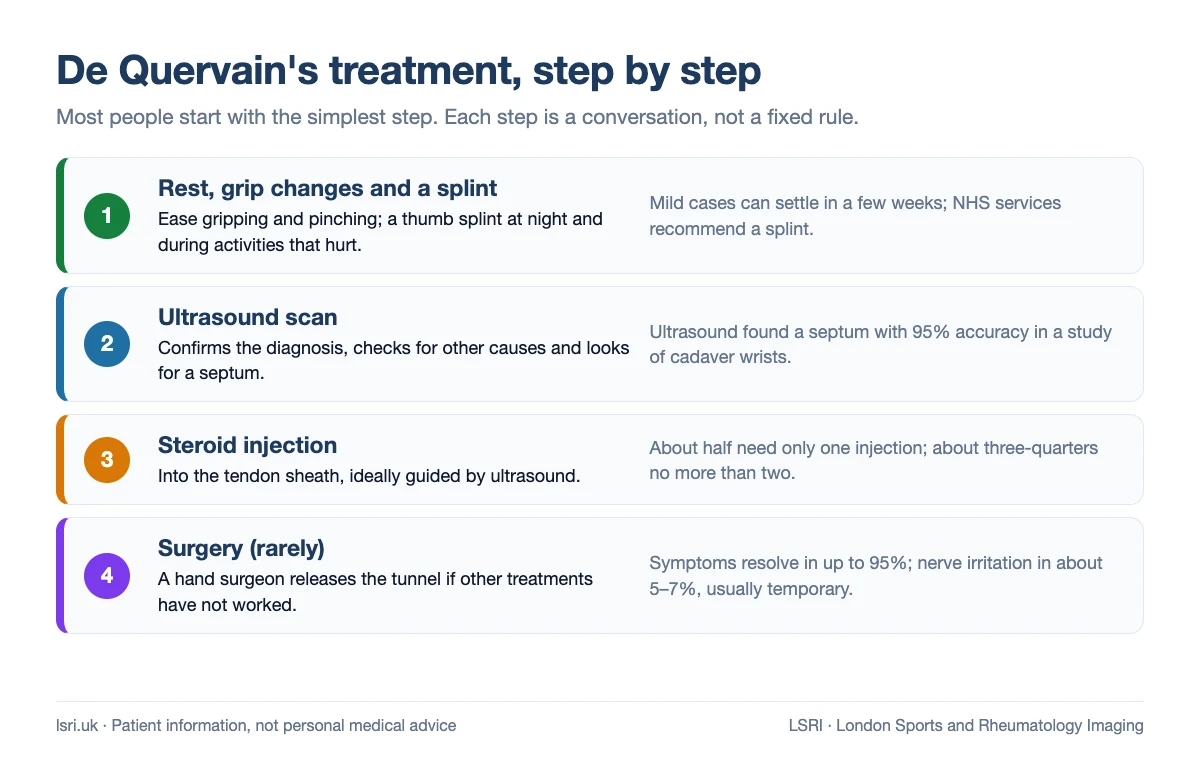
The first step is to reduce the movements that hurt, especially gripping and pinching, and to support the thumb with a splint that holds the wrist and thumb still (a thumb spica splint), particularly at night and during activities that trigger the pain.4,16 A splint is a sensible first step and is widely recommended, although in trials a splint on its own did less than a steroid injection: a 2023 review of 30 randomised trials found that an injection combined with a thumb splint was the most likely to improve hand function in the short term.17
Splint advice varies: some NHS hand therapy services advise wearing a splint for at least six weeks,18 while others warn that prolonged splinting may not be helpful and that the wrist and thumb need to keep moving.19 A hand therapist can tailor this for you.
Steroid injection
A steroid (corticosteroid) injection into the tendon sheath reduces the swelling in the tunnel. Reviews of the randomised trials show it helps more people’s symptoms settle than a placebo injection or the other non-surgical treatments it has been compared with.20,21 In a review of 222 treated wrists (199 patients), 51.8% needed only one injection, and 73.4% needed no more than two, with no surgery.5 The British Society for Surgery of the Hand quotes relief in about 70% of cases.4 An injection can take up to six weeks to work fully, and a second injection may be offered if relief is only temporary.5,18
Why ultrasound guidance can help: the septum
A septum is one recognised reason an injection may not work: if the tunnel is divided, steroid injected into one side may not reach the tendon on the other. In a study of 50 people who were scanned before an injection given by feel, a septum was found in 54% of wrists, and 13 of the 15 people whose symptoms came back within six weeks had one.7
Ultrasound lets the radiologist see the septum and guide the needle into each compartment, so that the steroid reaches both tendons. Injections guided by ultrasound are more accurate than injections placed by feel: across studies, at least 90% of guided injections reached the right place, compared with as few as 40% of injections placed by feel.3 In a small study of 44 wrists with a septum, an ultrasound-guided injection targeting the affected compartment reduced pain more than an injection placed by feel.22
The evidence is not one-sided: a 2024 randomised trial found no significant difference in pain or function between the two methods overall.23 Our view is that ultrasound guidance makes the most difference when there is a septum, which is common in De Quervain’s, or when an earlier injection has not worked.
Should you wear a splint after an injection?
The trials disagree. In one, adding a thumb cast after the injection increased the success rate from 69% to 93%;24 in another, smaller trial (20 patients followed up), a splint added nothing.25 The 2023 review found a small benefit from three to four weeks of splinting after an injection, which was not large enough to be clinically important, though the authors still suggested it.17 We will advise you on what makes sense for your work and family life.
Side effects of an injection
The tunnel lies just under the skin, so the main side effects of a steroid injection here are lightening of the skin colour and thinning of the fat under the skin at the injection site. The British Society for Surgery of the Hand describes these as very occasional,4 but in one trial in patients with a septum, skin lightening was seen in 33% after an injection into one compartment and 67% after injections into both, with no extra pain relief from injecting both.26 Using the smallest effective dose, placed precisely, helps reduce this risk.26 When a septum divides the tunnel, we inject both compartments under ultrasound so that the steroid reaches both tendons, keeping to the smallest effective dose. A short flare of pain after the injection can also occur.27
Serious complications, such as tendon rupture, are rare.26,27
Surgery
If symptoms persist despite non-surgical treatment, a hand surgeon can release the tunnel in a short operation, often under local anaesthetic, which leads to full resolution of symptoms in up to 95% of people.4,17 The main risks are irritation or injury of the small sensory nerve over the wrist, which affected about 5 to 7% of people in studies and is usually temporary,28,29 and the tendons slipping out of position after the tunnel has been opened.28
Can I have a steroid injection while breastfeeding?
Yes, in most cases. The steroid we use, methylprednisolone, is one that the NHS Specialist Pharmacy Service lists as a preferred choice during breastfeeding, because only negligible to very small amounts pass into breast milk.8
Occasionally, a steroid injection can cause a temporary dip in milk supply, so as a routine precaution the NHS advises keeping an eye on your baby’s feeding and weight gain.8 Let us know you are breastfeeding when you book, and we will plan the injection with you. If you would rather avoid an injection for now, a splint and hand therapy are also options.18
Looking after your thumb with a new baby
NHS services suggest reducing the movements that make the pain worse, especially gripping, and wearing a thumb splint at night and during activities that trigger it.16
NHS physiotherapy advice for new parents also includes: scoop your baby up with your palms and forearms rather than lifting under the arms with your thumbs stretched out; keep your wrist straight and your thumb close to your hand when holding bottles or pushing the pram; and support your baby on a pillow when feeding (but move your baby to their own cot or Moses basket to sleep).30 Sharing lifting with a partner or family where you can also gives the thumb a rest. A hand therapist or physiotherapist can show you the techniques that suit you.
If you are pregnant: learn the techniques before the birth
Midwives and antenatal classes have traditionally shown parents how to lift and hold a newborn, but in our experience many parents now go home without this advice. If you are expecting a baby, it is worth practising the scoop lift and a straight-wrist hold before the birth, so that they are second nature by the time your baby arrives. De Quervain’s can also start during pregnancy itself,9 so if your wrist is already sore, mention it to your midwife, GP or physiotherapist.
How LSRI can help
- A clear diagnosis with ultrasound from Dr Prashant Sankaye, Consultant MSK Radiologist, who examines the tendon tunnel, checks for a septum and looks for other causes of thumb-side wrist pain, such as a ganglion or thumb-base arthritis, arranging an X-ray if needed. Ultrasound starts from £200 at our Harley Street and Harrow clinics, and X-ray from £200 at our partner imaging centre in Fitzrovia, central London.
- MRI, if it is needed (it rarely is for De Quervain’s), at our partner imaging centres, in two options: scan only, from £375 per body part (the scan, a report from a consultant MSK radiologist, usually within 24 hours, and access to your images, without a consultation or advice on treatment), or scan with a consultation, from £425, which adds a consultation to go through your results and next steps. Our clinical team checks every MRI request first and will tell you if an X-ray or ultrasound would answer your question better; see do you need a GP referral for a private MRI?.
- Ultrasound-guided injection into the tendon sheath when it is the right option for you, with the needle guided into both compartments when a septum divides the tunnel. See our De Quervain’s treatment page; treatment prices are on our pricing page.
- Advice that fits your life, including if you are pregnant or breastfeeding, and referral to a hand surgeon if surgery might help.
Our clinics are on Harley Street (W1G 9QJ) and in Harrow (HA2 7SJ); call 0203 633 5040. Read more: what happens at an ultrasound-guided injection appointment?
Frequently asked questions
Can men get “mummy thumb”?
Yes. De Quervain’s is more common in women,1 but anyone who lifts and carries a baby, or grips and pinches repeatedly, can get it.
Can De Quervain’s affect both wrists?
Yes. New parents and carers often have symptoms in both hands.16
Why didn’t my injection work?
One recognised reason is a septum dividing the tunnel, so that the steroid does not reach both tendons. In studies, a septum was linked with symptoms coming back, and targeting the separate compartment under ultrasound helped more than an injection placed by feel.7,22 Going straight back to heavy gripping and lifting may also make it harder to settle. An ultrasound scan can check for a septum before a repeat injection.
Can De Quervain’s come back after an injection?
Yes. In one study of 50 people who were scanned and then given a single injection placed by feel, symptoms had come back or not fully settled by six weeks in 30%, and 13 of those 15 people had a septum.7 A second injection helps some people.5
Is De Quervain’s caused by using my phone?
There is no good evidence that it does. A survey of students found heavy phone use was linked with thumb and wrist pain, but not clearly with De Quervain’s, and surveys like this cannot show cause.31 Once it has started, though, any repeated thumb use, including texting and scrolling, can aggravate the pain.4
Is a “De Quervain’s ganglion cyst” the same thing?
No, but the two can occur together. Small fluid-filled ganglia can form inside the tendon tunnel in people with De Quervain’s,15 and ultrasound can show them.
References
- Walker-Bone K, Palmer KT, Reading I, Coggon D, Cooper C. Prevalence and impact of musculoskeletal disorders of the upper limb in the general population. Arthritis Rheum 2004;51(4):642-51. doi:10.1002/art.20535
- Kazmers NH, Liu TC, Wu CH, Steinberg DR, Bozentka DJ, Levin LS, et al. Deferring routine wrist radiography does not affect management of de Quervain tendinopathy patients. J Wrist Surg 2018;7(2):115-20 (epub 14 August 2017). doi:10.1055/s-0037-1606124
- Abi-Rafeh J, Mojtahed Jaberi M, Kazan R, Alabdulkarim A, Boily M, Thibaudeau S. Utility of ultrasonography and significance of surgical anatomy in the management of de Quervain disease: a systematic review and meta-analysis. Plast Reconstr Surg 2022;149(2):420-34. doi:10.1097/PRS.0000000000008792
- British Society for Surgery of the Hand. De Quervain’s syndrome (patient information). bssh.ac.uk
- Oh JK, Messing S, Hyrien O, Hammert WC. Effectiveness of corticosteroid injections for treatment of de Quervain’s tenosynovitis. Hand (N Y) 2017;12(4):357-61. doi:10.1177/1558944716681976
- Rousset P, Vuillemin-Bodaghi V, Laredo JD, Parlier-Cuau C. Anatomic variations in the first extensor compartment of the wrist: accuracy of US. Radiology 2010;257(2):427-33. doi:10.1148/radiol.10092265
- Kitridis D, Perdikakis E, Potoupnis M, Pavlidis L, Karagergou E, Givissis P. De Quervain tendinopathy: anatomical prognostic indicators of corticosteroid injection success. J Pers Med 2024;14(9):928. doi:10.3390/jpm14090928
- Specialist Pharmacy Service (NHS). Using oral or parenteral corticosteroids during breastfeeding. Published 17 July 2023. sps.nhs.uk
- Schned ES. DeQuervain tenosynovitis in pregnant and postpartum women. Obstet Gynecol 1986;68(3):411-4. doi:10.1097/00006250-198609000-00025
- Shehab R, Mirabelli MH. Evaluation and diagnosis of wrist pain: a case-based approach. Am Fam Physician 2013;87(8):568-73. aafp.org
- Goubau JF, Goubau L, Van Tongel A, Van Hoonacker P, Kerckhove D, Berghs B. The wrist hyperflexion and abduction of the thumb (WHAT) test: a more specific and sensitive test to diagnose de Quervain tenosynovitis than the Eichhoff’s test. J Hand Surg Eur Vol 2014;39(3):286-92 (epub 2013). doi:10.1177/1753193412475043
- Wolf JM, Sturdivant RX, Owens BD. Incidence of de Quervain’s tenosynovitis in a young, active population. J Hand Surg Am 2009;34(1):112-5. doi:10.1016/j.jhsa.2008.08.020
- Stahl S, Vida D, Meisner C, Lotter O, Rothenberger J, Schaller HE, et al. Systematic review and meta-analysis on the work-related cause of de Quervain tenosynovitis. Plast Reconstr Surg 2013;132(6):1479-91. doi:10.1097/01.prs.0000434409.32594.1b
- Pujalte GGA, Vomer R, Shah N. Injections of the hand and wrist: part II. Carpal tunnel syndrome, ganglion cyst, intersection syndrome, triangular fibrocartilage complex injury, and de Quervain tenosynovitis. Am Fam Physician 2024;110(4):402-10. aafp.org
- Lee HJ, Kim PT, Aminata IW, Hong HP, Yoon JP, Jeon IH. Surgical release of the first extensor compartment for refractory de Quervain’s tenosynovitis: surgical findings and functional evaluation using DASH scores. Clin Orthop Surg 2014;6(4):405-9. doi:10.4055/cios.2014.6.4.405
- Midlands Partnership University NHS Foundation Trust (MPFT) MSK self-help. De Quervain’s. mpft.nhs.uk
- Challoumas D, Ramasubbu R, Rooney E, Seymour-Jackson E, Putti A, Millar NL. Management of de Quervain tenosynovitis: a systematic review and network meta-analysis. JAMA Netw Open 2023;6(10):e2337001. doi:10.1001/jamanetworkopen.2023.37001
- North Tees and Hartlepool NHS Foundation Trust. Hand therapy – De Quervain’s tenosynovitis: inflammation of the tendons of the thumb (PI029). nth.nhs.uk
- St George’s University Hospitals NHS Foundation Trust, Hand Therapy. De Quervain’s (THE_DEQ_04), May 2023. stgeorges.nhs.uk
- Rowland P, Phelan N, Gardiner S, Linton KN, Galvin R. The effectiveness of corticosteroid injection for de Quervain’s stenosing tenosynovitis (DQST): a systematic review and meta-analysis. Open Orthop J 2015;9:437-44. doi:10.2174/1874325001509010437
- Ashraf MO, Devadoss VG. Systematic review and meta-analysis on steroid injection therapy for de Quervain’s tenosynovitis in adults. Eur J Orthop Surg Traumatol 2014;24(2):149-57. doi:10.1007/s00590-012-1164-z
- Kume K, Amano K, Yamada S, Amano K, Kuwaba N, Ohta H. In de Quervain’s with a separate EPB compartment, ultrasound-guided steroid injection is more effective than a clinical injection technique: a prospective open-label study. J Hand Surg Eur Vol 2012;37(6):523-7 (epub 2011). doi:10.1177/1753193411427829
- Kuo YC, Hsieh LF, Liu YF, Chang CS. Ultrasound versus palpation-guided corticosteroid injection for de Quervain disease: a randomized controlled trial. PM R 2024;16(9):948-58. doi:10.1002/pmrj.13144
- Mardani-Kivi M, Karimi Mobarakeh M, Bahrami F, Hashemi-Motlagh K, Saheb-Ekhtiari K, Akhoondzadeh N. Corticosteroid injection with or without thumb spica cast for de Quervain tenosynovitis. J Hand Surg Am 2014;39(1):37-41. doi:10.1016/j.jhsa.2013.10.013
- Ippolito JA, Hauser S, Patel J, Vosbikian M, Ahmed I. Nonsurgical treatment of de Quervain tenosynovitis: a prospective randomized trial. Hand (N Y) 2020;15(2):215-9. doi:10.1177/1558944718791187
- Jung HS, Baek SH, Lee JS. Is a steroid injection in both compartments more effective than an injection in the extensor pollicis brevis subcompartment alone in patients with de Quervain disease? A randomized, controlled trial. Clin Orthop Relat Res 2022;480(4):762-70 (epub 2021). doi:10.1097/CORR.0000000000002018
- Brinks A, Koes BW, Volkers AC, Verhaar JA, Bierma-Zeinstra SM. Adverse effects of extra-articular corticosteroid injections: a systematic review. BMC Musculoskelet Disord 2010;11:206. doi:10.1186/1471-2474-11-206
- Kitridis D, Karagergou E, Givissis A, Tsikopoulos K, Pavlidis L, Potoupnis M, et al. Optimal skin incision for the surgical treatment of de Quervain tenosynovitis: a systematic review and meta-analysis. Medicina (Kaunas) 2026;62(3):590. doi:10.3390/medicina62030590
- Scheller A, Schuh R, Hönle W, Schuh A. Long-term results of surgical release of de Quervain’s stenosing tenosynovitis. Int Orthop 2009;33(5):1301-3. doi:10.1007/s00264-008-0667-z
- Northern Care Alliance NHS Foundation Trust, Physiotherapy. De Quervain’s syndrome (PI_M_1824). Reviewed September 2023. northerncarealliance.nhs.uk (accessed 22 October 2026)
- Baabdullah A, Bokhary D, Kabli Y, Saggaf O, Daiwali M, Hamdi A. The association between smartphone addiction and thumb/wrist pain: a cross-sectional study. Medicine (Baltimore) 2020;99(10):e19124. doi:10.1097/MD.0000000000019124
Book an appointment
Call 0203 633 5040 or book online. Clinics at Harley Street (W1G 9QJ) and Harrow (HA2 7SJ).
About this article
Purpose: written by the LSRI clinical team to explain De Quervain’s tenosynovitis (“mummy thumb”): its symptoms and causes, why it does not show on X-ray, how it is diagnosed with ultrasound, and what the evidence shows for splints, steroid injections and surgery, including during breastfeeding, based on the research and guidance listed above. It is general information, not a diagnosis. If you are worried about your own symptoms, speak to your GP.