Written by: LSRI Editorial Team
Medically reviewed by Dr Prashant Sankaye, Consultant MSK Radiologist ·
Last Updated: October 24, 2026
Read Time: 18 Minutes
Written by the LSRI clinical team and medically reviewed by Dr Prashant Sankaye, Consultant MSK Radiologist, on 22 October 2026.
Frozen shoulder most often starts between the ages of 40 and 60, and it affects more women than men.1,2 Those are also the years of perimenopause and menopause, so it is no surprise that many women, and many menopause clinics, have started asking whether the two are linked. Google searches in the UK for “frozen shoulder menopause” and “perimenopause frozen shoulder” have risen sharply.
This article sets out what the research actually shows about frozen shoulder and the menopause, including what is known about HRT, how to tell frozen shoulder from the general aches of menopause, the stages of frozen shoulder, and which treatments help. It is written by the LSRI clinical team, led by a consultant musculoskeletal (MSK) radiologist who diagnoses and treats frozen shoulder with ultrasound.
Key points
- A link between frozen shoulder and the menopause is plausible but not proven. The evidence so far comes from two small observational studies, both published only as conference abstracts.3,4
- In the first study to look at this, frozen shoulder was diagnosed in 4.0% of women aged 45 to 60 who used HRT and 7.7% of those who did not, but the difference was not statistically significant.3
- No trial has yet shown that HRT prevents or treats frozen shoulder. The first small randomised trial began in 2026.5 HRT is prescribed to relieve menopause symptoms, and there is no evidence to support taking it for the shoulder alone.6
- Frozen shoulder is different from the widespread aches of menopause: it usually affects one shoulder and steadily stops it moving, even when someone else tries to move it for you.2
- Diabetes and thyroid problems are more firmly linked with frozen shoulder than the menopause is.1,7
- Frozen shoulder does not always fully recover on its own.8 In the UK FROST trial, people treated with physiotherapy plus a steroid injection, manipulation, or keyhole surgery all improved substantially, and none of the three was clearly better than the others.9
What is frozen shoulder?
Frozen shoulder (adhesive capsulitis) happens when the capsule, the tough lining that surrounds the shoulder joint, becomes inflamed, thickened and scarred.10 The shoulder becomes painful, often worse at night, and then increasingly stiff.11 The stiffness is usually worst when you try to turn your arm outwards, for example to reach behind your head.2 A key feature is that the shoulder will not move further even when someone else tries to move it for you: both active and passive movement are lost.2
Estimates of how common it is vary, from under 1% to about 5% of people.1,2 It is uncommon before 40.1
Is frozen shoulder linked to the menopause?
A link is suspected for two reasons: frozen shoulder peaks in women at the age of perimenopause and menopause, and oestrogen affects almost every tissue in the musculoskeletal system, including tendon, ligament and muscle.12 But suspecting a link is not the same as proving one. Here is what the research shows so far.
The studies on HRT and frozen shoulder
- Duke University, USA (presented at a menopause conference in 2022; abstract published 2023): researchers looked back at the records of 1,952 women aged 45 to 60, of whom 152 had used hormone replacement therapy (HRT). Frozen shoulder was diagnosed in 4.0% of HRT users and 7.7% of non-users. This difference was not statistically significant, and the authors called for larger studies.3 You may see this reported online as “99% greater odds” of frozen shoulder without HRT; that figure is not reliable, because the result could have been due to chance.
- A 2026 US conference abstract: in women with frozen shoulder at one hospital, the 15 who had used HRT had symptoms for an average of 159 days, compared with 370 days in 60 similar women who had not. There was no difference in the number of steroid injections or the risk of surgery. The study was retrospective and very small, and the authors say a randomised trial is needed.4
- Joint pain more generally: in a large randomised trial in postmenopausal women who had had a hysterectomy, oestrogen-only HRT slightly reduced how often they reported joint pain (76.3% vs 79.2% at one year). This was general joint pain, not frozen shoulder.13
Studies like these cannot show cause and effect. Women who take HRT may differ in other ways: in the Duke study, for example, fewer HRT users had diabetes,3 and diabetes is a strong risk factor for frozen shoulder in its own right.1
Why oestrogen might matter
A 2025 review suggested that falling oestrogen could shift the shoulder capsule towards inflammation and scarring, because oestrogen normally dampens some of the signals that drive both.14 A 2024 review proposed the term “musculoskeletal syndrome of menopause” for the joint and muscle symptoms many women develop, noting that more than 70% of women experience musculoskeletal symptoms around the menopause.12 These are hypotheses and proposals, not established facts. Oestrogen loss cannot be the whole story: most postmenopausal women never develop frozen shoulder, and men get it too.1,14
What is being studied now
The first randomised trial we know of to test HRT alongside standard treatment for frozen shoulder, in about 60 women in the US, began recruiting in 2026 and has not yet reported. It is open label, meaning there is no placebo.5 In the UK, the University of Nottingham has registered a study, MENO-FROST, to explore whether menopause, blood sugar control and frozen shoulder are linked; it has not yet started recruiting.15 Until results like these are available, the honest answer is that the link is possible but unproven.
Should I take HRT for frozen shoulder?
Not for the shoulder alone. HRT is prescribed to relieve menopause symptoms such as hot flushes and night sweats, and for most women under 60 who have menopause symptoms and are not at high risk of breast cancer or blood clots, the benefits are likely to outweigh the risks.6 If you have other menopause symptoms, it is reasonable to discuss HRT with your GP or a menopause specialist, and to mention your shoulder. But there is no evidence to support starting HRT for frozen shoulder on its own, and the shoulder still needs its own assessment and treatment.
Frozen shoulder or menopause aches: how to tell the difference
Muscle aches and joint pains are common symptoms of perimenopause and menopause.16 More than half of perimenopausal women report joint pain.12 Frozen shoulder is different, and the difference matters because it is treated differently.
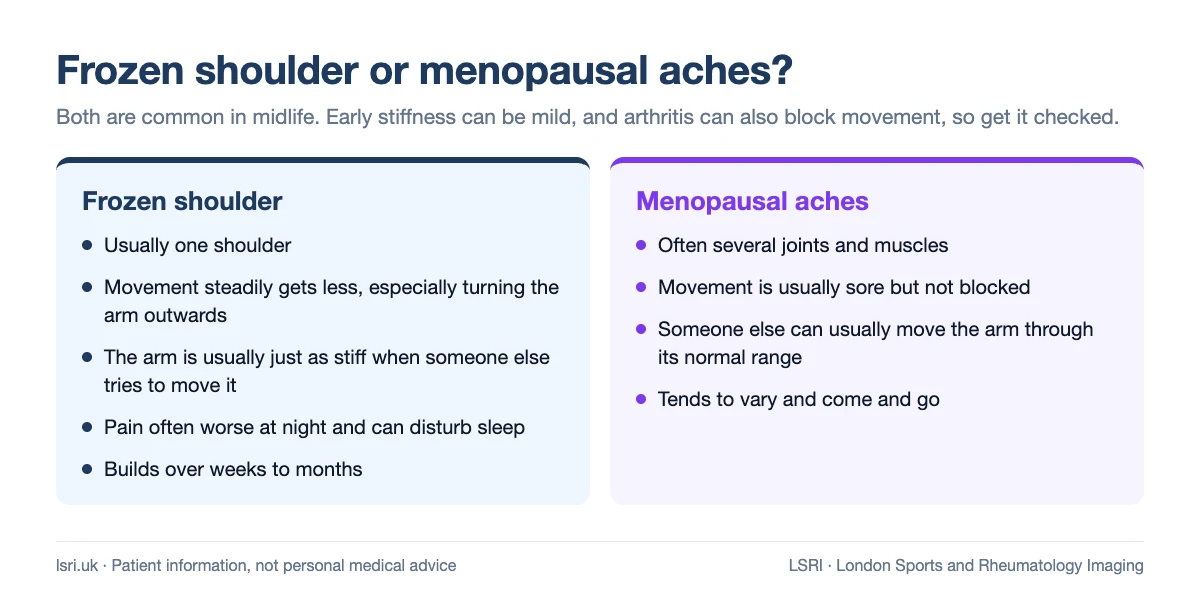
The simplest test is whether the shoulder is stiff when someone else moves it. In frozen shoulder, a doctor or physiotherapist cannot turn your arm outwards much further than you can yourself.2 With menopausal aches, movement is usually painful but not physically blocked. Early frozen shoulder and shoulder arthritis can be harder to tell apart, which is why an examination, and sometimes an X-ray or ultrasound, helps.
The stages of frozen shoulder
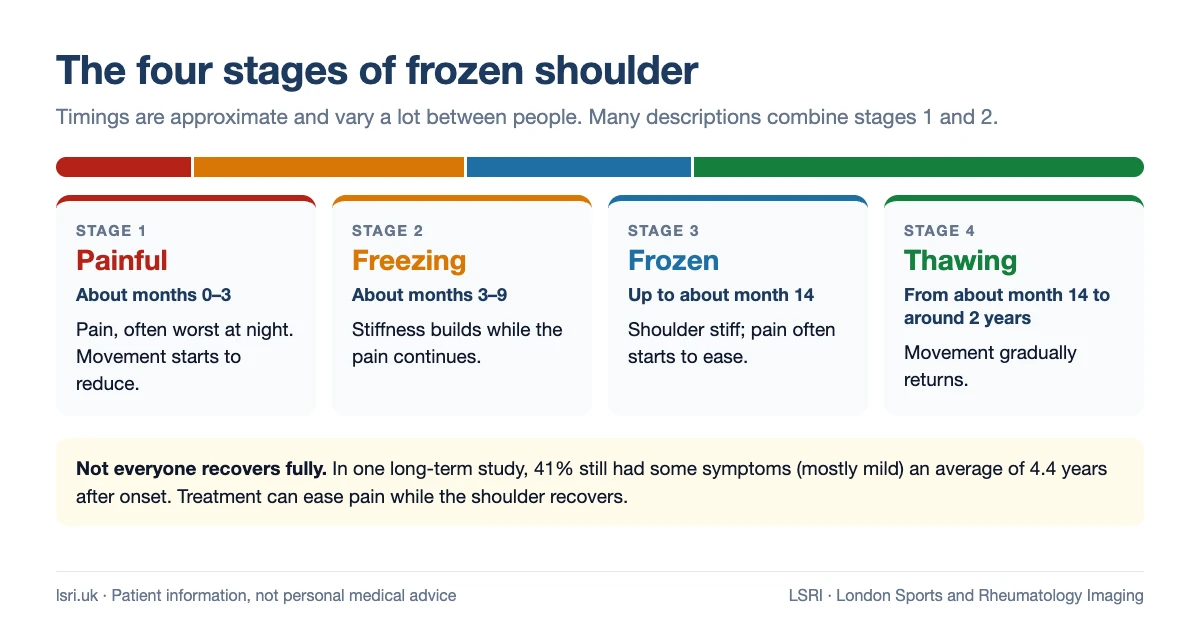
Frozen shoulder is often described in three or four stages.2 The four-stage version runs roughly like this:2
- Painful stage (about the first 3 months): pain, often worst at night, with movement starting to reduce.
- Freezing stage (about months 3 to 9): stiffness builds as the pain continues.
- Frozen stage (up to about month 14): the shoulder is stiff, but pain often starts to ease.
- Thawing stage (from about month 14, often until around 2 years after it started, sometimes longer): movement gradually returns.
Does frozen shoulder always get better on its own?
Not always completely. A systematic review found no good evidence that frozen shoulder passes through stages to full recovery without treatment; most improvement happens early, and some stiffness often remains.8 In an Oxford study that assessed people an average of 4.4 years after their symptoms began, 59% had normal or near-normal shoulders and 41% still had some symptoms. For almost all of them (94%) these were mild; only a small minority had severe pain and loss of function. People with the most severe symptoms at the start tended to do worst.17 If your pain is severe, it is worth having your shoulder assessed rather than simply waiting, because treatment can ease the pain in the short term.18
Other conditions linked with frozen shoulder: diabetes and thyroid problems
Diabetes is the most firmly established risk factor. In a systematic review by UK researchers, people with diabetes had about 3.7 times the odds of developing frozen shoulder,1 and in a pooled analysis of 18 studies, about 30% of people with frozen shoulder had diabetes.19 An underactive thyroid is also more common in people with frozen shoulder.7
Researchers disagree about whether everyone with frozen shoulder should be tested for diabetes. One review suggests considering it,19 while two smaller studies found no undiagnosed diabetes in the people they tested.20,21 Even so, if you have frozen shoulder, it is reasonable to ask your GP whether a blood sugar (HbA1c) or thyroid test is appropriate, especially if you have other risk factors. Blood sugar control can also change around the menopause, which is one of the questions the Nottingham study is exploring.15
How is frozen shoulder diagnosed?
Frozen shoulder is mainly diagnosed by examination: a painful, stiff shoulder with loss of movement, especially turning outwards.2 Imaging is not always needed, but it is useful to confirm the diagnosis and rule out other causes:2
- X-ray rules out shoulder arthritis and calcific tendinitis, which can cause similar pain and stiffness.2 See our guide to acute calcific tendinitis.
- Ultrasound can show thickening of the coracohumeral ligament at the front of the shoulder and changes in the rotator interval, an area that is typically inflamed in frozen shoulder, as well as checking the rotator cuff.2
- MRI is useful when the diagnosis is uncertain: features such as a thickened capsule and ligament support it.22 A standard MRI, without an injection of dye into the joint (an arthrogram), is usually enough.2,22
As MSK radiologists, we find ultrasound especially useful in the clinic, because it also guides treatment such as an injection or hydrodilatation.
Which treatments help frozen shoulder?
Pain relief and physiotherapy
The NHS suggests starting with painkillers such as paracetamol and anti-inflammatories such as ibuprofen, then stronger painkillers or a steroid injection if needed, with physiotherapy usually lasting at least six weeks.11 The NHS advises moving the shoulder gently, as keeping it completely still can make the pain worse.11
Steroid injection
Of the treatments studied, a steroid (corticosteroid) injection into the shoulder joint was the only one clearly better for short-term pain. In a review of 65 studies, it was the only treatment that was both statistically and clinically better for pain in the first 12 weeks, although the effect was modest, about 1 point on a 10-point pain scale compared with placebo or physiotherapy.18 An injection given early, in the first year, was linked with better results, and a home exercise programme alongside it helps.18 Under ultrasound guidance, the injection can be placed accurately into the joint.
Hydrodilatation (hydrodistension)
Hydrodilatation stretches the tight capsule by injecting a larger volume of fluid, usually saline with a local anaesthetic and a steroid, into the joint under imaging guidance, followed by physiotherapy.23 The evidence is limited and mixed. Compared with a steroid injection alone, a 2023 review found hydrodilatation gave a short-lived improvement in function and better outward rotation, but no difference in pain, and the clinical importance of the benefit is unclear.24 A 2021 UK review called the evidence inconclusive.25 We compare the two options in hydrodistension or steroid injection for frozen shoulder?
Manipulation and keyhole surgery
The UK FROST trial, run across 35 NHS hospitals, compared three treatments in 503 adults with frozen shoulder: early structured physiotherapy with a steroid injection, manipulation under anaesthetic with a steroid injection, and keyhole surgery to release the capsule.9 All three groups improved a great deal. At 12 months their Oxford Shoulder Scores were 37.2, 38.3 and 40.3 out of 48 respectively, and none of the differences was large enough to matter clinically. There were 8 serious adverse events after surgery, compared with 2 after manipulation, and manipulation was the most cost-effective option for the NHS.9
When to get urgent help: shoulder or arm pain with chest pain or breathlessness needs a 999 call. A hot, swollen, very painful joint with a fever needs same-day help from NHS 111 or A&E.26 LSRI is not an emergency service.
How LSRI can help
- A clear diagnosis. Dr Prashant Sankaye, Consultant MSK Radiologist, examines your shoulder and uses ultrasound to confirm frozen shoulder and rule out other causes. Ultrasound starts from £200 at our Harley Street and Harrow clinics, and X-ray from £200 at our partner imaging centre in Fitzrovia, central London.
- MRI, if it is needed, at our partner imaging centres, in two options: scan only, from £375 per body part (the scan, a report from a consultant MSK radiologist, usually within 24 hours, and access to your images, without a consultation or advice on treatment), or scan with a consultation, from £425, which adds a consultation to go through your results and next steps. Our clinical team checks every MRI request first and will tell you if an X-ray or ultrasound would answer your question better; see do you need a GP referral for a private MRI?.
- Ultrasound-guided treatment when it is right for you, including shoulder injections and hydrodistension, alongside a rehabilitation plan. See our frozen shoulder page; treatment prices are on our pricing page.
- Working with your GP. With your permission, we share our findings with your GP, who can look at blood tests, menopause symptoms and HRT with you.
What patients say about LSRI
“As with my previous visit, he was reassuring throughout the process explaining what he was doing ensuring that everything went smoothly and with as little discomfort as possible. I can’t speak more highly of his professionalism and that of the practice.”
S.N., Google review of LSRI Harley Street
Reviews describe individual experiences of our service; results of treatment vary from person to person.
Our clinics are on Harley Street (W1G 9QJ) and in Harrow (HA2 7SJ); call 0203 633 5040.
Frequently asked questions
Can perimenopause cause frozen shoulder?
It has not been proven. Frozen shoulder is most common in women around the age of perimenopause, and there are plausible reasons why falling oestrogen might contribute, but no study has yet shown that perimenopause causes it.14,15
Does HRT help frozen shoulder?
We do not know yet. One US study found slightly fewer diagnoses in women using HRT, but the difference could have been due to chance. Another, with only 15 HRT users, found shorter symptoms. Neither can show cause and effect, and the first randomised trial has not reported.3,4,5 There is no evidence to support taking HRT for the shoulder alone.
How long does frozen shoulder last?
It varies a lot: frozen shoulder can take months or years to get better.11 In one long-term study, 41% of people still had some symptoms, mostly mild, about four and a half years after it started.17
Can frozen shoulder affect both shoulders?
Yes. In an Oxford study, 20% of people had it in both shoulders at some point, but it did not come back in the same shoulder.17
Is frozen shoulder more common in women?
Yes. Between 58% and 70% of people with frozen shoulder are women, depending on the study.1,2
How much does hydrodilatation for frozen shoulder cost?
Prices vary between clinics. Our current prices for hydrodistension and other ultrasound-guided treatments are on our pricing page, and we will confirm your total before any treatment.
References
- Dyer BP, Rathod-Mistry T, Burton C, van der Windt D, Bucknall M. Diabetes as a risk factor for the onset of frozen shoulder: a systematic review and meta-analysis. BMJ Open 2023;13(1):e062377. doi:10.1136/bmjopen-2022-062377
- Picasso R, Pistoia F, Zaottini F, Marcenaro G, Miguel-Pérez M, Tagliafico AS, et al. Adhesive capsulitis of the shoulder: current concepts on the diagnostic work-up and evidence-based protocol for radiological evaluation. Diagnostics (Basel) 2023;13(22):3410. doi:10.3390/diagnostics13223410
- Saltzman E, Kennedy J, Ford A, Reinke E, Green C, Poehlein E, et al. Poster 188: Is hormone replacing therapy associated with reduced risk of adhesive capsulitis in menopausal women? A single center analysis. Orthop J Sports Med 2023;11(7 Suppl 3):2325967123S00174. doi:10.1177/2325967123S00174
- Ranson W, Burapachaisri A, Capotosto S, Schroen CA, Galatz LM, Cagle PJ, et al. Hormone replacement therapy is associated with significantly reduced symptom duration in postmenopausal women with adhesive capsulitis [conference abstract]. American Academy of Orthopaedic Surgeons Annual Meeting 2026. AAOS 2026 abstract AAOS2026-005847 (PDF) (accessed 22 October 2026)
- University of California, San Francisco. Hormone replacement therapy as an adjunct treatment for adhesive capsulitis of the shoulder (frozen shoulder) in peri- and postmenopausal women (FSHRT). ClinicalTrials.gov NCT07278323. clinicaltrials.gov (accessed 22 October 2026)
- NHS. Benefits and risks of hormone replacement therapy (HRT). nhs.uk (page last reviewed 8 February 2023; accessed 22 October 2026)
- Schiefer M, Teixeira PFS, Fontenelle C, Carminatti T, Santos DA, Righi LD, et al. Prevalence of hypothyroidism in patients with frozen shoulder. J Shoulder Elbow Surg 2017;26(1):49-55. doi:10.1016/j.jse.2016.04.026
- Wong CK, Levine WN, Deo K, Kesting RS, Mercer EA, Schram GA, et al. Natural history of frozen shoulder: fact or fiction? A systematic review. Physiotherapy 2017;103(1):40-7. doi:10.1016/j.physio.2016.05.009
- Rangan A, Brealey SD, Keding A, Corbacho B, Northgraves M, Kottam L, et al. Management of adults with primary frozen shoulder in secondary care (UK FROST): a multicentre, pragmatic, three-arm, superiority randomised clinical trial. Lancet 2020;396(10256):977-89. doi:10.1016/S0140-6736(20)31965-6
- Millar NL, Meakins A, Struyf F, Willmore E, Campbell AL, Kirwan P, et al. Frozen shoulder. Nat Rev Dis Primers 2022;8(1):59. doi:10.1038/s41572-022-00386-2
- NHS. Frozen shoulder. nhs.uk (page last reviewed 24 June 2024; accessed 22 October 2026)
- Wright VJ, Schwartzman JD, Itinoche R, Wittstein J. The musculoskeletal syndrome of menopause. Climacteric 2024;27(5):466-72. doi:10.1080/13697137.2024.2380363
- Chlebowski RT, Cirillo DJ, Eaton CB, Stefanick ML, Pettinger M, Carbone LD, et al. Estrogen alone and joint symptoms in the Women’s Health Initiative randomized trial. Menopause 2013;20(6):600-8. doi:10.1097/GME.0b013e31828392c4
- Navarro-Ledesma S. Frozen shoulder as a systemic immunometabolic disorder: the roles of estrogen, thyroid dysfunction, endothelial health, lifestyle, and clinical implications. J Clin Med 2025;14(20):7315. doi:10.3390/jcm14207315
- University of Nottingham. Exploring the link between menopause, glucose control, and frozen shoulder in women (MENO-FROST). ClinicalTrials.gov NCT07603089. clinicaltrials.gov (accessed 22 October 2026)
- NHS. Menopause: symptoms. nhs.uk (page last reviewed 19 May 2026; accessed 22 October 2026)
- Hand C, Clipsham K, Rees JL, Carr AJ. Long-term outcome of frozen shoulder. J Shoulder Elbow Surg 2008;17(2):231-6. doi:10.1016/j.jse.2007.05.009
- Challoumas D, Biddle M, McLean M, Millar NL. Comparison of treatments for frozen shoulder: a systematic review and meta-analysis. JAMA Netw Open 2020;3(12):e2029581. doi:10.1001/jamanetworkopen.2020.29581
- Zreik NH, Malik RA, Charalambous CP. Adhesive capsulitis of the shoulder and diabetes: a meta-analysis of prevalence. Muscles Ligaments Tendons J 2016;6(1):26-34. doi:10.11138/mltj/2016.6.1.026
- Safran O, El-Haj M, Leibowitz G, Beyth S, Furman Z, Milgrom C, et al. Should patients with frozen shoulder be screened for diabetes mellitus? Orthop J Sports Med 2017;5(7):2325967117716450. doi:10.1177/2325967117716450
- Gundtoft PH, Kristensen AK, Attrup M, Vobbe JW, Luxhøi T, Rix FG, et al. Prevalence and impact of diabetes mellitus on the frozen shoulder. South Med J 2018;111(11):654-9. doi:10.14423/SMJ.0000000000000886
- Suh CH, Yun SJ, Jin W, Lee SH, Park SY, Park JS, et al. Systematic review and meta-analysis of magnetic resonance imaging features for diagnosis of adhesive capsulitis of the shoulder. Eur Radiol 2019;29(2):566-77. doi:10.1007/s00330-018-5604-y
- Thompson H, Brealey S, Cook E, Hadi S, Khan SHM, Rangan A. Expert clinical consensus in the delivery of hydrodilatation for the management of patients with a primary frozen shoulder: a modified Delphi study. Bone Jt Open 2022;3(9):701-9. doi:10.1302/2633-1462.39.BJO-2022-0072.R1
- Poku D, Hassan R, Migliorini F, Maffulli N. Efficacy of hydrodilatation in frozen shoulder: a systematic review and meta-analysis. Br Med Bull 2023;147(1):121-47. doi:10.1093/bmb/ldad018
- Rex SS, Kottam L, McDaid C, Brealey S, Dias J, Hewitt CE, et al. Effectiveness of interventions for the management of primary frozen shoulder: a systematic review of randomized trials. Bone Jt Open 2021;2(9):773-84. doi:10.1302/2633-1462.29.BJO-2021-0060.R1
- NHS. Septic arthritis. nhs.uk (page last reviewed 3 September 2026; accessed 22 October 2026)
Book an appointment
Call 0203 633 5040 or book online. Clinics at Harley Street (W1G 9QJ) and Harrow (HA2 7SJ).
About this article
Purpose: written by the LSRI clinical team to explain what the research shows about frozen shoulder and the menopause, including HRT, how frozen shoulder differs from menopausal joint pain, its stages, and the evidence for its treatments, based on the research and guidance listed above. It is general information, not a diagnosis, and it is not advice about HRT, which should be discussed with your GP or a menopause specialist. If you are worried about your own symptoms, speak to your GP.