Written by: LSRI Editorial Team
Medically reviewed by Dr Prashant Sankaye, Consultant MSK Radiologist ·
Last Updated: October 24, 2026
Read Time: 18 Minutes
Written by the LSRI clinical team and medically reviewed by Dr Prashant Sankaye, Consultant MSK Radiologist, on 22 October 2026.
Tennis elbow causes pain on the outside of the elbow that flares when you grip, lift a kettle, turn a door handle or shake hands. It is common, affecting around 1 to 3% of adults, mostly between the ages of about 35 and 55.1,2,3 Despite the name, you do not have to play tennis to get it: it is often linked with work, hobbies or everyday gripping tasks, such as using a mouse or a screwdriver.1,3 Racket sports can bring it on too. In padel, which has grown rapidly in Britain, the elbow is the most commonly injured area.4,5
The two questions people ask most are: how long does tennis elbow last, and how can you get rid of it quickly? This guide answers both honestly, using the strongest trials, and explains what actually helps, how tennis elbow differs from golfer’s elbow, why padel players get it, and when a scan is worthwhile. It is written by the LSRI clinical team, led by a consultant musculoskeletal (MSK) radiologist who diagnoses and treats elbow tendon problems with ultrasound.
Key points
- Most tennis elbow gets better: in trials, about 8 to 9 in 10 people reported success or improvement by one year, even without active treatment.6,7,8
- There is no proven quick fix. A steroid injection gives the fastest short-term relief, but people who had one did worse at one year and relapsed more often.6,9
- Progressive strengthening exercise is safe and helps a little more than passive treatments, though the evidence is low certainty.10
- PRP injections, made from your own blood, are an option when tennis elbow has not settled. In a trial against a steroid injection, PRP gave better results at two years, and higher-concentration PRP has shown the most promise.11,12
- In padel injury studies, the elbow is the most commonly injured area and tennis elbow the most commonly reported diagnosis.4
- A scan is not needed for most cases, but ultrasound or MRI helps when symptoms are not settling, the diagnosis is unclear or a tear is suspected.13,14
What is tennis elbow?
Tennis elbow (lateral elbow tendinopathy, or lateral epicondylitis) affects the tendons that attach the forearm muscles to the bony bump on the outside of the elbow. The tendon most often involved is the extensor carpi radialis brevis, which helps steady the wrist when you grip.2 Although the name ends in “-itis”, most experts now see it mainly as a tendon overload and degeneration problem rather than simple inflammation.2,15
It is caused by repeated or forceful use of the forearm, especially when the two are combined: for example, gripping tools, lifting, typing and mouse work, or racket sports.1,3 Smoking is also linked with it.1
How long does tennis elbow last?
For most people, months rather than years. The most reliable evidence comes from trials that included a “wait-and-see” group, who received advice but no active treatment:
- In a Dutch trial, 83% of the wait-and-see group reported success at one year.6
- In an Australian trial, about 9 in 10 people in the wait-and-see group had recovered or were much improved at one year.7
- Pooling the placebo and no-treatment groups from several trials, 89% had improved at one year. The proportion of people not yet improved roughly halved every 2.5 to 3 months.8
The NHS says tennis elbow usually goes away with rest but can sometimes last over a year.3 Encouragingly, how long you have already had it does not seem to reduce your chance of getting better.8 In US population data, about 1 in 12 people had a recurrence within two years.16
Is there a quick fix for tennis elbow?
Many people search for “how to fix tennis elbow fast”, so it is worth being straight: no treatment has been shown to improve how people are doing at one year compared with giving it time.6,7,8 Some treatments do speed up early relief. In two trials, physiotherapy (hands-on treatment plus exercise) roughly doubled the number of people doing well at six weeks compared with wait-and-see, without a later relapse.6,7 A steroid injection gives the quickest short-term relief, but it comes with a trade-off (see below). What does help is easing the load that triggers your pain while gradually strengthening the forearm, and using simple measures to stay comfortable in the meantime.3,10
What actually helps tennis elbow?
Easing the load
The NHS suggests resting the arm from the activities that cause the pain, using a hot or cold pack, and trying paracetamol or an anti-inflammatory gel.3 Complete rest is rarely needed. The aim is to cut back on whatever provokes the pain, such as heavy gripping, long spells of mouse work or a sudden increase in racket sport, while keeping the arm moving.
Strengthening exercise
A review of 30 trials (2,123 people) found that exercise gave better results than passive treatments for pain, function and pain-free grip strength. The benefits were small and the certainty of the evidence low, and no single programme has been shown to be better than the others.10 Some approaches look promising:
- Heavy slow resistance training: in a Danish trial of 60 people, everyone did 12 weeks of home exercise with elastic bands and improved, and adding a steroid injection or tendon needling gave no extra benefit. There was no group without exercise, so some of the improvement may have been natural recovery.17
- Eccentric exercise with a flexible rubber bar: in a small trial of 21 patients, adding this exercise to usual care led to much larger improvements.18
- Isometric (static) exercise on its own was of doubtful benefit in a small trial of 40 people that compared it with wait-and-see.19
The NHS suggests seeing a physiotherapist if your symptoms have not improved after six weeks of home treatment.3
Braces and straps
A forearm strap worn just below the elbow (a counterforce brace) is a simple, low-risk option. In a small trial of 31 people with recent-onset tennis elbow, it reduced pain over the first three months compared with a placebo brace.20
Steroid injection: fast relief, but a trade-off
A steroid (corticosteroid) injection gives the quickest relief. In the Dutch trial, 92% of people reported success six weeks after an injection, compared with 47% after physiotherapy and 32% with wait-and-see. But by one year the order had reversed: 69% after injection, 91% after physiotherapy and 83% with wait-and-see, and recurrence after injection was high.6
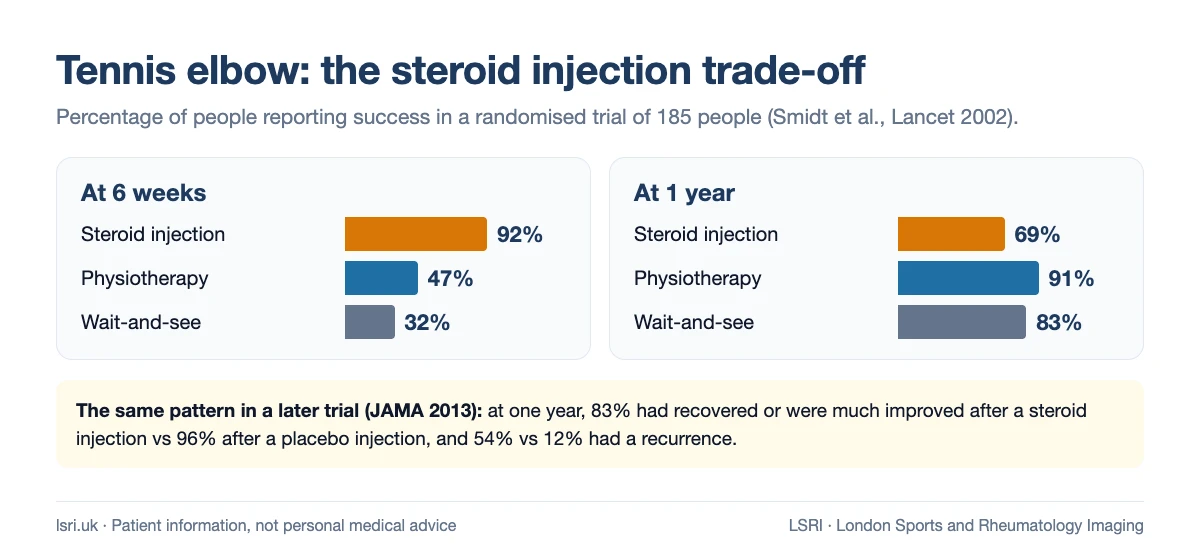
A later trial published in JAMA found the same pattern. At one year, 83% of people who had a steroid injection had recovered or were much improved, compared with 96% of those given a placebo injection, and 54% had improved at first but then relapsed during the year, compared with 12%.9 A steroid injection can still be the right choice in some situations, for example to get through an important period of work, but it is worth knowing the trade-off before you decide.
PRP injections
Platelet-rich plasma (PRP) is made from a small sample of your own blood, spun to concentrate the platelets, and injected into the tendon under ultrasound guidance. It is an option for tennis elbow that has not settled with exercise and time, and an alternative to a steroid injection, which helps in the short term but is linked with more relapses later.9
- PRP compared with steroid: in a randomised trial of 100 people, PRP gave better pain and function scores than a steroid injection, and the difference was still there at two years.11
- The preparation matters: a 2025 analysis of 13 trials (791 patients) found that PRP with a high platelet concentration relieved pain better than the treatments it was compared with, while lower-concentration PRP did not.12
- Results vary: not every trial has found a clear benefit over a placebo injection,21 so we will talk you through whether PRP is likely to suit you.
If you are considering PRP, we will explain the preparation we use and what to expect afterwards.
Shockwave therapy
A 2005 Cochrane review found that shockwave therapy gives little or no benefit for pain and function in tennis elbow,22 and a 2021 analysis of 27 studies found no clinically important benefit over sham treatment.23
Massage guns
Many people ask whether a massage gun helps. There is very little research: we found only two small studies, a 20-person study published in Korea in 2021 and a US trial that has so far reported early results only as a conference abstract. Neither compared the massage gun with a placebo device.24,25 Gentle use for comfort is unlikely to do harm, but it is not a proven treatment.
Surgery
Surgery is rarely needed. The NHS mentions it as an option if symptoms persist after 6 to 12 months,3 but in a small trial that was stopped early, removing the damaged tendon did no better than a placebo operation in which the tendon was only exposed.26
Tennis elbow vs golfer’s elbow: what is the difference?
Golfer’s elbow (medial epicondylitis) is the mirror image of tennis elbow, on the inside of the elbow. It is about a third as common: in a Finnish population study, 0.4% of adults had golfer’s elbow and 1.3% had tennis elbow.1
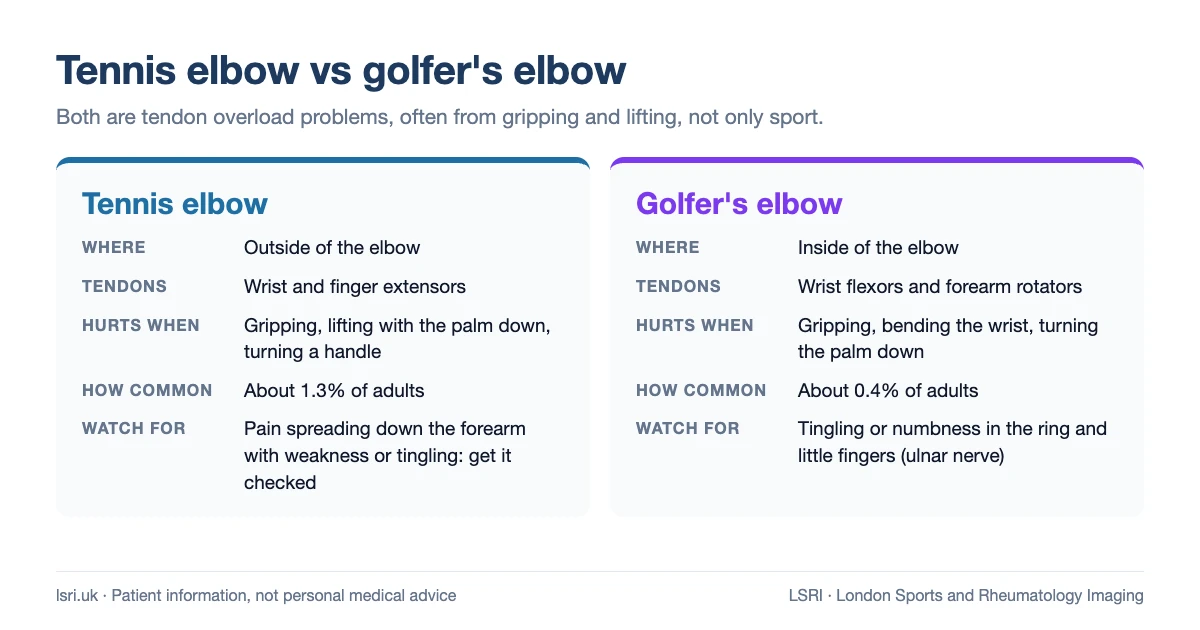
One important difference is the ulnar nerve, which runs close to the inner elbow. Tingling or numbness in the ring and little fingers alongside inner elbow pain suggests the nerve may be involved: in one series of people having surgery for golfer’s elbow, 16 of 30 elbows also had ulnar nerve problems.27 That needs assessment rather than waiting. Read more on our golfer’s elbow page.
Padel elbow: why padel players get tennis elbow
Padel is one of the fastest-growing sports in Britain: the Lawn Tennis Association reported about 1,000,000 players in May 2026, up from 15,000 in 2019.5 For many new players, the elbow is where problems show up first.
- The elbow is the most commonly injured area. In a systematic review of padel injuries, the elbow was the most common site of injury and tennis elbow the most frequently reported diagnosis.4 A 2026 review of 14 studies (3,581 players) also found that the elbow was the most commonly injured area, mostly from problems with the tendon involved in tennis elbow.28
- Racket weight and hours played may matter. In an international survey of 950 amateur players, upper-body injuries were linked with rackets weighing 350 g or more and with playing more than six hours a week, although the links were modest.29
- Other suggested reasons are plausible but unproven: the solid, unstrung padel bat, the many overhead shots, and repeated braking of the forearm muscles as you control the ball.4 A sudden jump in how much you play is a common trigger for tendon pain in general, and it may well apply to newcomers to padel.
Practical steps that follow from this: build up playing time gradually, consider a lighter bat if you are getting elbow pain, ask a coach to look at your technique, and start forearm strengthening early rather than playing through worsening pain. These are sensible measures rather than proven ones, as padel research is still limited.4,29
When do you need a scan for tennis elbow?
Most tennis elbow can be diagnosed by examination alone.2 As MSK radiologists, we find a scan most useful when:
- symptoms are not settling despite treatment: US radiology guidance then considers ultrasound or MRI appropriate to look for a tendon tear or other problem;13
- the diagnosis is uncertain: other causes of outer elbow pain include a trapped nerve (radial tunnel syndrome), elbow instability and pain referred from the neck;2
- a tear or ligament injury is suspected: in one ultrasound study, people with a tear of the outer elbow ligament or a larger tear within the tendon tended to do less well;14
- an injection is being considered: ultrasound confirms the diagnosis and guides the needle precisely.
Scan findings always need to be read alongside your symptoms: ultrasound appearances can improve without the pain improving, and the reverse.2,30
When to get urgent help: if your elbow is hot, red and swollen and you have a fever or feel unwell, contact NHS 111 or your GP the same day, or go to A&E.31 LSRI is not an emergency service.
How LSRI can help
- A clear diagnosis with ultrasound from Dr Prashant Sankaye, Consultant MSK Radiologist, who examines the tendon, the ligament and the nerve, and looks for other causes of your pain. Ultrasound starts from £200.
- Honest advice on treatment, including whether an ultrasound-guided injection is likely to help you, alongside a rehabilitation plan with the experienced physiotherapists we work closely with. See our tennis elbow treatment page; treatment prices are on our pricing page.
- MRI at our partner imaging centres when a tear, ligament injury or other problem needs a closer look, in two options: scan only, from £375 per body part (the scan, a report from a consultant MSK radiologist, usually within 24 hours, and access to your images, without a consultation or advice on treatment), or scan with a consultation, from £425, which adds a consultation to go through your results and next steps. Our clinical team checks every MRI request first and will tell you if an X-ray or ultrasound would answer your question better; see do you need a GP referral for a private MRI?.
What patients say about LSRI
“Amazing services provided by [Dr Sankaye] and his team, more than helpful in diagnosing as well as treating the issue. Even then after care is brilliant with follow up phone calls to check on progress.”
T.S., Google review of LSRI Harley Street
“My heartfelt thanks to Dr. Sankaye and also many thanks for the lovely way [I] was treated in his surgery. I highly recommend him …”
Patient review on iWantGreatCare
Reviews describe individual experiences of our service; results of treatment vary from person to person.
Our clinics are on Harley Street (W1G 9QJ) and in Harrow (HA2 7SJ); call 0203 633 5040. Read more: MRI or ultrasound for joint pain?
Frequently asked questions
Should I stop playing tennis or padel?
Not necessarily. Complete rest is rarely needed. Cut back on how long and how hard you play, avoid what makes the pain flare, and add forearm strengthening, then build up gradually.3,10 If the pain is getting worse despite this, get it assessed.
Does a tennis elbow strap work?
It may help in the short term. In a small trial, a counterforce brace reduced pain over the first three months compared with a placebo brace.20
Does a cortisone injection help tennis elbow?
It eases pain for a few weeks, but people who had a steroid injection did worse at one year and relapsed more often than those who had a placebo injection or physiotherapy.6,9
Does PRP work for tennis elbow?
It can help some people whose tennis elbow has not settled: in one trial, PRP gave better results than a steroid injection at two years,11 and higher-concentration PRP has shown the most promise.12 Results vary between studies,21 so it is worth discussing whether it suits you.
Can tennis elbow come back?
Yes. In US population data, about 1 in 12 people had a recurrence within two years,16 and recurrence was much more common after a steroid injection in trials.9
Is tennis elbow the same as padel elbow?
“Padel elbow” is not a separate diagnosis: it usually means tennis elbow in a padel player, which is the most commonly reported diagnosis in padel injury studies.4
References
- Shiri R, Viikari-Juntura E, Varonen H, Heliövaara M. Prevalence and determinants of lateral and medial epicondylitis: a population study. Am J Epidemiol 2006;164(11):1065-74. doi:10.1093/aje/kwj325
- Vaquero-Picado A, Barco R, Antuña SA. Lateral epicondylitis of the elbow. EFORT Open Rev 2016;1(11):391-7. doi:10.1302/2058-5241.1.000049
- NHS. Tennis elbow. nhs.uk (page last reviewed 31 May 2024; accessed 22 October 2026)
- Dahmen J, Emanuel KS, Fontanellas-Fes A, Verhagen E, Kerkhoffs GMMJ, Pluim BM. Incidence, prevalence and nature of injuries in padel: a systematic review. BMJ Open Sport Exerc Med 2023;9(2):e001607. doi:10.1136/bmjsem-2023-001607
- LTA Padel. 1,000,000 padel players in Britain. 15 May 2026. ltapadel.org.uk (accessed 22 October 2026)
- Smidt N, van der Windt DA, Assendelft WJ, Devillé WL, Korthals-de Bos IB, Bouter LM. Corticosteroid injections, physiotherapy, or a wait-and-see policy for lateral epicondylitis: a randomised controlled trial. Lancet 2002;359(9307):657-62. doi:10.1016/S0140-6736(02)07811-X
- Bisset L, Beller E, Jull G, Brooks P, Darnell R, Vicenzino B. Mobilisation with movement and exercise, corticosteroid injection, or wait and see for tennis elbow: randomised trial. BMJ 2006;333(7575):939. doi:10.1136/bmj.38961.584653.AE
- Ikonen J, Lähdeoja T, Ardern CL, Buchbinder R, Reito A, Karjalainen T. Persistent tennis elbow symptoms have little prognostic value: a systematic review and meta-analysis. Clin Orthop Relat Res 2022;480(4):647-60. doi:10.1097/CORR.0000000000002058
- Coombes BK, Bisset L, Brooks P, Khan A, Vicenzino B. Effect of corticosteroid injection, physiotherapy, or both on clinical outcomes in patients with unilateral lateral epicondylalgia: a randomized controlled trial. JAMA 2013;309(5):461-9. doi:10.1001/jama.2013.129
- Karanasios S, Korakakis V, Whiteley R, Vasilogeorgis I, Woodbridge S, Gioftsos G. Exercise interventions in lateral elbow tendinopathy have better outcomes than passive interventions, but the effects are small: a systematic review and meta-analysis of 2123 subjects in 30 trials. Br J Sports Med 2021;55(9):477-85. doi:10.1136/bjsports-2020-102525
- Gosens T, Peerbooms JC, van Laar W, den Oudsten BL. Ongoing positive effect of platelet-rich plasma versus corticosteroid injection in lateral epicondylitis: a double-blind randomized controlled trial with 2-year follow-up. Am J Sports Med 2011;39(6):1200-8. doi:10.1177/0363546510397173
- Oeding JF, Varady NH, Messer CJ, Dines JS, Williams RJ, Rodeo SA. Platelet concentration explains variability in outcomes of platelet-rich plasma for lateral epicondylitis: a high dose is critical for a positive response: a systematic review and meta-analysis with meta-regression. Am J Sports Med 2025;53(10):2489-96. doi:10.1177/03635465241303716
- Thomas JM, Chang EY, Ha AS, Bartolotta RJ, Bucknor MD, Caracciolo JT, et al. ACR Appropriateness Criteria® Chronic Elbow Pain. J Am Coll Radiol 2022;19(11S):S256-65. doi:10.1016/j.jacr.2022.09.022
- Clarke AW, Ahmad M, Curtis M, Connell DA. Lateral elbow tendinopathy: correlation of ultrasound findings with pain and functional disability. Am J Sports Med 2010;38(6):1209-14. doi:10.1177/0363546509359066
- Walz DM, Newman JS, Konin GP, Ross G. Epicondylitis: pathogenesis, imaging, and treatment. Radiographics 2010;30(1):167-84. doi:10.1148/rg.301095078
- Sanders TL, Maradit Kremers H, Bryan AJ, Ransom JE, Smith J, Morrey BF. The epidemiology and health care burden of tennis elbow: a population-based study. Am J Sports Med 2015;43(5):1066-71. doi:10.1177/0363546514568087
- Couppé C, Døssing S, Bülow PM, Siersma VD, Zilmer CK, Bang CW, et al. Effects of heavy slow resistance training combined with corticosteroid injections or tendon needling in patients with lateral elbow tendinopathy: a 3-arm randomized double-blinded placebo-controlled study. Am J Sports Med 2022;50(10):2787-96. doi:10.1177/03635465221110214
- Tyler TF, Thomas GC, Nicholas SJ, McHugh MP. Addition of isolated wrist extensor eccentric exercise to standard treatment for chronic lateral epicondylosis: a prospective randomized trial. J Shoulder Elbow Surg 2010;19(6):917-22. doi:10.1016/j.jse.2010.04.041
- Vuvan V, Vicenzino B, Mellor R, Heales LJ, Coombes BK. Unsupervised isometric exercise versus wait-and-see for lateral elbow tendinopathy. Med Sci Sports Exerc 2020;52(2):287-95. doi:10.1249/MSS.0000000000002128
- Kroslak M, Pirapakaran K, Murrell GAC. Counterforce bracing of lateral epicondylitis: a prospective, randomized, double-blinded, placebo-controlled clinical trial. J Shoulder Elbow Surg 2019;28(2):288-95. doi:10.1016/j.jse.2018.10.002
- Karjalainen TV, Silagy M, O’Bryan E, Johnston RV, Cyril S, Buchbinder R. Autologous blood and platelet-rich plasma injection therapy for lateral elbow pain. Cochrane Database Syst Rev 2021;9(9):CD010951. doi:10.1002/14651858.CD010951.pub2
- Buchbinder R, Green SE, Youd JM, Assendelft WJJ, Barnsley L, Smidt N. Shock wave therapy for lateral elbow pain. Cochrane Database Syst Rev 2005;(4):CD003524. doi:10.1002/14651858.CD003524.pub2
- Karanasios S, Tsamasiotis GK, Michopoulos K, Sakellari V, Gioftsos G. Clinical effectiveness of shockwave therapy in lateral elbow tendinopathy: systematic review and meta-analysis. Clin Rehabil 2021;35(10):1383-98. doi:10.1177/02692155211006860
- Kim S, Ju S. Analysis of the pain-control effect of percussive massage gun therapy in patients with lateral epicondylitis [in Korean]. Journal of Sport and Dance Science 2021;1(1):31-8. earticle.net (accessed 22 October 2026)
- Sebt S, Stone M, Tsai EY, Yoshida R, Koh JJ. Treatment of lateral epicondylitis with a percussive therapy device: midpoint outcomes of a randomized controlled trial [conference abstract]. American Academy of Orthopaedic Surgeons Annual Meeting 2026. AAOS 2026 abstract AAOS2026-000722 (PDF) (accessed 22 October 2026)
- Kroslak M, Murrell GAC. Surgical treatment of lateral epicondylitis: a prospective, randomized, double-blinded, placebo-controlled clinical trial. Am J Sports Med 2018;46(5):1106-13. doi:10.1177/0363546517753385
- Gabel GT, Morrey BF. Operative treatment of medial epicondylitis: influence of concomitant ulnar neuropathy at the elbow. J Bone Joint Surg Am 1995;77(7):1065-9. doi:10.2106/00004623-199507000-00013
- Aguilar-Núñez D, González-Romero A, Pérez-Montilla JJ, Hamed-Hamed D, González-Muñoz A, Navarro-Ledesma S. Epidemiology, incidence, prevalence, and treatment of injuries in padel: a scoping review. Appl Sci 2026;16(6):2680. doi:10.3390/app16062680
- Muñoz D, Coronado M, Robles-Gil MC, Martín M, Escudero-Tena A. Incidence of upper body injuries in amateur padel players. Int J Environ Res Public Health 2022;19(24):16858. doi:10.3390/ijerph192416858
- Krogh TP, Fredberg U, Stengaard-Pedersen K, Christensen R, Jensen P, Ellingsen T. Treatment of lateral epicondylitis with platelet-rich plasma, glucocorticoid, or saline: a randomized, double-blind, placebo-controlled trial. Am J Sports Med 2013;41(3):625-35. doi:10.1177/0363546512472975
- NHS. Septic arthritis. nhs.uk (page last reviewed 3 September 2026; accessed 22 October 2026)
Book an appointment
Call 0203 633 5040 or book online. Clinics at Harley Street (W1G 9QJ) and Harrow (HA2 7SJ).
About this article
Purpose: written by the LSRI clinical team to explain how long tennis elbow usually lasts, what the evidence shows for exercise, braces, injections, shockwave and surgery, how it differs from golfer’s elbow, why padel players get it, and when a scan helps, based on the research and guidance listed above. It is general information, not a diagnosis. If you are worried about your own symptoms, speak to your GP.