Written by: LSRI Editorial Team
Medically reviewed by Dr Prashant Sankaye, Consultant MSK Radiologist ·
Last Updated: October 25, 2026
Read Time: 23 Minutes
Written by the LSRI clinical team and medically reviewed by Dr Prashant Sankaye, Consultant MSK Radiologist, on 25 October 2026.
Shin pain is one of the commonest problems when people start running or build up for a marathon, a HYROX race or a triathlon. Most of the time it is shin splints. Sometimes it is a stress fracture of the shin bone (tibia). The two can feel similar at first, but they are managed differently: rest for longer than you need and you lose fitness, but keep running on a stress fracture and a few weeks off can turn into a few months.
This guide, written by the LSRI clinical team, led by a consultant musculoskeletal (MSK) radiologist, explains how to tell shin splints from a stress fracture, what an X-ray and an MRI can and cannot show, what actually helps (and what does not), and how to get back to running. For stress fractures in the foot, hip and elsewhere, see our guide to stress fractures in runners, HYROX athletes and triathletes.
Key points
- Shin splints cause an ache spread along the inner edge of the shin. A stress fracture usually causes one small spot on the bone that is very tender to press.1
- Shin splints are common: across studies, 13.6% to 20.0% of runners developed them.2
- An X-ray is often normal, especially early on. Across studies, X-rays picked up only 12% to 56% of lower-limb stress fractures. MRI is the most accurate test.1,3
- MRI must be read alongside your symptoms. In one small study, 43% of runners with no symptoms had stress changes in the shin bone on MRI.4
- There is no quick fix. No treatment has been shown to be clearly better than the others, and compression socks did not speed recovery in a trial.5,6
- Pain in one spot on the front ridge of the shin bone needs prompt assessment, because stress fractures there heal less reliably.7,8
What are shin splints?
“Shin splints” is the everyday name for medial tibial stress syndrome (MTSS): pain along the inner (posteromedial) edge of the shin bone during exercise.9 It used to be blamed on an inflamed lining of the bone, but research has not supported that. It is now thought to be a bone-stress problem, where the bone is being broken down by loading faster than it can rebuild.9
Shin splints are common in anyone whose running or marching goes up quickly. In one study of naval recruits, 35% developed them during 10 weeks of basic training, women more often than men (53% vs 28%).10
What is a tibial stress fracture?
A stress fracture happens when bone cannot keep up with repeated loading. It sits on a spectrum: first a stress reaction (swelling, or oedema, inside the bone), then a stress fracture, and rarely a complete break.11,12 The tibia is one of the commonest places for it. In a 12-month study of track and field athletes, 46% of stress fractures were in the tibia.13
Shin splints and stress fractures can happen together, and how one relates to the other is not fully understood.14 Shin splints do not always lead to a stress fracture, but shin pain that is changing in character should be checked.
Shin splints or a stress fracture: how to tell the difference
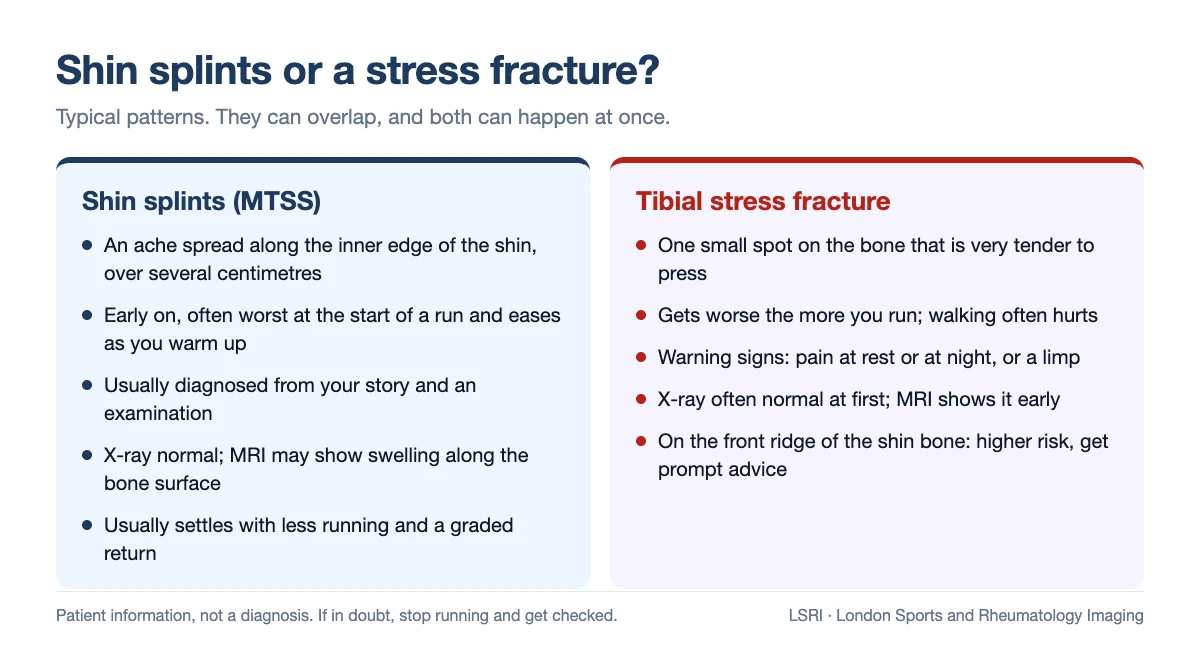
Where it hurts. Shin splints usually cause a vague, spread-out ache along the middle and lower part of the inner shin. A stress fracture usually causes one small, very tender spot on the bone.1
How it behaves. Early shin splints often hurt most at the start of a run and ease as you warm up, although as they get worse the pain comes on sooner and can be felt at rest.1 A stress fracture tends to get worse the more you run, and walking often hurts: in one review, 81% of people with a stress fracture had pain on walking.15,16
Warning signs that mean you should stop running and get checked include pain in one spot that hurts to press, pain on walking, pain at rest or at night, a limp, or pain in one spot on the front ridge of the shin bone (rather than along its inner edge).1,15,16
Home tests are not reliable. You may read that hopping on the painful leg, or holding a tuning fork against the bone, can tell you whether there is a fracture. There is no good evidence on how accurate the hop test is (it is often positive in shin splints too), and tuning-fork tests vary too much to rely on.15,17 If hopping causes sharp pain in one spot, stop and get checked rather than repeating it.
A doctor or physiotherapist can usually diagnose shin splints from your story and an examination. In one study, two clinicians agreed on the diagnosis 96% of the time without any scan.18 Scans are used when the picture is not typical, a stress fracture is suspected, or it is not getting better.1 Many runners also choose a scan to make sure there is no stress fracture before they build their training back up.
What do shin splints feel like?
Most people describe a dull ache or soreness along the inner edge of the shin, spread over a stretch of bone rather than one spot. It is usually brought on by running or jumping. The bone may be tender when you run your fingers down it.1,9
Other causes of shin pain
Not all shin pain is bone stress. Other causes include:19
- Chronic exertional compartment syndrome: pain or tightness in the muscles that builds during exercise and eases with rest. It affects both legs in 85% to 95% of cases. The usual test measures the pressure in the muscle compartments.
- Nerve entrapment: burning pain brought on by activity, sometimes with numbness or tingling.
- Popliteal artery entrapment: an uncommon problem with the artery behind the knee, often confused with compartment syndrome.
- Rarely, a bone or soft-tissue growth (tumour) can cause shin pain. This is one reason pain that is unusual, or not settling, should be looked at properly.
Do shin splints and stress fractures show on an X-ray or MRI?
X-ray. Shin splints do not show on an X-ray, and an early stress fracture often does not either. Across studies, X-rays picked up only 12% to 56% of lower-limb stress fractures.3 They are usually normal in the first two to three weeks.1 A normal X-ray does not rule out a stress fracture.
MRI. MRI is the most accurate test for a stress fracture, picking up 68% to 99% in studies.3 In athletes with early shin bone stress injuries, MRI picked up 88%, compared with 74% for a bone scan and 42% for CT.20 MRI can show swelling in the bone within days of the pain starting, and in shin splints it may show swelling along the inner surface of the bone.19 MRI also shows how severe a bone stress injury is (its grade), which helps plan your return.21,22 Our stress fracture guide explains the grades.
Why the MRI has to match your symptoms. In a small study of 21 college distance runners with no pain, 43% had signs of stress in the shin bone on MRI, and these did not predict later injury.4 A scan finding is only meaningful alongside your symptoms and examination. That is why we think it matters that a specialist in musculoskeletal imaging reads the scan with your history in mind. Read this way, a scan that shows no stress fracture lets you increase your training with more confidence.
In our view, an MRI is worth considering if you have:
- pain in one spot on the bone, or pain on walking, at rest or at night;
- pain in one spot on the front ridge of the shin bone;
- shin pain that is not settling after two to three weeks of reduced running;
- a previous stress fracture, or signs of low energy intake (see below);
- an important race coming up, where knowing the diagnosis and grade will change your plans;
- you want to know whether there is a stress fracture before you build your training back up.
Shin splints can often be diagnosed without a scan, but whether to have one is your choice.1 In our experience, many runners want to know that there is no stress fracture before they increase their training again, and knowing this helps them build back up with more confidence.
How long do shin splints last?
It depends on how long you have had them. NHS guidance says shin splints usually get better within a few weeks, and nidirect advises stopping the activity that causes them for at least two to three weeks.23,24 Shin splints that have built up over months take longer. In a trial of athletes referred to sports medicine clinics with shin splints, those who finished the programme took on average 102 to 118 days to complete a graded return to 18 minutes of continuous running.6 Some people take longer still.14
Both can be true: an early, mild case may settle in a few weeks, while long-standing shin splints often need a patient, step-by-step return over a few months.
What helps shin splints
The honest summary is that no treatment has been shown to be clearly better than the others, and the trials are small.5,25 The approach with the most support is to reduce the load, keep fit another way, and build back gradually.
- Reduce the running that hurts. One review suggests cutting weekly distance, frequency and intensity by about half; some people need two to six weeks of relative rest.1
- Keep fit with low-impact exercise, such as swimming or cycling, if it is pain-free.23,24
- Ice and simple painkillers (such as paracetamol or ibuprofen gel) can ease pain in the short term. They do not heal the bone.23
- Return with a graded running plan (below). In the same trial, adding calf stretching and strengthening exercises did not speed recovery, although strength work is often part of a wider rehabilitation plan.6
Can you fix shin splints in 5 minutes? Do compression socks help?
No treatment has been shown to clear shin splints in minutes or days. A stretch, a massage or an ice pack may ease the pain for a while, but there is no good evidence that they speed recovery.5,25
Compression socks did not help in a randomised trial. Athletes who wore a compression stocking as well as following a graded running programme took 102 days on average to finish the programme, compared with 105 days with the programme alone, which was not a significant difference.6 A 2025 review found no evidence that special socks prevent shin splints either.26 If compression socks feel comfortable, they are unlikely to do harm, but they are not a treatment.
Can you run with shin splints? A graded return
Usually not at your normal volume, at least at first. Stop the running that causes the pain, then build back up gradually. A Dutch trial of athletes with shin splints used a simple set of rules, shown below.6
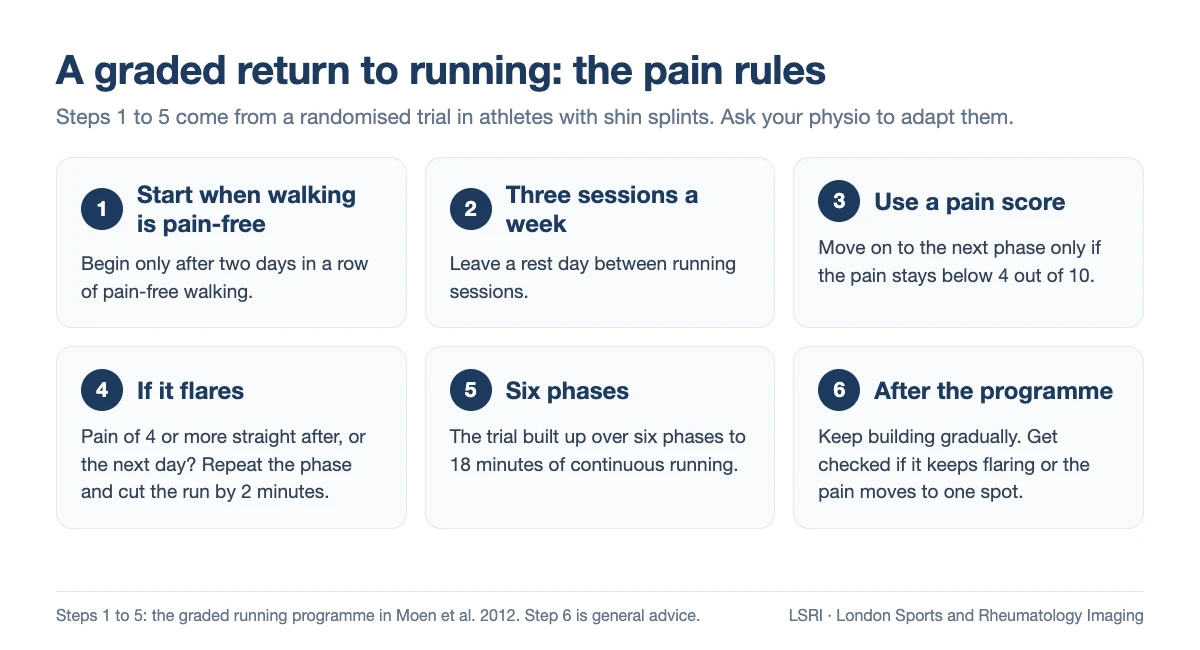
The aim is steady progress without flare-ups. If you keep stalling, or the pain moves into one spot, get it checked.
Treating a tibial stress fracture
Most stress fractures along the inner edge of the shin bone (the posteromedial tibia) are low-risk. They usually heal with a period of modified activity, keeping your activity to pain-free levels (crutches can help if walking hurts), followed by a gradual return to running.11,12,15 Healing generally takes 4 to 12 weeks or longer.15 In a meta-analysis, athletes with this kind of stress injury returned to sport after an average of 44 days, and more than 90% of athletes overall got back to their sport.7
Evidence on air-filled (pneumatic) leg braces is mixed. A small trial found athletes got back to full activity much sooner with a brace, but a later trial in soldiers found no added benefit.27,28,29
Stress fractures on the front ridge of the shin bone (the anterior tibia) are different. This side of the bone is under tension, and these fractures are more likely to have complications and to heal slowly or not at all.7,8 On an X-ray, a thin line across the front of the bone, sometimes called the “dreaded black line”, is a sign of this kind of fracture.8 One review reported return to sport in 71% of people with non-surgical treatment and 96% after surgery, although these figures come from small studies and return took around seven months either way. The line is often not visible on an X-ray, so MRI is used when this kind of fracture is suspected.8 If you have pain in one spot on the front ridge of the shin bone, get it assessed promptly.
Getting back to running after a stress fracture. One review suggests starting again when you have had 10 to 14 pain-free days and the bone is no longer tender to press, beginning at 30% to 50% of your previous running and building back over three to six weeks.16
Who gets shin splints and stress fractures?
For shin splints, the risk factors with the best evidence are being female, having had shin splints before, a higher body weight, a foot arch that drops more under load, and fewer years of running experience.14,30 For stress fractures in runners, a previous stress fracture (about five times the odds) and being female (about twice the odds) are the clearest risk factors.31
Not eating enough for your training (low energy availability, which can lead to a condition called REDs) harms bone health and raises the risk of bone stress injuries, in men as well as women.32,33 Missed or irregular periods are an important warning sign. See our article on missed periods, the female athlete triad and REDs.
Preventing shin splints and stress fractures
- Build up gradually. No single rule is proven: in a trial of 532 new runners, a slower programme based on the “10% rule” did not reduce injuries (20.8% vs 20.3%).34 Big, sudden jumps in weekly distance may raise the risk of some injuries, although that evidence is weaker.35
- Strength and balance training. A 2025 review found that neuromuscular training (exercises for strength, balance and control) helped prevent shin splints, while shock-absorbing insoles did not.26
- Running form. Taking slightly quicker, shorter steps (5% to 10% more steps a minute) reduced the load on the knee, and at 10% the hip, in one study.36 In a trial of new runners, two weeks of retraining to land more softly cut injuries over a year from 38% to 16%.37 These studies did not test shin splints specifically, so think of them as sensible adjustments, not proven prevention.
- Fuel your training, and ask your GP about vitamin D if you are unsure. In a trial of 5,201 female navy recruits, daily calcium and vitamin D reduced stress fractures by 20% (5.3% vs 6.6%).38,39
When to get checked
- Pain in one spot on the shin bone that hurts to press.
- Pain when walking, at rest or at night, or a limp.
- Pain in one spot on the front ridge of the shin bone (rather than along its inner edge).
- Shin pain that is not improving after two to three weeks of reduced running.
- Numbness, tingling, or a tight, bursting pain during exercise.
- A previous stress fracture, missed periods, recent weight loss, or a feeling that you are not eating enough for your training.
If you have severe pain, cannot put weight on the leg, or your leg is hot, swollen or numb, seek urgent medical advice from NHS 111 or A&E. LSRI is not an emergency service.
How LSRI can help
LSRI is a doctor-led musculoskeletal imaging clinic. We see runners, HYROX athletes and triathletes with shin pain, and our aim is to get the diagnosis right so you can make a clear plan.
- A consultation with a consultant MSK radiologist, in clinic or by video, to go through your symptoms (and examine you, in clinic), work out whether this is likely to be shin splints, a stress fracture or something else, and decide with you whether a scan is needed.
- Two clear MRI options. Scan only, from £375 per body part, includes the scan, a report from a consultant MSK radiologist (usually within 24 hours) and your images, but not a consultation or advice on treatment. Scan with a consultation, from £425, adds a consultation with a consultant MSK radiologist to go through your images and next steps. MRI is done at partner imaging centres in London and across the UK, and same-day appointments are often available, depending on location.
- A report that explains what the scan shows, including the grade of any bone stress injury. If you choose MRI with a consultation, we go through what it means for your training and race plans.
Our clinics are on Harley Street (W1G 9QJ) and in Harrow (HA2 7SJ); call 0203 633 5040. See also our guides to MRI for marathon running injuries and post-marathon pain.
Frequently asked questions
How can I tell if it is shin splints or a stress fracture?
Shin splints usually cause an ache spread along the inner edge of the shin. A stress fracture usually causes one small spot on the bone that is very tender to press, gets worse the more you run, and often hurts when you walk. If you are not sure, stop running and get checked.
What do shin splints feel like?
A dull ache or soreness along the inner edge of the shin bone, spread over several centimetres, that comes on with running or jumping. Early on it often eases as you warm up.
How long do shin splints last?
Mild, early shin splints often settle within a few weeks of cutting back. Long-standing shin splints take longer: in a trial of athletes, a graded return to 18 minutes of running took about three to four months on average.
Can I run with shin splints?
Not at your normal volume at first. Cut back the running that hurts, keep fit with pain-free cross-training, then return with a graded running plan that only moves forward while pain stays mild (below 4 out of 10).
Do compression socks help shin splints?
Not as a treatment. In a randomised trial, adding a compression stocking to a graded running programme did not speed recovery, and a 2025 review found no evidence that special socks prevent shin splints.
Can you fix shin splints in 5 minutes?
No. Ice, massage or stretching may ease the pain briefly, but no treatment has been shown to heal shin splints quickly. Reducing the load and building back gradually is the approach with the most support.
Will shin splints show on an X-ray?
No. X-rays are normal in shin splints and often normal in the first few weeks of a stress fracture. If a stress fracture is suspected, MRI is the most accurate test.
References
- Galbraith RM, Lavallee ME. Medial tibial stress syndrome: conservative treatment options. Curr Rev Musculoskelet Med 2009;2(3):127-33. doi:10.1007/s12178-009-9055-6
- Lopes AD, Hespanhol Júnior LC, Yeung SS, Costa LO. What are the main running-related musculoskeletal injuries? A systematic review. Sports Med 2012;42(10):891-905. doi:10.1007/BF03262301
- Wright AA, Hegedus EJ, Lenchik L, Kuhn KJ, Santiago L, Smoliga JM. Diagnostic accuracy of various imaging modalities for suspected lower extremity stress fractures: a systematic review with evidence-based recommendations for clinical practice. Am J Sports Med 2016;44(1):255-63. doi:10.1177/0363546515574066
- Bergman AG, Fredericson M, Ho C, Matheson GO. Asymptomatic tibial stress reactions: MRI detection and clinical follow-up in distance runners. AJR Am J Roentgenol 2004;183(3):635-8. doi:10.2214/ajr.183.3.1830635
- Teles AI, da Silva Carto JP, Parpa K, Thuany M, de Vasconcelos GS. Load-induced medial leg pain in runners: a systematic review of non-invasive treatment approaches. Phys Ther Sport 2026;81:101962. doi:10.1016/j.ptsp.2026.101962
- Moen MH, Holtslag L, Bakker E, Barten C, Weir A, Tol JL, et al. The treatment of medial tibial stress syndrome in athletes; a randomized clinical trial. Sports Med Arthrosc Rehabil Ther Technol 2012;4:12. doi:10.1186/1758-2555-4-12
- Hoenig T, Eissele J, Strahl A, Popp KL, Stürznickel J, Ackerman KE, et al. Return to sport following low-risk and high-risk bone stress injuries: a systematic review and meta-analysis. Br J Sports Med 2023;57(7):427-32. doi:10.1136/bjsports-2022-106328
- Robertson GA, Wood AM. Lower limb stress fractures in sport: optimising their management and outcome. World J Orthop 2017;8(3):242-55. doi:10.5312/wjo.v8.i3.242
- Moen MH, Tol JL, Weir A, Steunebrink M, De Winter TC. Medial tibial stress syndrome: a critical review. Sports Med 2009;39(7):523-46. doi:10.2165/00007256-200939070-00002
- Yates B, White S. The incidence and risk factors in the development of medial tibial stress syndrome among naval recruits. Am J Sports Med 2004;32(3):772-80. doi:10.1177/0095399703258776
- Warden SJ, Davis IS, Fredericson M. Management and prevention of bone stress injuries in long-distance runners. J Orthop Sports Phys Ther 2014;44(10):749-65. doi:10.2519/jospt.2014.5334
- Hoenig T, Ackerman KE, Beck BR, Bouxsein ML, Burr DB, Hollander K, et al. Bone stress injuries. Nat Rev Dis Primers 2022;8(1):26. doi:10.1038/s41572-022-00352-y
- Bennell KL, Malcolm SA, Thomas SA, Wark JD, Brukner PD. The incidence and distribution of stress fractures in competitive track and field athletes: a twelve-month prospective study. Am J Sports Med 1996;24(2):211-7. doi:10.1177/036354659602400217
- Newman P, Witchalls J, Waddington G, Adams R. Risk factors associated with medial tibial stress syndrome in runners: a systematic review and meta-analysis. Open Access J Sports Med 2013;4:229-41. doi:10.2147/OAJSM.S39331
- Patel DS, Roth M, Kapil N. Stress fractures: diagnosis, treatment, and prevention. Am Fam Physician 2011;83(1):39-46. aafp.org
- Kahanov L, Eberman LE, Games KE, Wasik M. Diagnosis, treatment, and rehabilitation of stress fractures in the lower extremity in runners. Open Access J Sports Med 2015;6:87-95. doi:10.2147/OAJSM.S39512
- Schneiders AG, Sullivan SJ, Hendrick PA, Hones BD, McMaster AR, Sugden BA, et al. The ability of clinical tests to diagnose stress fractures: a systematic review and meta-analysis. J Orthop Sports Phys Ther 2012;42(9):760-71. doi:10.2519/jospt.2012.4000
- Winters M, Bakker EWP, Moen MH, Barten CC, Teeuwen R, Weir A. Medial tibial stress syndrome can be diagnosed reliably using history and physical examination. Br J Sports Med 2018;52(19):1267-72. doi:10.1136/bjsports-2016-097037
- Brewer RB, Gregory AJ. Chronic lower leg pain in athletes: a guide for the differential diagnosis, evaluation, and treatment. Sports Health 2012;4(2):121-7. doi:10.1177/1941738111426115
- Gaeta M, Minutoli F, Scribano E, Ascenti G, Vinci S, Bruschetta D, et al. CT and MR imaging findings in athletes with early tibial stress injuries: comparison with bone scintigraphy findings and emphasis on cortical abnormalities. Radiology 2005;235(2):553-61. doi:10.1148/radiol.2352040406
- Fredericson M, Bergman AG, Hoffman KL, Dillingham MS. Tibial stress reaction in runners: correlation of clinical symptoms and scintigraphy with a new magnetic resonance imaging grading system. Am J Sports Med 1995;23(4):472-81. doi:10.1177/036354659502300418
- Nattiv A, Kennedy G, Barrack MT, Abdelkerim A, Goolsby MA, Arends JC, et al. Correlation of MRI grading of bone stress injuries with clinical risk factors and return to play: a 5-year prospective study in collegiate track and field athletes. Am J Sports Med 2013;41(8):1930-41. doi:10.1177/0363546513490645
- NHS. Shin splints. NHS website. Page last reviewed 9 February 2023; next review due 9 February 2026. (accessed 25 October 2026) nhs.uk
- nidirect (Northern Ireland Government). Shin splints. Last updated 10 January 2025. (accessed 25 October 2026) nidirect.gov.uk
- Winters M, Eskes M, Weir A, Moen MH, Backx FJ, Bakker EW. Treatment of medial tibial stress syndrome: a systematic review. Sports Med 2013;43(12):1315-33. doi:10.1007/s40279-013-0087-0
- Marques TBT, Rangel RPS, Martins LV, Vidal APC. Preventive interventions for medial tibial stress syndrome: systematic review and meta-analysis. Gait Posture 2025;122:92-8. doi:10.1016/j.gaitpost.2025.07.312
- Swenson EJ Jr, DeHaven KE, Sebastianelli WJ, Hanks G, Kalenak A, Lynch JM. The effect of a pneumatic leg brace on return to play in athletes with tibial stress fractures. Am J Sports Med 1997;25(3):322-8. doi:10.1177/036354659702500309
- Allen CS, Flynn TW, Kardouni JR, Hemphill MH, Schneider CA, Pritchard AE, et al. The use of a pneumatic leg brace in soldiers with tibial stress fractures: a randomized clinical trial. Mil Med 2004;169(11):880-4. doi:10.7205/MILMED.169.11.880
- Rome K, Handoll HHG, Ashford R. Interventions for preventing and treating stress fractures and stress reactions of bone of the lower limbs in young adults. Cochrane Database Syst Rev 2005;(2):CD000450. doi:10.1002/14651858.CD000450.pub2
- Reinking MF, Austin TM, Richter RR, Krieger MM. Medial tibial stress syndrome in active individuals: a systematic review and meta-analysis of risk factors. Sports Health 2017;9(3):252-61. doi:10.1177/1941738116673299
- Wright AA, Taylor JB, Ford KR, Siska L, Smoliga JM. Risk factors associated with lower extremity stress fractures in runners: a systematic review with meta-analysis. Br J Sports Med 2015;49(23):1517-23. doi:10.1136/bjsports-2015-094828
- Mountjoy M, Ackerman KE, Bailey DM, Burke LM, Constantini N, Hackney AC, et al. 2023 International Olympic Committee’s (IOC) consensus statement on Relative Energy Deficiency in Sport (REDs). Br J Sports Med 2023;57(17):1073-98. doi:10.1136/bjsports-2023-106994
- Barrack MT, Gibbs JC, De Souza MJ, Williams NI, Nichols JF, Rauh MJ, et al. Higher incidence of bone stress injuries with increasing female athlete triad-related risk factors: a prospective multisite study of exercising girls and women. Am J Sports Med 2014;42(4):949-58. doi:10.1177/0363546513520295
- Buist I, Bredeweg SW, van Mechelen W, Lemmink KA, Pepping GJ, Diercks RL. No effect of a graded training program on the number of running-related injuries in novice runners: a randomized controlled trial. Am J Sports Med 2008;36(1):33-9. doi:10.1177/0363546507307505
- Nielsen RO, Parner ET, Nohr EA, Sørensen H, Lind M, Rasmussen S. Excessive progression in weekly running distance and risk of running-related injuries: an association which varies according to type of injury. J Orthop Sports Phys Ther 2014;44(10):739-47. doi:10.2519/jospt.2014.5164
- Heiderscheit BC, Chumanov ES, Michalski MP, Wille CM, Ryan MB. Effects of step rate manipulation on joint mechanics during running. Med Sci Sports Exerc 2011;43(2):296-302. doi:10.1249/MSS.0b013e3181ebedf4
- Chan ZYS, Zhang JH, Au IPH, An WW, Shum GLK, Ng GYF, et al. Gait retraining for the reduction of injury occurrence in novice distance runners: 1-year follow-up of a randomized controlled trial. Am J Sports Med 2018;46(2):388-95. doi:10.1177/0363546517736277
- Lappe J, Cullen D, Haynatzki G, Recker R, Ahlf R, Thompson K. Calcium and vitamin D supplementation decreases incidence of stress fractures in female navy recruits. J Bone Miner Res 2008;23(5):741-9. doi:10.1359/jbmr.080102
- Dao D, Sodhi SK, Tabasinejad R, Peterson DC, Ayeni OR, Bhandari M, et al. Serum 25-hydroxyvitamin D levels and stress fractures in military personnel: a systematic review and meta-analysis. Am J Sports Med 2015;43(8):2064-72. doi:10.1177/0363546514555971
Book an appointment
Call 0203 633 5040 or book online. Clinics at Harley Street (W1G 9QJ) and Harrow (HA2 7SJ).
About this article
Purpose: written by the LSRI clinical team to explain, in plain English, the difference between shin splints (medial tibial stress syndrome) and a tibial stress fracture, how they are diagnosed, what the evidence shows about treatment, and how to return to running, based on the research listed above. It is general information, not a diagnosis. If you are worried about your own symptoms, speak to your GP. If you have emergency symptoms, call 999 or go to A&E.