Written by: LSRI Editorial Team
Medically reviewed by Dr Prashant Sankaye, Consultant MSK Radiologist ·
Last Updated: October 25, 2026
Read Time: 24 Minutes
Written by the LSRI clinical team and medically reviewed by Dr Prashant Sankaye, Consultant MSK Radiologist, on 25 October 2026.
More people than ever are training for endurance events. A world-record 1,338,544 people applied for the 2027 London Marathon ballot.1 HYROX, which combines eight 1 km runs with eight workout stations, had held races in 22 countries by the 2023/24 season.2,3 Triathlon and Ironman racing ask the legs to run a long way after a hard swim and bike. More training means more repeated loading of the bones, and a stress fracture can stop that training for weeks or months.
Stress fractures are also easy to miss early, because the first X-ray is often normal. This guide, written by the LSRI clinical team, led by a consultant musculoskeletal (MSK) radiologist, explains where stress fractures happen in runners, HYROX athletes and triathletes, which ones are high-risk, what the MRI grades mean (including “grade 4”), how low energy intake raises the risk, and how to get back to sport. If your pain is in the shin, see our guide to shin splints vs a stress fracture.
Key points
- The foot is one of the commonest places. In US college athletes, the metatarsals (the long bones in the middle of the foot) accounted for 37.9% of stress fractures, ahead of the tibia (shin bone) at 21.9%.4
- An early X-ray is often normal. Across studies, X-rays picked up only 12% to 56% of stress fractures. MRI is the most accurate test.5
- Some stress fractures are high-risk, including those of the femoral neck (top of the thigh bone), the navicular (a bone in the midfoot), the front of the tibia and the base of the fifth metatarsal. They heal more slowly and some need surgery.6,7
- The MRI grade predicts time out. Return to sport took an average of 41.7 days for grade 1 injuries and 98.5 days for grade 4.8
- Not eating enough for your training raises the risk, in men as well as women. This is called low energy availability, part of REDs.9,10
- No device or medicine has been shown in good-quality trials to make the bone heal faster. Offloading the bone, fixing the cause and a gradual return remain the main treatment.11,12,13
What is a stress fracture?
Bone is living tissue that constantly repairs and strengthens itself in response to load. Each run or jump causes tiny amounts of damage that the bone normally repairs. When loading outpaces repair, the bone becomes stressed. Doctors call this a bone stress injury. It runs along a spectrum: first a stress reaction (swelling, or oedema, inside the bone with no break), then a stress fracture with a visible crack, and rarely a complete break.13,14
Most stress fractures in athletes are fatigue injuries: normal bone under too much repeated load. An insufficiency fracture is different: normal loads on bone that has been weakened, for example by osteoporosis.14 Both can happen in endurance athletes, and both are found the same way.
The two risk factors most clearly supported by a meta-analysis of runners are a previous stress fracture (about five times the odds) and being female (about twice the odds).15 They are not rare: in one study of male college distance runners, 27% had at least one bone stress injury over an average of 1.9 years.10
Why endurance sport puts bones at risk
Marathon and distance running
Running injuries are common: across studies of long-distance runners, between 19.4% and 79.3% had a lower-limb running injury during the study period, which ranged from a day to 18 months.16 New runners are injured more often than recreational runners, at 17.8 injuries per 1,000 hours of running compared with 7.7.17 In sport, stress fractures of the femoral neck, one of the most serious kinds, are most often linked to marathon and long-distance running.18
HYROX
A HYROX race is eight 1 km runs, each followed by a station: SkiErg, sled push, sled pull, burpee broad jumps, rowing, farmers carry, sandbag lunges and wall balls.2 In a simulated race, running took about 60% of the total time.19
The first study to follow HYROX athletes week by week was published in 2026. In 89 HYROX athletes followed for 12 weeks, about 14% reported an overuse injury in any given week. The knee was the most often injured area. Where the cause was recorded, running was the most common one (43%). The study did not report stress fractures separately. The authors concluded that HYROX does not appear to carry more injury risk than the activities it combines, although the study was small and relied on self-reported data.20
In our clinical view (this is reasoning, not trial evidence), the bone risk in HYROX is mostly a running risk. It can rise when athletes from a gym background add running volume quickly, and when repeated jump-landings and lunges are added on top of the running. Any rapid increase in running load is a recognised risk for bone stress injury.13,14
Triathlon and Ironman
A full Ironman is a 3.8 km swim, a 180 km bike and a 42.2 km run.21 Overuse injuries are common in long-distance triathletes: a review of six mostly small, retrospective studies found rates of 37% to 91%, with running and cycling the disciplines most often involved.22 In a study of iron-distance athletes, 56% had an overuse problem at any one time, and almost half of their training time was spent cycling.23
Swimming and cycling put little load through the skeleton. Road cyclists in regular training often have low bone density, especially in the lower spine.24 In our view (reasoning, not trial evidence), triathletes who do most of their training in the pool or on the bike may start their run training with less bone conditioning than their fitness suggests.
Where stress fractures happen, and which are high-risk
In US college athletes across all sports, the commonest sites were the metatarsals, the tibia (shin bone), and the lower back and pelvis, and women’s cross-country runners had the highest rate.4 Older clinic series also put the fibula (the thin bone on the outside of the lower leg) high on the list.6 The order varies between studies and sports, so it is more useful to know which sites are low-risk and which are high-risk.
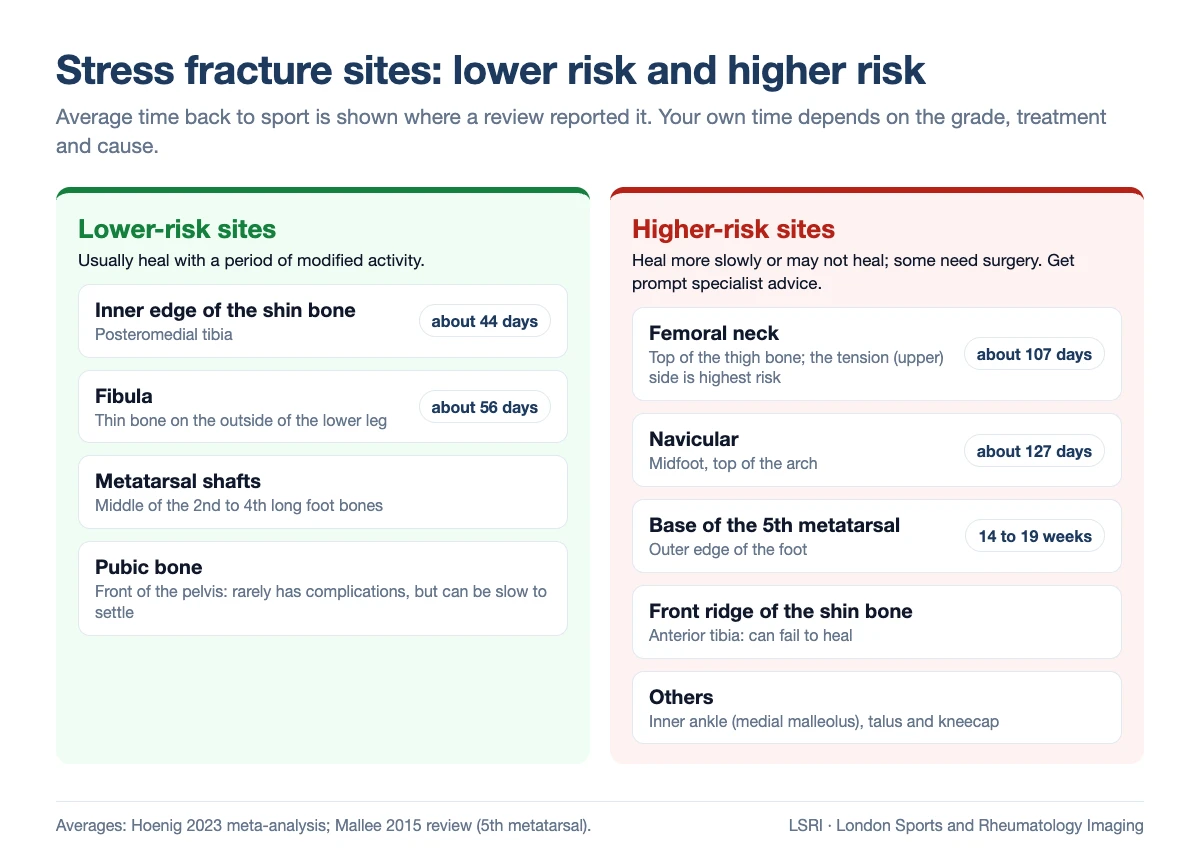
Low-risk stress fractures, such as those on the inner (posteromedial) side of the tibia, the fibula and most metatarsal shafts, usually heal with a period of modified activity.14 High-risk sites are those where the bone is under tension, has a poorer blood supply or tends not to heal: the tension side of the femoral neck, the front of the tibia, the navicular, the base of the fifth metatarsal, the inner ankle (medial malleolus), the talus and the kneecap.6,25
In a 2023 meta-analysis of almost 3,000 bone stress injuries, more than 90% of athletes returned to sport. Navicular injuries took longest (127 days on average), then the femoral neck (107 days); the inner tibia was quickest (44 days). Complications were most common at the femoral neck, navicular, front of the tibia and fifth metatarsal. The authors also noted that the simple high-risk and low-risk split has not been fully validated, so each injury needs individual judgement.7
Foot stress fractures: what they feel like and how long they take
A foot stress fracture usually causes a dull ache in one area of the foot. It is worse when you run or jump, eases with rest, and the bone is tender to press. There may be some swelling.26,27
Most metatarsal stress fractures heal well. Treatment is often a removable fracture shoe, boot or stiff-soled shoe, sometimes with crutches for a while; some people only need to change their activities. Return to activity is gradual. NHS hospital leaflets give a healing time of about 6 weeks, with a range of 6 weeks to 6 months, and getting back to high-impact sport can take longer.26,27
Two foot stress fractures need more care:
- Navicular (midfoot, top of the arch). Pain is often vague and felt on top of the midfoot. Treatment matters: in a review, treatment succeeded in 80% of people given a non-weight-bearing cast, compared with 29% with weight-bearing rest, although the evidence is low quality. Return to sport took about 22 weeks with non-surgical treatment and 16 weeks after surgery.28
- Base of the fifth metatarsal (outer edge of the foot). This area has a poor blood supply. Return to sport took about 19 weeks with non-surgical treatment and 14 weeks after surgery, and the bone failed to heal in 7.1% and 4.6% respectively.28
Heel pain in runners is usually plantar fasciitis, but a stress fracture of the heel bone can feel similar. See our case of a calcaneal fracture found on MRI after eight months of heel pain, and our article on delayed diagnosis of stress fractures.
Hip, pelvis and lower back: warning signs not to ignore
Femoral neck stress fractures usually start with gradual, vague pain in the groin or hip, which later comes on at rest and at night.18 Fractures on the compression (lower) side of the femoral neck that have not gone right through the bone can usually be treated without surgery. Fractures on the tension (upper) side usually need surgery, as do complete and displaced fractures. If the fracture displaces, the blood supply to the head of the femur can be damaged (avascular necrosis), which happened in 24% to 42% of displaced fractures in reported series.18
If you are a runner with groin pain that is getting worse, a limp, or pain at night, stop running and get advice the same day from NHS 111 or your GP. If you cannot put weight on the leg, or the pain came on suddenly and severely, go to A&E. LSRI is not an emergency service. Read more in our article on hip stress fractures.
Sacral stress fractures (the bone at the base of the spine) are a rare cause of low back or buttock pain in runners. In a series of 13 athletes, all treated without surgery, most (about 5 in 6) returned to sport, although most noticed their running was not quite back to its previous level.29 Sacral fractures in older people with thinner bones are a different problem; see our article on sacral insufficiency fractures. Injuries in the femoral neck, pubic bone and sacrum, which are mainly spongy (trabecular) bone, took longer to recover in a five-year study of track and field athletes.30
Does a stress fracture show on an X-ray?
Often not at first. In a systematic review, X-rays picked up only 12% to 56% of lower-limb stress fractures, while MRI picked up 68% to 99% and was the most accurate test overall.5 An X-ray may show a stress fracture a few weeks later, once healing bone has formed, but by then you may have kept running on it.6 A normal X-ray therefore does not rule out a stress fracture.
MRI shows a bone stress injury early, before a crack is visible. It also shows how severe it is and whether something else, such as a tendon problem, is causing the pain. That is why MRI is usually the scan we recommend when a stress fracture is suspected and the answer will change what you do.
MRI grades explained, including “grade 4”
Radiologists often grade bone stress injuries using a system first described for the tibia, now used more widely.31,32 This is the grading we use in LSRI reports:
- Grade 1: swelling (oedema) of the lining of the bone (periosteum) only.
- Grade 2: swelling inside the bone (bone marrow) that shows on fluid-sensitive, fat-suppressed images.
- Grade 3: bone marrow swelling that also shows on T1 images.
- Grade 4: a fracture in the outer shell of the bone (the cortex). A later version splits this into 4a, small changes within the cortex, and 4b, a visible fracture line.32,33
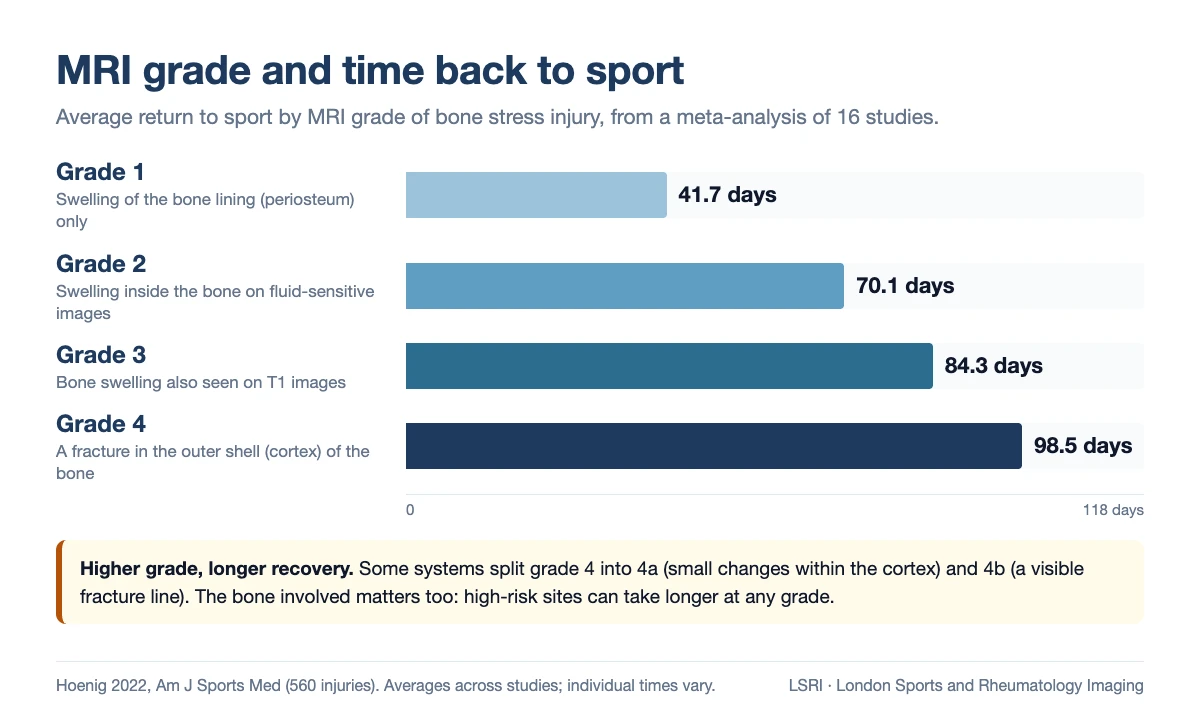
So a “grade 4 stress fracture” means the outer shell (cortex) of the bone is involved; in grade 4b a fracture line is clearly visible. In a meta-analysis, return to sport took an average of 41.7 days at grade 1, 70.1 days at grade 2, 84.3 days at grade 3 and 98.5 days at grade 4.8 In a five-year study, a higher MRI grade and lower bone density both predicted a longer recovery, and women with irregular or absent periods tended to have higher-grade injuries.30
Low energy (REDs): the hidden cause behind many stress fractures
Relative Energy Deficiency in Sport (REDs) happens when you do not eat enough to cover both your training and your body’s normal needs. This low energy availability disrupts hormones and bone health, and can lead to bone stress injuries. It affects men as well as women; in men, low libido and fewer morning erections may be warning signs.9
The risk adds up. In a study of exercising girls and women, the chance of a bone stress injury rose from about 15–20% with one risk factor to 30–50% with several together.34 In male distance runners, each extra point on a similar risk score raised the risk of a bone stress injury by 37%.10
If your periods have become irregular or stopped, the contraceptive pill can hide this without protecting your bones. In a randomised trial, oestrogen given through the skin improved bone density more than a combined pill.35,36 Read more in our article on missed periods, the female athlete triad and REDs.
A bone density (DXA) scan can be part of the assessment. The Female Athlete Triad Coalition lists two previous stress fractures, or one in mainly spongy (trabecular) bone such as the femoral neck, sacrum or pelvis, among the reasons for a DXA scan in female athletes.36 In our view, a stress fracture in an older runner, or after the menopause, should also prompt a review of bone health with your GP, and a DXA scan is an important part of that review.
What is the fastest way to heal a stress fracture?
There is no shortcut that has been proven to work, and it is worth being wary of anything sold as one. The approach with the most evidence behind it is to:
- take load off the bone, with a boot, stiff-soled shoe or crutches if needed, for long enough that it can heal;13,26
- find and fix the cause, especially low energy intake and training errors;9,13
- keep fit with pain-free cross-training, then return gradually.13,37
What the trials show for the extras:
- Bone-healing ultrasound (LIPUS): no benefit over a dummy device in a randomised trial.11
- Electrical bone stimulators: no difference in healing time in a randomised trial of tibial stress fractures.12
- Shockwave therapy: no good-quality trials in stress fractures.38,39
- Bone-building medicines: a small pilot trial of teriparatide in 13 women found no significant difference, and it is not licensed for stress fractures.40
- Vitamin D and calcium: in a trial of 5,201 female navy recruits, daily calcium and vitamin D during training led to 20% fewer new stress fractures (5.3% vs 6.6% of recruits). That trial was about prevention, not faster healing.41
For tibial stress fractures, a pneumatic (air-filled) leg brace may help some people get back to activity sooner, although the evidence is limited.6
Getting back to running, HYROX or triathlon
A review of return-to-run guidance for tibial bone stress injuries (mostly based on expert opinion) suggests these checks before you run: no tenderness when the bone is pressed, pain-free walking, evidence of healing on imaging for high-risk injuries, enough strength, and a plan to deal with whatever caused the injury.37
- Start with walk-run intervals, and build distance before speed.37
- Strengthen the area: the calf muscles after a tibial injury, the small muscles of the foot after a metatarsal one.13
- HYROX: in our view, it makes sense to rebuild running first, then add the impact stations (burpee broad jumps and lunges) and heavy sled work one at a time.
- Triathlon: in our view, swimming and cycling can often keep your fitness going while a lower-limb bone heals, if they are pain-free and your clinician agrees. Hip and pelvic injuries need more caution.
Because a previous stress fracture is the strongest risk factor for another,15 working out why it happened is part of the treatment, not an optional extra.
When to get checked
- Pain in one spot on a bone that gets worse with each run, or that comes on at rest or at night.
- Groin pain in a runner, especially with a limp or pain at night. Stop running and get same-day advice from NHS 111 or your GP; go to A&E if you cannot put weight on the leg.
- Pain on the top of the midfoot, or on the outer edge of the foot.
- Pain that is not improving after a week or two of reduced training.
- A previous stress fracture, missed or irregular periods, recent weight loss, or a feeling that you are not eating enough for your training.
How LSRI can help
LSRI is a doctor-led musculoskeletal imaging clinic. We see runners, HYROX athletes and triathletes with bone and joint pain, and we focus on getting the diagnosis right first.
- A consultation with a consultant MSK radiologist, in clinic or by video, to go through your symptoms (and examine you, in clinic), decide with you whether a scan is needed and which one, and explain the results.
- Two clear MRI options. Scan only, from £375 per body part, includes the scan, a report from a consultant MSK radiologist (usually within 24 hours) and your images, but not a consultation or advice on treatment. Scan with a consultation, from £425, adds a consultation with a consultant MSK radiologist to go through your images and next steps. MRI is done at partner imaging centres in London and across the UK, and same-day appointments are often available, depending on location.
- A clear answer on the grade and site, what it means for your training, and whether you need offloading, a specialist opinion or a bone health check with your GP.
Our clinics are on Harley Street (W1G 9QJ) and in Harrow (HA2 7SJ); call 0203 633 5040. See also our hip MRI page, our guide to MRI for marathon running injuries and our article on post-marathon pain.
Frequently asked questions
What does a stress fracture in the foot feel like?
Usually a dull ache in one area of the foot that gets worse with running or jumping and eases with rest. The bone is tender when you press on it, and there may be some swelling.
How long does a foot stress fracture take to heal?
Many metatarsal stress fractures heal in about 6 weeks, but NHS leaflets give a range of 6 weeks to 6 months. High-risk foot sites take longer: return to sport took on average about 4 months for the navicular and 14 to 19 weeks for the base of the fifth metatarsal.
What is a grade 4 stress fracture?
On MRI, grade 4 means a fracture in the outer shell of the bone has been seen, not just swelling inside it. In a meta-analysis, people with grade 4 injuries returned to sport after an average of 98.5 days (about 14 weeks), compared with 41.7 days for grade 1.
Will a stress fracture show on an X-ray?
Often not in the first few weeks. Studies found X-rays picked up only 12% to 56% of stress fractures. MRI is the most accurate test and shows the injury early, along with its grade.
What is the fastest way to heal a stress fracture?
Take load off the bone for long enough, fix the cause (often low energy intake or a sudden jump in training), stay fit with pain-free cross-training, and return gradually. Bone-healing ultrasound and electrical stimulators did not speed healing in trials.
Can I keep training for HYROX or a triathlon with a stress fracture?
Not in a way that loads the injured bone. Many people can keep up pain-free swimming, cycling or upper-body work while it heals, if their clinician agrees. High-risk sites, such as the femoral neck or navicular, need stricter offloading and a specialist plan.
References
- London Marathon Events. Record 1.33 million people apply for 2027 TCS London Marathon. May 2026. Accessed 25 October 2026. londonmarathonevents.co.uk
- HYROX. The fitness race (format, stations and weights). Accessed 25 October 2026. hyrox.com
- Fernández-Navarrete I, Ruiz-Alias SA, Gómez-García M, Riquelme-Sebastián L, García-Pinillos F. Hyrox©: a descriptive analysis of participation trends among over 275,000 athletes in the new fitness modality. Res Q Exerc Sport 2026;97(2):266-72. doi:10.1080/02701367.2025.2584226
- Rizzone KH, Ackerman KE, Roos KG, Dompier TP, Kerr ZY. The epidemiology of stress fractures in collegiate student-athletes, 2004-2005 through 2013-2014 academic years. J Athl Train 2017;52(10):966-75. doi:10.4085/1062-6050-52.8.01
- Wright AA, Hegedus EJ, Lenchik L, Kuhn KJ, Santiago L, Smoliga JM. Diagnostic accuracy of various imaging modalities for suspected lower extremity stress fractures: a systematic review with evidence-based recommendations for clinical practice. Am J Sports Med 2016;44(1):255-63. doi:10.1177/0363546515574066
- Patel DS, Roth M, Kapil N. Stress fractures: diagnosis, treatment, and prevention. Am Fam Physician 2011;83(1):39-46. aafp.org
- Hoenig T, Eissele J, Strahl A, Popp KL, Stürznickel J, Ackerman KE, et al. Return to sport following low-risk and high-risk bone stress injuries: a systematic review and meta-analysis. Br J Sports Med 2023;57(7):427-32. doi:10.1136/bjsports-2022-106328
- Hoenig T, Tenforde AS, Strahl A, Rolvien T, Hollander K. Does magnetic resonance imaging grading correlate with return to sports after bone stress injuries? A systematic review and meta-analysis. Am J Sports Med 2022;50(3):834-44. doi:10.1177/0363546521993807
- Mountjoy M, Ackerman KE, Bailey DM, Burke LM, Constantini N, Hackney AC, et al. 2023 International Olympic Committee’s (IOC) consensus statement on Relative Energy Deficiency in Sport (REDs). Br J Sports Med 2023;57(17):1073-98. doi:10.1136/bjsports-2023-106994
- Kraus E, Tenforde AS, Nattiv A, Sainani KL, Kussman A, Deakins-Roche M, et al. Bone stress injuries in male distance runners: higher modified Female Athlete Triad Cumulative Risk Assessment scores predict increased rates of injury. Br J Sports Med 2019;53(4):237-42. doi:10.1136/bjsports-2018-099861
- Gan TY, Kuah DE, Graham KS, Markson G. Low-intensity pulsed ultrasound in lower limb bone stress injuries: a randomized controlled trial. Clin J Sport Med 2014;24(6):457-60. doi:10.1097/JSM.0000000000000084
- Beck BR, Matheson GO, Bergman G, Norling T, Fredericson M, Hoffman AR, et al. Do capacitively coupled electric fields accelerate tibial stress fracture healing? A randomized controlled trial. Am J Sports Med 2008;36(3):545-53. doi:10.1177/0363546507310076
- Warden SJ, Davis IS, Fredericson M. Management and prevention of bone stress injuries in long-distance runners. J Orthop Sports Phys Ther 2014;44(10):749-65. doi:10.2519/jospt.2014.5334
- Hoenig T, Ackerman KE, Beck BR, Bouxsein ML, Burr DB, Hollander K, et al. Bone stress injuries. Nat Rev Dis Primers 2022;8(1):26. doi:10.1038/s41572-022-00352-y
- Wright AA, Taylor JB, Ford KR, Siska L, Smoliga JM. Risk factors associated with lower extremity stress fractures in runners: a systematic review with meta-analysis. Br J Sports Med 2015;49(23):1517-23. doi:10.1136/bjsports-2015-094828
- van Gent RN, Siem D, van Middelkoop M, van Os AG, Bierma-Zeinstra SMA, Koes BW, et al. Incidence and determinants of lower extremity running injuries in long distance runners: a systematic review. Br J Sports Med 2007;41(8):469-80. doi:10.1136/bjsm.2006.033548
- Videbæk S, Bueno AM, Nielsen RO, Rasmussen S. Incidence of running-related injuries per 1000 h of running in different types of runners: a systematic review and meta-analysis. Sports Med 2015;45(7):1017-26. doi:10.1007/s40279-015-0333-8
- Robertson G, Wood A. Femoral neck stress fractures in sport: a current concepts review. Sports Med Int Open 2017;1(2):E58-E68. doi:10.1055/s-0043-103946
- Brandt T, Ebel C, Lebahn C, Schmidt A. Acute physiological responses and performance determinants in Hyrox© – a new running-focused high intensity functional fitness trend. Front Physiol 2025;16:1519240. doi:10.3389/fphys.2025.1519240
- Chittenden E, Bell A, Forbes G, Tooth P, Porter R, Van Der Vliet R, et al. Prevalence, burden and risk markers of health problems in HYROX athletes: a 12-week prospective cohort study. Front Sports Act Living 2026;8:1937574. doi:10.3389/fspor.2026.1937574
- Chippenham Triathlon Club (British Triathlon clubs platform). Race distances. Accessed 25 October 2026. clubs.britishtriathlon.org
- Rhind JH, Dass D, Barnett A, Carmont M. A systematic review of long-distance triathlon musculoskeletal injuries. J Hum Kinet 2022;81:123-34. doi:10.2478/hukin-2022-0011
- Andersen CA, Clarsen B, Johansen TV, Engebretsen L. High prevalence of overuse injury among iron-distance triathletes. Br J Sports Med 2013;47(13):857-61. doi:10.1136/bjsports-2013-092397
- Olmedillas H, González-Agüero A, Moreno LA, Casajus JA, Vicente-Rodríguez G. Cycling and bone health: a systematic review. BMC Med 2012;10:168. doi:10.1186/1741-7015-10-168
- Kaeding CC, Yu JR, Wright R, Amendola A, Spindler KP. Management and return to play of stress fractures. Clin J Sport Med 2005;15(6):442-7. doi:10.1097/01.jsm.0000188207.62608.35
- University Hospitals Sussex NHS Foundation Trust. Stress fracture of the foot [patient leaflet 2693]. Published 01/2026; review 01/2029. Accessed 25 October 2026. uhsussex.nhs.uk
- Gloucestershire Hospitals NHS Foundation Trust. Caring for a stress fracture [patient leaflet GHPI1576_03_26]. Review due March 2029. Accessed 25 October 2026. gloshospitals.nhs.uk
- Mallee WH, Weel H, van Dijk CN, van Tulder MW, Kerkhoffs GM, Lin CW. Surgical versus conservative treatment for high-risk stress fractures of the lower leg (anterior tibial cortex, navicular and fifth metatarsal base): a systematic review. Br J Sports Med 2015;49(6):370-6. doi:10.1136/bjsports-2013-093246
- Shankar DS, Gillinov LA, Buldo-Licciardi M, Vargas L, Cardone DA. Clinical presentation and outcomes of sacral stress fractures in athletes: a case series of 13 patients. Sports Health 2024;16(5):759-65. doi:10.1177/19417381231190580
- Nattiv A, Kennedy G, Barrack MT, Abdelkerim A, Goolsby MA, Arends JC, et al. Correlation of MRI grading of bone stress injuries with clinical risk factors and return to play: a 5-year prospective study in collegiate track and field athletes. Am J Sports Med 2013;41(8):1930-41. doi:10.1177/0363546513490645
- Fredericson M, Bergman AG, Hoffman KL, Dillingham MS. Tibial stress reaction in runners: correlation of clinical symptoms and scintigraphy with a new magnetic resonance imaging grading system. Am J Sports Med 1995;23(4):472-81. doi:10.1177/036354659502300418
- Gmachowska AM, Żabicka M, Pacho R, Pacho S, Majek A, Feldman B. Tibial stress injuries – location, severity, and classification in magnetic resonance imaging examination. Pol J Radiol 2018;83:e471-e481. doi:10.5114/pjr.2018.80218
- Kijowski R, Choi J, Shinki K, Del Rio AM, De Smet A. Validation of MRI classification system for tibial stress injuries. AJR Am J Roentgenol 2012;198(4):878-84. doi:10.2214/AJR.11.6826
- Barrack MT, Gibbs JC, De Souza MJ, Williams NI, Nichols JF, Rauh MJ, et al. Higher incidence of bone stress injuries with increasing female athlete triad-related risk factors: a prospective multisite study of exercising girls and women. Am J Sports Med 2014;42(4):949-58. doi:10.1177/0363546513520295
- Ackerman KE, Singhal V, Baskaran C, Slattery M, Campoverde Reyes KJ, Toth A, et al. Oestrogen replacement improves bone mineral density in oligo-amenorrhoeic athletes: a randomised clinical trial. Br J Sports Med 2019;53(4):229-36. doi:10.1136/bjsports-2018-099723
- De Souza MJ, Nattiv A, Joy E, Misra M, Williams NI, Mallinson RJ, et al. 2014 Female Athlete Triad Coalition consensus statement on treatment and return to play of the female athlete triad. Br J Sports Med 2014;48(4):289. doi:10.1136/bjsports-2013-093218
- George ERM, Sheerin KR, Reid D. Criteria and guidelines for returning to running following a tibial bone stress injury: a scoping review. Sports Med 2024;54(9):2247-65. doi:10.1007/s40279-024-02051-y
- Rhim HC, Shin J, Kang J, Dyrek P, Crockett Z, Galido P, et al. Use of extracorporeal shockwave therapies for athletes and physically active individuals: a systematic review. Br J Sports Med 2024;58(3):154-63. doi:10.1136/bjsports-2023-107567
- Leal C, D’Agostino C, Gomez Garcia S, Fernandez A. Current concepts of shockwave therapy in stress fractures. Int J Surg 2015;24(Pt B):195-200. doi:10.1016/j.ijsu.2015.07.723
- Almirol EA, Chi LY, Khurana B, Hurwitz S, Bluman EM, Chiodo C, et al. Short-term effects of teriparatide versus placebo on bone biomarkers, structure, and fracture healing in women with lower-extremity stress fractures: a pilot study. J Clin Transl Endocrinol 2016;5:7-14. doi:10.1016/j.jcte.2016.05.004
- Lappe J, Cullen D, Haynatzki G, Recker R, Ahlf R, Thompson K. Calcium and vitamin D supplementation decreases incidence of stress fractures in female navy recruits. J Bone Miner Res 2008;23(5):741-9. doi:10.1359/jbmr.080102
Book an appointment
Call 0203 633 5040 or book online. Clinics at Harley Street (W1G 9QJ) and Harrow (HA2 7SJ).
About this article
Purpose: written by the LSRI clinical team to explain, in plain English, stress fractures in runners, HYROX athletes and triathletes: where they happen, which are high-risk, how they are diagnosed and graded on MRI, the role of low energy availability, and how to return to sport, based on the research listed above. It is general information, not a diagnosis. If you are worried about your own symptoms, speak to your GP. If you have emergency symptoms, call 999 or go to A&E.