Written by: LSRI Editorial Team
Medically reviewed by Dr Prashant Sankaye, Consultant MSK Radiologist ·
Last Updated: October 24, 2026
Read Time: 18 Minutes
Written by the LSRI clinical team and medically reviewed by Dr Prashant Sankaye, Consultant MSK Radiologist, on 22 October 2026.
Booking a private MRI online can take minutes. Search for one and you will find many websites, often offering a low price, a convenient location and no need for a GP referral. Some are clinics run by doctors. Others are resellers, also called booking services: they sell you a scan at an imaging centre run by another company, take your payment, and arrange for a radiologist, whom you may never speak to, to report it. The scan itself may be perfectly good. But a scan is only one step in finding out what is wrong, and the steps around it matter just as much.
This guide, written by the LSRI clinical team, led by a consultant musculoskeletal (MSK) radiologist, explains what happens behind a private MRI booking, the questions worth asking before you pay, and how we do things at LSRI.
Key points
- A scan is one step in a diagnosis. UK radiology bodies say an MRI, like an X-ray, should be requested by a registered healthcare professional who has assessed your symptoms.1,2
- X-ray and CT need a referral by law from a registered healthcare professional, so a service that can only take self-referrals cannot offer them, even when they are the better test.1,3
- MRI often shows changes that are normal for your age. Without someone who knows your symptoms, these can be blamed for your pain.4,5
- Who reads your scan matters. Reports can differ between imaging centres and radiologists, even for the same patient.6
- Someone must act on the report. UK guidance says this is the job of the person who requested the scan. If nobody clinical requested yours, ask who will.7
- Before you pay, ask who checks your request, who designs the scan, who reports it, and who will explain the results.
- Urgent symptoms need the NHS, not a private booking. Call 999 or go to A&E if you have back pain with numbness around your genitals or bottom, new problems controlling your bladder or bowels, or weakness or numbness in both legs. Contact NHS 111 or your GP urgently if you have a hot, swollen joint and feel feverish or unwell.8,9
What actually happens when you book a private MRI online?
Broadly, there are three kinds of website:
- Doctor-led clinics. A doctor or radiologist checks your request, the scan is done in the clinic or at a partner imaging centre, and the same team reports it and can see you about the results.
- Resellers (also called booking services, aggregators or brokers). They resell scan appointments at imaging centres run by other companies: they take your booking and payment, send you to that centre, and arrange for a radiologist to report the scan. The people you deal with may be booking staff rather than doctors.
- Imaging centres that sell scans directly to the public.
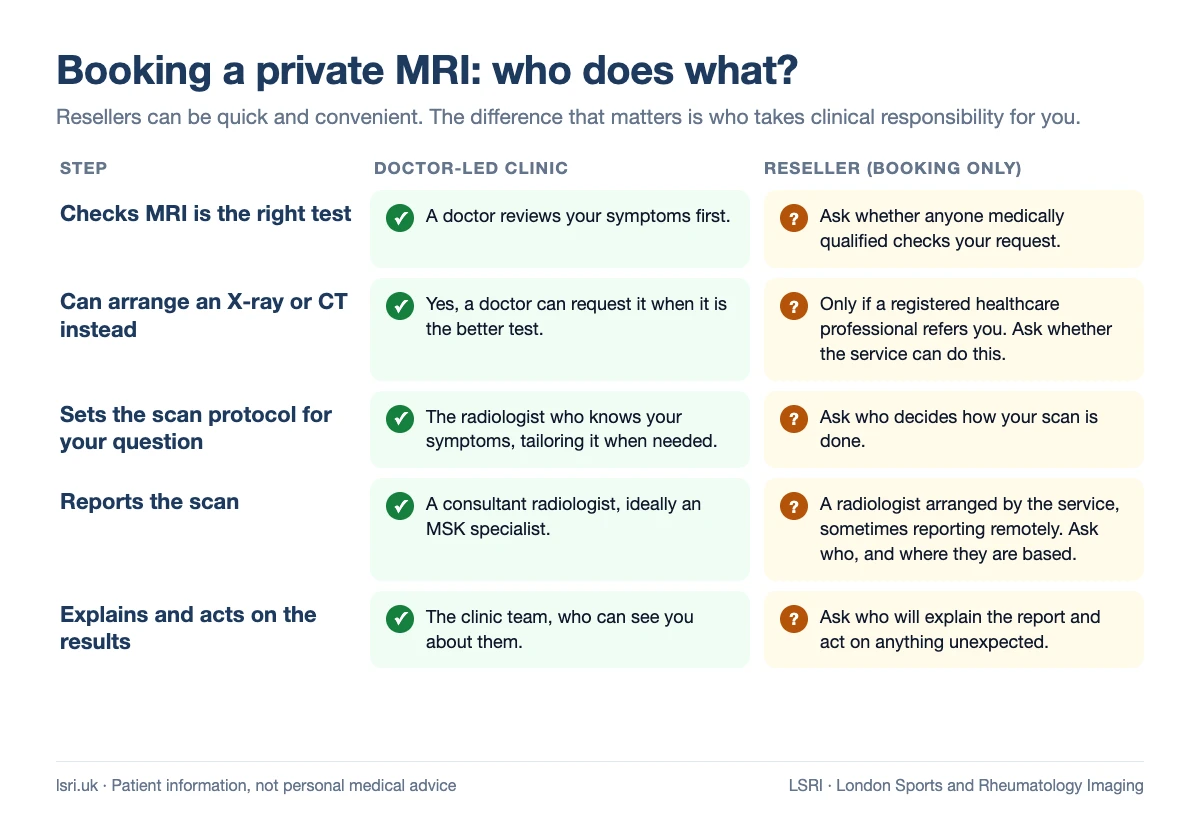
All of these are legal, and a reseller can be quick and convenient. The difference that matters is who takes clinical responsibility for you. Whoever you book with, find out who is providing each part of the service, and what the price includes.
Step 1: is MRI the right test?
MRI is excellent for many joint and soft-tissue problems, but it is not always the right test, or the right first test. Sometimes an X-ray or an ultrasound answers the question better, or should come first. See MRI or ultrasound for joint pain?
The law also shapes what a reseller can offer. X-ray and CT use ionising radiation, so they need a referral from a registered healthcare professional, such as a doctor, and each scan must be justified before it goes ahead.1,3 MRI and ultrasound fall outside that law, which is why you can book them yourself. A service that can only take self-referrals cannot arrange an X-ray or CT for you, so MRI, and sometimes ultrasound, may be the only tests on offer, even when an X-ray would answer your question better.
UK professional bodies still say an MRI should be requested by a registered healthcare professional. The Royal College of Radiologists calls it best practice to handle MRI requests in the same way as X-ray requests.1 The Clinical Imaging Board, a joint board of the UK’s radiology, radiography and medical physics bodies, does not support patients referring themselves for MRI. It says a registered healthcare professional should make the referral after assessing you.2 The UK’s MRI safety guidance calls the person requesting the scan “the first line of defence” for safety, because they must tell the scanning centre about any implants or medical devices.10 For more on referrals, see do you need a GP referral for a private MRI?
Step 2: who designs your scan?
An MRI scan is not a single picture. It is a set of different image types (sequences), taken at different angles, and the right set depends on the body part and the question being asked. A radiologist who knows your symptoms can choose a protocol to answer that question, for example looking closely at one tendon or at a possible stress fracture. A standard protocol run without your story may be less suited to your question. We explain this in more detail in who reports your MRI matters.
Step 3: who reads your scan?
The report is the part of the scan you actually use, and reports can vary. When one person in the USA had a lower back MRI at ten different centres within three weeks, the reports disagreed widely.6 For muscle, bone and joint problems, it helps if the report is written by a consultant radiologist who specialises in musculoskeletal imaging and has your clinical details.
It is also worth asking where the report comes from. Many imaging services, in the NHS and privately, send scans to teleradiology companies, where a radiologist reports them remotely, sometimes from outside the UK. Done well, this works. The Royal College of Radiologists says UK patients should get the same standard of care wherever their radiologist is based, that radiologists reporting UK patients’ scans should be on the General Medical Council (GMC) Specialist Register for clinical radiology, and that they should have the same patient information as a radiologist working in the hospital.11
In practice, though, the radiologist may be a general radiologist rather than a musculoskeletal specialist, you may not be able to speak to them, and they often have only what is written on the request form. If that is a few words typed into a booking form, the report may not answer your question. Clinical details matter: in a review of 22 studies, 15 found that radiologists interpreted scans more accurately when they had the patient’s clinical history.12
MRI is also very sensitive. In a review of 33 studies of people with no back pain, disc degeneration was seen on the CT or MRI scans of 37% of 20-year-olds and 96% of 80-year-olds.4 In adults aged 40 and over with no knee pain or injury, 19% had a meniscal tear on MRI.5 A good report explains which findings are likely to matter for you and which are normal for your age. Without that, a finding that has nothing to do with your pain can be blamed for it.
Step 4: who explains and acts on the results?
UK guidance on imaging reports says it is the responsibility of the person who requested the scan, and their team, to read and act on the report, and that they are best placed to explain the results to the patient.7 Any scan can also show something unexpected, from a harmless cyst to something that needs prompt attention.2 When you book a scan for yourself through a reseller, there may be no doctor in that role. Before you book, ask:
- Will anyone talk me through the report, and is that included in the price?
- If the scan shows something unexpected or urgent, who will contact me, and who arranges what happens next?
- Will the report be sent to my GP or specialist, with my permission?
Step 5: what does the price include?
Private MRI prices vary, and the lowest headline price is not always comparable. Check whether the price includes the radiologist’s report, how quickly the report arrives, access to your images, a consultation to explain the results, and any extra charges, such as for contrast or a second body part. See also is a cheap MRI scan worth it?
You also have a legal right to a copy of your own records, including your scan images. Under data protection law, an organisation must usually respond within one month and, in most cases, cannot charge a fee.13
Before booking a private MRI: eight questions to ask
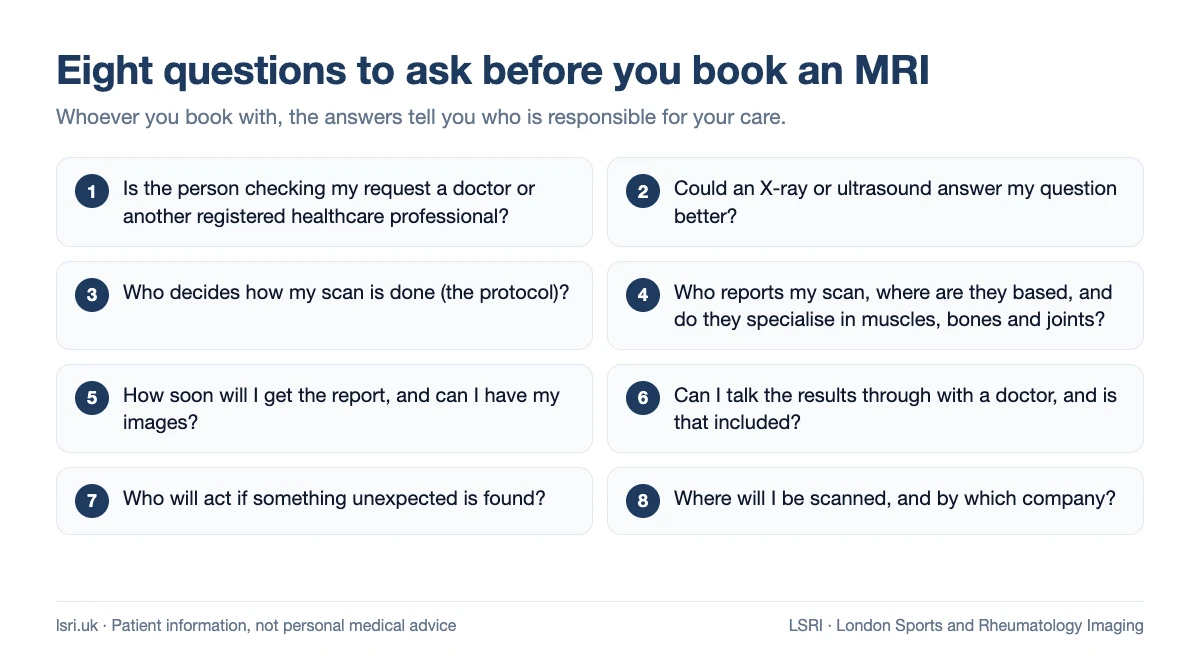
- Is the person checking my request a doctor or another registered healthcare professional?
- Could an X-ray or ultrasound answer my question better?
- Who decides how my scan is done (the protocol)?
- Who reports my scan, where are they based, and do they specialise in muscles, bones and joints?
- How soon will I get the report, and can I have my images?
- Can I talk the results through with a doctor, and is that included?
- Who will act if something unexpected is found?
- Where will I be scanned, and by which company?
How LSRI is different
LSRI is a doctor-led musculoskeletal imaging clinic. Like many clinics, we do not own an MRI scanner: MRI scans are done at partner imaging centres in London and across the UK. What is different is that our own clinical team looks after your request, the set-up of your scan and your report. The partner centre carries out the scan and its own safety checks on the day.
For you, that means you are not just a booking reference. From your first question to your results, you deal with a doctor-led team, and you can speak to a consultant MSK radiologist when you need to.
- Your request is reviewed by a consultant MSK radiologist, who checks that MRI is the right test and will tell you if an X-ray or ultrasound would answer your question better. Because our radiologists are doctors, they can also request an X-ray when that is the better test.
- When your question needs it, your scan protocol is tailored to your symptoms. Many scans are answered well by the standard protocol for that body part.
- When needed, our radiologist speaks to you before or after your scan, so that the scan and the report answer your question.
- Your scan is reported by a consultant MSK radiologist on the GMC Specialist Register, usually within 24 hours, with your clinical details and images.
- If something unexpected is found, whichever option you choose, we contact you and, with your permission, your GP, so that you know what to do next.
- Two clear MRI options, so you know what you are paying for. Scan only, from £375 per body part, includes the scan, the report and your images, but not a consultation or advice on treatment. Scan with a consultation, from £425, adds a consultation with a consultant MSK radiologist to go through your images, the results and next steps. Our prices do not depend on the time of day you book.
- Ultrasound at our clinics on Harley Street and in Harrow, from £200, and ultrasound-guided treatment when it is right for you. X-ray is also available from £200 at our partner imaging centre in Fitzrovia, central London.
- Your results, your choice. We explain your results to you, and you decide whether we share them with your GP, consultant or physiotherapist. We contact your GP only with your permission, unless the law requires it or, in rare cases, it is needed to protect someone from serious harm.14
- A second opinion on a scan you have already had elsewhere.
Our clinics are on Harley Street (W1G 9QJ) and in Harrow (HA2 7SJ); call 0203 633 5040.
Frequently asked questions
Why doesn’t a private MRI need a doctor’s referral?
Because the law that requires a referral for a scan was written for scans that use ionising radiation, such as X-ray and CT. MRI uses a magnetic field and radio waves instead, so it falls outside that law, and you can book one yourself.3 That is not because MRI is a simple test. UK radiology professional bodies say an MRI should be requested by a registered healthcare professional who has assessed you, and they do not support patients referring themselves for MRI or any other diagnostic scan.1,2 The person requesting the scan is also the “first line of defence” for MRI safety, because they must tell the scanning centre about any implants or medical devices.10
In our view, this is a gap that regulation has not yet closed. An MRI is a medical examination, not a product off a shelf: choosing the right test, setting up the scan and acting on the results all need clinical judgement, and a doctor should be involved. That is why at LSRI a consultant MSK radiologist reviews every MRI request before your scan is booked, even when you book online.
Is it safe to book an MRI online?
Serious problems from the scan itself are rare, as long as you are screened for metal, implants and medical devices before you go into the scanner.10,15 In our experience, problems are more likely to come from the steps around the scan: having the wrong test, a scan that is not set up for your question, or a report that nobody explains or acts on. The questions above help you avoid them.
Are MRI booking websites legal?
Yes. Booking an MRI yourself, without a referral, is legal in the UK (see above). But legal does not mean clinically checked. Many MRI booking websites work like online marketplaces: they list scans at imaging centres run by other companies, take your payment and pass you on. As with any online marketplace, the website may not be run by doctors, and nobody may check that what you are buying is right for you. UK law requires a business website to show who runs it: its name, a geographic address, an email address and, for a company, its registration number.16 Check these before you pay, then ask who will check your request and who will report your scan.
Do I need a GP referral for a private MRI?
Not if you are paying for yourself, although most health insurers have their own rules. Our guide do you need a GP referral for a private MRI? explains how it works.
Why do private MRI prices vary so much?
Prices depend on what is included: who checks your request, who reports the scan and how quickly, whether you get your images, and whether a consultation to explain the results is part of the price. Compare what is included, not just the headline figure.
Why can some centres offer an MRI for under £200?
A low price is not always a bad sign: some centres sell off-peak or spare slots, or leave extras out of the headline price. But an MRI is a medical test, not an off-the-shelf product, and the price often reflects the scanner, how long the scan takes, who reports it and what is included. Before you choose on price, check these six things.
- Whether you can actually get that price. A “from” price is the lowest price. It may apply only to a few slots at unusual hours, such as late at night or very early in the morning, or to the simplest scan, and the price most people pay can be higher. Check the price for the day, time and body part you need before you pay.
- The scanner. MRI scanners differ in magnet strength, measured in tesla (T). The signal, and so the detail in the images, rises with field strength. Lower-field scanners, such as some open or limb-only machines, have to make up for this with longer scans, or produce less detailed images.17 Ask whether the scanner is 1.5T, 3T or lower.
- The scan. Fewer image types and shorter scans let a centre scan more people each hour, but a quick standard scan may not answer your question (see Step 2).
- Who reports it. “GMC-registered” and “on the GMC Specialist Register” are not the same thing. The FRCR is an exam that radiologists can sit in many countries. Passing it lets a radiologist apply for full GMC registration, but it does not by itself put them on the Specialist Register.18 The Specialist Register, which NHS consultant posts require, needs either completed UK specialist training or a GMC assessment that a doctor’s training and experience are equivalent (the Portfolio Pathway, formerly CESR).18,19
- Their training and where they report from. Ask whether your report is written by a consultant radiologist on the GMC Specialist Register for clinical radiology, where they did their specialist training, whether they specialise in muscles, bones and joints, where they report from, and whether they have indemnity cover for UK patients.11
- What the price includes. Some low prices leave out the report, a quick report, your images or anyone to explain the results, and charge for these separately.
Because no referral is needed for MRI (see above), nobody has to check that it is the right test before you book, so the checks are often up to you. The eight questions above help you compare what you are really paying for. At LSRI, our MRI prices do not depend on the time of day you book.
Can I get a copy of my MRI images?
Yes. Your images and report are part of your records, and you have a legal right to a copy. An organisation must usually respond within one month and, in most cases, cannot charge a fee.13
What if my MRI shows something unexpected?
Any scan can show something unexpected.2 UK guidance says the person who requested the scan, and their team, should read the report and act on it.7 If you are booking for yourself, ask before you pay who will do this, and make sure the report can be shared with your GP. At LSRI, whichever option you choose, we contact you if your report shows something that needs prompt attention. We explain it to you first, and we share it with your GP only with your permission, unless the law requires it or someone is at risk of serious harm. We respect your privacy.
References
- The Royal College of Radiologists. Non-regulated professions requesting ionising radiation examinations. 18 June 2025. rcr.ac.uk (accessed 22 October 2026)
- Clinical Imaging Board (Society and College of Radiographers, Royal College of Radiologists, Institute of Physics and Engineering in Medicine). Position statement on self-referral for MRI examinations. 11 August 2021. sor.org (accessed 22 October 2026)
- The Ionising Radiation (Medical Exposure) Regulations 2017 (SI 2017/1322), regulations 2, 3, 10 and 11, as amended. legislation.gov.uk (accessed 22 October 2026)
- Brinjikji W, Luetmer PH, Comstock B, Bresnahan BW, Chen LE, Deyo RA, et al. Systematic literature review of imaging features of spinal degeneration in asymptomatic populations. AJNR Am J Neuroradiol 2015;36(4):811-6. doi:10.3174/ajnr.A4173
- Culvenor AG, Øiestad BE, Hart HF, Stefanik JJ, Guermazi A, Crossley KM. Prevalence of knee osteoarthritis features on magnetic resonance imaging in asymptomatic uninjured adults: a systematic review and meta-analysis. Br J Sports Med 2019;53(20):1268-78. doi:10.1136/bjsports-2018-099257
- Herzog R, Elgort DR, Flanders AE, Moley PJ. Variability in diagnostic error rates of 10 MRI centers performing lumbar spine MRI examinations on the same patient within a 3-week period. Spine J 2017;17(4):554-61. doi:10.1016/j.spinee.2016.11.009
- Academy of Medical Royal Colleges. Alerts and notification of imaging reports: recommendations. October 2022. aomrc.org.uk (accessed 22 October 2026)
- NHS. Back pain. nhs.uk (page last reviewed 5 March 2026; accessed 22 October 2026)
- NHS. Septic arthritis. nhs.uk (page last reviewed 3 September 2026; accessed 22 October 2026)
- Medicines and Healthcare products Regulatory Agency. Safety guidelines for magnetic resonance imaging equipment in clinical use, 5th edition. July 2026 (updated September 2026). gov.uk (accessed 22 October 2026)
- The Royal College of Radiologists. Standards for the provision of teleradiology within the United Kingdom, second edition (BFCR(16)8). December 2016. rcr.ac.uk (accessed 22 October 2026)
- Yapp KE, Brennan P, Ekpo E. The effect of clinical history on diagnostic imaging interpretation: a systematic review. Acad Radiol 2022;29(2):255-66. doi:10.1016/j.acra.2020.10.021
- Information Commissioner’s Office. Right of access: what should we consider when responding to a request? ico.org.uk (accessed 22 October 2026)
- General Medical Council. Confidentiality: good practice in handling patient information. In effect from 25 April 2017. gmc-uk.org (accessed 22 October 2026)
- NHS. MRI scan. nhs.uk (page last reviewed 11 September 2025; accessed 22 October 2026)
- The Electronic Commerce (EC Directive) Regulations 2002 (SI 2002/2013), regulation 6. legislation.gov.uk (accessed 22 October 2026)
- Kravchenko D, Hagar MT, Vecsey-Nagy M, et al. Low-field and portable MRI technology: advancements and innovations. Eur Radiol Exp 2025;9:103. doi:10.1186/s41747-025-00638-2
- The Royal College of Radiologists. GMC registration (radiology). rcr.ac.uk (accessed 22 October 2026)
- The Royal College of Radiologists. Portfolio Pathway (formerly CESR): radiology. rcr.ac.uk (accessed 22 October 2026)
Book an appointment
Call 0203 633 5040 or book online. Clinics at Harley Street (W1G 9QJ) and Harrow (HA2 7SJ).
About this article
Purpose: written by the LSRI clinical team to help patients understand what happens when they book a private MRI online, what UK law and professional guidance say about referrals and responsibility for results, and the questions to ask any provider before paying, based on the guidance and research listed above. It is general information, not a diagnosis. If you are worried about your own symptoms, speak to your GP. If you have emergency symptoms, call 999 or go to A&E.